
Qatar Has No Deadline. That Is the Whole Argument.
Every other Gulf market is being sold a deadline. Qatar has none — which removes the easiest reason to buy software and leaves you with the only good one.
Software gets bought for two kinds of reason. There is the reason on the business case — margin, control, visibility, the cost of the thing we keep getting wrong — and there is the reason that actually moves the decision through a board, which is almost always a date somebody else set.
Across the Gulf right now, that date is compliance. Saudi Arabia clears invoices through the tax authority. The UAE is phasing in its programme. Oman began a five-corner rollout this year. In each of those markets a finance director can walk into a meeting and say the word "mandate", and the conversation changes shape.
Qatar has no value added tax and no electronic invoicing mandate in force. That is unusual, it is genuinely an advantage, and it is also the reason software conversations here are strange.
Nothing in this piece is tax advice, and everything in it is the General Tax Authority's to change. Confirm your own position with them or with your adviser.
Three columns, which vendors collapse into one
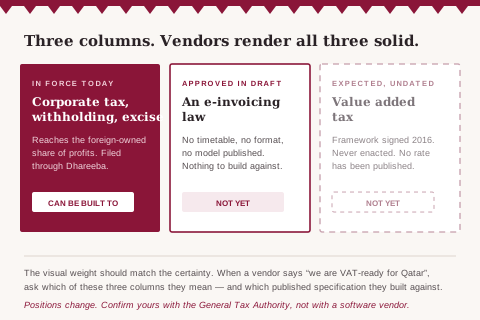
The single most useful thing you can do in a Qatari software evaluation is insist on separating what is in force from what is drafted from what is merely anticipated. Most vendor material blends all three into a comfortable fog labelled "the coming changes".
| Status | What it covers | Can a vendor build to it? |
|---|---|---|
| In force | Corporate income tax on the foreign-owned share of profits, withholding on certain non-resident payments, excise on a narrow list of goods. Filed through the Dhareeba portal. | Yes — this is real and applies now |
| Approved in draft | An electronic invoicing law and implementing regulations, approved at Council of Ministers level in 2026. | No — no timetable, format, or model has been published |
| Expected, undated | Value added tax. Qatar signed the GCC framework in 2016 and has not enacted it. | No — there is no rate and no return format |
A vendor who says "we are VAT-ready for Qatar" has told you something. Ask which specification they built against and the conversation usually ends.
The two ways this goes wrong
Buyers in a no-deadline market fail in one of two directions, and they are mirror images of each other.
Failure one: wait for the mandate
- Nothing forces a decision, so nothing happens for three years.
- The operational problems compound quietly — they were never urgent, only expensive.
- A mandate is eventually announced with a real deadline attached.
- A system is now chosen in a panic, on a single feature, by people with no time to test it.
- You end up with a compliance product that is poor at running your business, which is the reverse of what you needed.
Failure two: buy readiness now
- A vendor offers "VAT-ready" and it sounds like prudence.
- What is actually being sold is a configurable tax-rate field, which every accounting system has had for decades.
- You pay a premium for preparedness against a specification nobody has published.
- When the real specification arrives it does not match the assumption, and the work is done again.
- You have bought insurance against a risk that could not be priced.
The path between them is not clever and it is not proprietary: buy for the operation on its own merits, and separately do the small, cheap data work that makes any future mandate a small build rather than a large one.
What "cheap now, expensive later" actually means
Every e-invoicing regime we have worked with or read the specification of — Kenya's, and the published models across this region — depends on the same handful of data conditions. Not the same formats, not the same models, not remotely the same architecture. The same underlying record hygiene.
Six conditions, none of which require knowing what the mandate says
- One unbroken invoice sequence. Sequential numbering without gaps is close to universal, and a history of manual overrides and parallel books is a reconciliation project before an integration can even start.
- A tax field on every line, populated even at nil. If the field does not exist, adding one later means revisiting the item master, the price lists and every open order at the same time as building the integration.
- Counterparty identifiers as structured fields. Commercial registration and tax identifiers on the customer and supplier record — not typed into the second line of an address, where they cannot be validated.
- Net, tax and gross stored at capture. Not derived at report time from current settings, which quietly rewrites history whenever a rate changes.
- Documents attached to the transaction they justify. Nothing to do with e-invoicing; everything to do with whether a tax review is retrieval or archaeology.
- Cost and revenue attributed as they are captured. This one is not future-proofing at all — see below.
The one that already applies
Corporate income tax in Qatar reaches the foreign-owned share of profits. In a market where joint ventures are structurally common, that means somebody has to be able to say which profits belong to whom — this year, not after some future mandate. If costs carried an entity, project and cost-centre attribution as they were incurred, that is a query. If they did not, it is an annual reconstruction from memory, defended annually with difficulty. Of the six items above, this is the only one that is not preparation.
So what should you actually buy on?
On the things that were expensive before any of this and will still be expensive afterwards. In this market, in our experience, that is a fairly short list.
- Project cost that exists before the final account. Qatar runs an unusual amount of project work per head. The loss-making job is always identifiable — the question is whether you identify it in month two or at the retention conversation.
- Plant and tools with a named holder. The second time you hire in something you already own is the moment the asset register became a cost rather than a document.
- Landed cost that reaches the unit. Almost everything is imported and the freight, clearance and handling invoices arrive weeks later. Absorbed into overhead, they leave you pricing against a number you know is wrong.
- Purchase control that refuses. An approval threshold that produces a warning is a suggestion, and a suggestion is not a control.
Four questions, and what a vague answer usually means
Are you ready for Qatar VAT?
The answer you often get
Yes, fully VAT-ready.
What to press for instead
Ask which specification. There is no published rate, return format or filing mechanism, so readiness can only mean a configurable tax field. That is fine and worth having — but it is not a differentiator and it should not carry a premium. A vendor who will not concede this in the first meeting will not concede much later either.
What would have to change if a mandate arrived in eighteen months?
The answer you often get
It would just be an update.
What to press for instead
Ask for the list. A vendor who has built a fiscal integration somewhere real can describe the work concretely — document format, transmission, failure handling, reconciliation, archive. One who has not will keep the answer abstract, and abstract is the tell.
Can you attribute profit by owner for our joint venture?
The answer you often get
You can run a report by department.
What to press for instead
A department report is not an ownership attribution. Ask whether cost and revenue carry the attribution at capture or whether it is applied afterwards by allocation. Retrospective allocation is a judgement, and a judgement is what you least want in front of a tax authority.
How do you handle end-of-service gratuity?
The answer you often get
It is part of payroll.
What to press for instead
Ask whether it is accrued monthly on live employee records or calculated at settlement. Most systems do the latter, which means the liability is invisible until somebody leaves. Ours does not accrue it either — we say so on our Qatar page rather than letting the payroll line imply otherwise.
What AWRA OpsHub does today
- Tax fields on every sales and purchase line, split net, tax and gross at capture
- Project, cost-centre and department attribution carried at capture
- Procurement with approvals that refuse above a threshold
- Landed cost allocated onto the consignment
- Plant, equipment and tools under named custody
- Documents attached to transactions, checksummed and access-logged
More we can add to your workspace
- A Qatari fiscal integration, once there is a published specification to build against
- A "VAT-ready" claim of any kind
- Corporate income tax computation, apportionment or filing
- An Arabic interface or right-to-left layout
- Wage Protection System files or Qatarisation tracking
- End-of-service gratuity accrued month by month
What we can build for Qatar on top of the standard product
Everything listed above as something we can add describes what ships in the standard product today — it is a starting point for Qatar, not a limit on what AWRA OpsHub can do there. Kenya's eTIMS integration and its maintained payroll engine are in the product because Kenyan clients needed them and commissioned them; neither appeared by itself. The same door is open here. If a tax pipeline once there is one to build to, an Arabic interface, a bank or mobile money feed, a statutory return format, a rule specific to how your operation runs, or a link to a system you already have is what stands between you and a decision, tell us and we will scope it as a build — written spec, timeline and price — before you commit to anything.
Built when Qatar publishes a specification, not before
Whatever the General Tax Authority eventually publishes — a VAT return, an electronic invoicing interface, or both — built against the actual specification rather than against a rumour of one. We are deliberately not naming a rate or a date, because Qatar has not, and a vendor pretending otherwise is telling you something about how they will handle the rest of the project. What we would do in the meantime is the readiness work that makes the build small: tax codes carried on every line at whatever rate applies today, one invoice numbering series, and a document trail that survives a change of regime.
Arabic interface, banks and acquirers
Arabic interface text with right-to-left layout and bilingual document templates, plus bank statement feeds, card acquirer settlements and payment files wired into the Payments Register so collections match invoices without anyone re-keying a statement.
The operational work, which is what most commissions actually are
An extra approval stage in a chain that does not match the standard one, a custom field set on employees or assets that only your sector needs, an expiry that has to block an order rather than send an email, a report your board asks for in a shape nothing produces, or a scanner or weighbridge feeding the goods-in door. These are the commissions we are asked for most often and the smallest ones we quote — and unlike a revenue-authority pipeline, none of them waits on a regulator.
Payroll and statutory returns
A Qatari payroll engine producing wage files in the layout the Wage Protection System expects, with end-of-service gratuity accrued on live employee records rather than estimated once a year, and the Qatarisation position visible before a deadline.
Systems you already run
The accounting package, CRM, online store or custom database you intend to keep — connected through our API so a fact is entered once and appears everywhere it is needed.
How it works: you describe the requirement, we return a written scope, timeline and cost, and once agreed it is built into your environment and maintained as part of the product. No roadmap slide, and no pretending in a demo that something exists when it does not.
Tell us what you need integratedOur take
The absence of a deadline is the best thing about buying software in Qatar and the reason it is hard. You cannot borrow urgency from a regulator, so the case has to survive on operations alone — and if it does not survive, the right answer is to wait, which is an answer almost nobody in this industry will give you. Do the six cheap things while nothing is urgent, buy for the operation when the operation justifies it, and treat anyone selling you readiness for an unpublished specification as having told you what the rest of the relationship will be like.
No deadline, so bring a real problem
One live project or one real month of purchasing, run end to end. If the position at the end tells you nothing you did not already know, we will say so — there is no mandate here for either of us to hide behind.
Talk to us about QatarFrequently asked questions
Does Qatar have VAT in 2026?
No. Qatar signed the GCC unified VAT framework agreement in 2016 and has not enacted implementing legislation, so there is no VAT in force, no registration process and no VAT charged on supplies. It has been widely anticipated for several years and the tax authority's portal reportedly carries fields that would support it, but anticipated is not enacted. Confirm the current position with the General Tax Authority or your tax adviser rather than with a software vendor.
What taxes does apply to a business in Qatar today?
Broadly: a corporate income tax reaching the foreign-owned share of profits, a withholding tax on certain payments to non-residents, and excise on a narrow list of goods — filed through the General Tax Authority's Dhareeba portal. The Qatar Financial Centre operates its own regime with different rules, so which one you are in matters. This is a question for your adviser, and the answer changes what your accounting records need to be able to prove.
What happened with the electronic invoicing law?
A draft electronic invoicing law and its implementing regulations were approved at Council of Ministers level in 2026. What has not been published alongside it is a timetable, a technical specification, a document format, or the model — clearance like Saudi Arabia, a network like Oman, or something else. Those details are the entire content of an integration project. Until they exist, nobody can build to it, and any specific date you are quoted should be treated as a sales device until you can find it published.
Should we wait to buy a system until the mandate lands?
Only if your operation does not currently justify one, in which case yes, absolutely wait. The trap is waiting for the mandate to make the decision for you, because a system chosen under deadline pressure gets picked on the deadline feature and is frequently poor at everything else. Decide on the operational case. If it is thin now, do the six cheap data things, keep good records and revisit in a year.
Is a "VAT-ready" system worth paying more for?
Not in Qatar today, because there is nothing to be ready for. Every accounting system built in the last thirty years has a configurable tax rate, and that is what "ready" resolves to in the absence of a published specification. What is genuinely worth paying for is a vendor who has built and maintained a real fiscal integration somewhere — because they can describe the work concretely rather than abstractly, and that is the honest predictor of how the eventual project will go.
Does AWRA charge more for markets with no tax integration?
No. Pricing is published rather than quoted per deal and there is no per-country premium — which cuts both ways, because it also means there is no discount for a market where we do less. What you get here is the operations layer, and the honest framing is that in Qatar that is all anybody can sell you at the moment.
