
Buying Operations Software in Kuwait: A Straight Guide
No VAT, no e-invoicing, no filing deadline to force anything into order. Which means every control in a Kuwaiti business is chosen rather than compelled — and a shortlist built the usual way will score the wrong things.
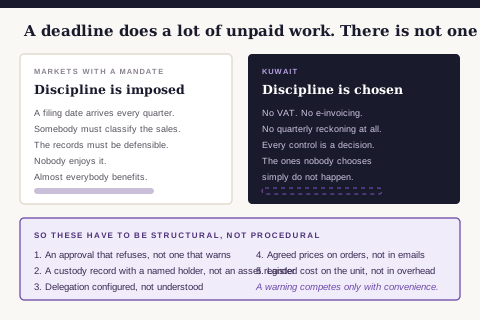
In most markets a tax deadline does an enormous amount of unpaid work for a business. Once a quarter it drags the sales ledger into order, forces somebody to look at the classifications, and produces a moment when the records have to be defensible. Nobody enjoys it and almost everybody benefits from it.
Kuwait has no value added tax and no electronic invoicing programme, so that quarterly forcing function does not exist. The consequence is subtle and it shapes everything about how software should be bought here: every discipline in the business is chosen deliberately, and the ones nobody chooses simply do not happen.
Written by a vendor, so weigh it accordingly. Nothing here is tax or legal advice.
Three decisions, and the first one is not ours
The workforce layer
A Kuwaiti payroll provider, and probably this quarter
End-of-service indemnity at both its termination and resignation values, social security for the nationals it applies to, wage protection files and the Kuwaitisation position. This is the largest financial exposure on the page and it belongs with somebody who does it monthly. We do not calculate or accrue any of it, and if this is your central problem then this is the whole of your answer.
The statutory layer
Your adviser, unchanged
Corporate income tax on the foreign-owned share of profits, and — for very large multinational groups only — the domestic minimum top-up tax. Neither is a software purchase. What software should do is hold attributed records a computation can be built from.
The operations layer
This is the actual decision
Custody, purchase control, stock, landed cost and project cost. The only layer where the choice is open — and, because nothing external forces discipline here, the layer where "does it refuse or does it warn" matters more than anywhere else in the region.
Where a deadline imposes order once a quarter, you can get away with a system that merely warns. Where nothing imposes anything, a warning is just a message somebody clicks past.
Why "refuses" beats "warns" more here than elsewhere
This is the specific adaptation a Kuwaiti buyer should make to an otherwise ordinary evaluation, and it is worth being concrete about the mechanism rather than treating it as a preference.
A warning depends on the person receiving it having a reason to act. In a market with a filing deadline, that reason arrives externally: somebody will eventually have to defend these numbers to an authority, and everyone knows it. Remove the deadline and the warning is competing purely against convenience, in a moment when somebody is busy. Warnings lose that competition consistently.
The practical implication is that features which look equivalent on a comparison sheet are not equivalent here. "Approval workflow" that flags an over-threshold order and "approval workflow" that will not let it be raised are two different products with the same name. We hold ourselves to that distinction in this guide rather than around it: where we flag rather than block, the row below says so.
What to score
Seven things worth scoring, and how to test each one
Every one of these is testable in a demo on your own data. A vendor who will not is telling you about the implementation.
Does an approval refuse, or only warn?
Make them prove it: Try to raise an order above your own threshold and watch what happens. This is the single highest-weighted question in a market with no external forcing function — which is exactly why we should answer it about ourselves first. Purchase orders carry no value ceiling, and an over-budget request is approved with the warning sent afterwards. Stock write-offs refuse above your figure and cannot be approved by whoever raised them. Weigh that split against what you actually need to control.
Can you generate a custody list for one employee?
Make them prove it: Ask for it live, for a real person. "We could put one together" means offboarding depends on somebody having spare time in the week somebody leaves.
Is delegation configured or understood?
Make them prove it: Ask what happens to approval authority when the holder is on leave. In a high-turnover business, an understood chain gets rewritten by accident, always toward permissiveness.
Does landed cost reach the unit?
Make them prove it: Add a clearance invoice three weeks after a receipt and ask whether the unit cost changes. Almost everything here is imported.
Is the agreed price on the order, or in an email?
Make them prove it: Ask to see an invoice matched against an agreed price with a variance shown to the approver. This is what detects drift after a relationship holder leaves.
Does payroll cost reach the project?
Make them prove it: Not payroll processing — attribution. Ask whether a project carries the labour that was spent on it, because that is what an indemnity accrual eventually attaches to.
What is the audit trail on a changed record?
Make them prove it: Ask to see who changed a price, and when, on a record that was edited twice. With no external review to fear, internal traceability is the only check there is.
Where we fit, and where we do not
AWRA OpsHub against a Kuwaiti requirement, row by row
Asset and tool custody
A named holder, check-out and check-in, condition at each hand-over, last verification and warranty expiry. The row this page argues matters most operationally — and it carries no service schedule, no maintenance record, and an indicative value trend rather than accounting depreciation.
Procurement, approvals and delegation
Requisition, approval routing, RFQ comparison and three-way matching. This page argues hard for thresholds that refuse, so here is our own score on it: purchase orders have no value ceiling, there is no field for the award reason, and delegation exists as a column rather than an action. Stock write-offs do refuse above a threshold, and bar the raiser from approving.
Three-way matching
Agreed price and quantity on the order, matched against receipt and invoice, with exceptions held rather than passed on.
Multi-location stock
Yards, stores, site stores and vans as distinct positions, with governed transfers, in-transit visibility and valued variance.
Landed cost
Freight, duty, clearance and handling allocated onto the receipt at the rate actually paid, changing the unit cost retrospectively.
Employee records and leave
Contracts, documents with expiry dates the system watches, leave with balances and approval.
Payroll cost attribution
Labour cost carried to the project, cost centre and department that consumed it — what an indemnity accrual would eventually attach to.
Audit trail and access control
Who changed what and when. With no external review to anticipate, this is the only check that exists.
Dinar base currency
Pegged to a basket rather than the dollar alone, so foreign-currency purchases stay in their own currency at the rate actually applied.
Friday and Saturday working week
Set once, and leave arithmetic, workflow due dates, escalation timers and helpdesk clocks all read it.
End-of-service indemnity accrual
Not calculated, not held at both values, not accrued monthly. The largest gap we publish on any market page.
PIFSS contributions and wage protection files
Our maintained statutory payroll engine covers Kenya only. This stays with a Kuwaiti provider.
Kuwaitisation tracking
No quota position, no sectoral ratio, no visibility before a deadline.
Arabic interface and RTL layout
English only, documents included. Test it with whoever would key transactions, not with the finance director.
Corporate income tax and statutory accounts
We hold the attributed records. We calculate, apportion and file nothing.
Customs integration
No connection to any customs authority or port system. Paperwork is attached as evidence, not exchanged as data.
Four questions, and what a vague answer usually means
Do you handle Kuwaiti payroll?
The answer you often get
We support payroll for any country.
What to press for instead
Ask specifically about the indemnity: is it calculated at both the termination and the resignation value, and accrued monthly? Almost every "any country" payroll claim means a configurable pay-element engine somebody has to set up correctly, and the person who sets it up is you.
Do you have an asset register?
The answer you often get
Yes, with full asset tracking.
What to press for instead
Ask who currently holds a specific item and when they took it. A register answers what you own; a custody record answers who has it. The difference only becomes visible on the day somebody leaves the country.
Is the approval workflow configurable?
The answer you often get
Fully configurable.
What to press for instead
Configurable to refuse, or configurable to warn? Ask them to demonstrate an over-threshold order being blocked rather than flagged. In this market that distinction is worth more than any other line on the comparison sheet — and by our own test, we would fail it on purchasing and pass it on stock write-offs. Ask us to show you both.
Will we need this when VAT arrives?
The answer you often get
We are ready for GCC VAT.
What to press for instead
No legislation has been enacted and no specification published, so readiness resolves to a configurable tax field. Ask what they would actually build against a published specification. A vendor who has maintained a real fiscal integration somewhere can describe it concretely; one who has not stays abstract.
When you should not buy from us
- If the indemnity number is your problem. It is the largest exposure discussed on this page and we do not calculate it. A Kuwaiti payroll provider does. Go there first and come back afterwards, or not at all.
- If Arabic is the working language of whoever keys transactions. Test it with them. Treat "they will manage" as a no.
- If you want statutory payroll and operations from one vendor. Reasonable, and not something the standard product does today — our maintained statutory engine covers Kenya only. A Kuwaiti engine, indemnity included, is a build we will scope and price if one system matters more to you than a local specialist answering for the statutory layer.
- If nothing on this page is currently costing you money. There is no deadline making you act. Wait, and treat a vendor who cannot say that as having answered a different question.
When we are worth a conversation
- If you could not produce a custody list for your last four leavers and it has occurred to you that this recurs on a schedule.
- If approval authority in your business is understood rather than configured, and the people who understood it have changed twice.
- If landed cost is sitting in overhead and your gross margin by product is therefore an estimate.
- If you price multi-year work and the labour cost in the pricing is salary only.
Our take
Buy differently here, because nothing external will compensate for a weak system. In markets with a mandate you can tolerate software that warns, because a quarterly deadline eventually forces the reckoning. Kuwait has no such event, so score hard on whether controls refuse, whether custody is a record rather than a recollection, and whether authority is configured rather than remembered. Then go and get the indemnity number from somebody who is not a software vendor, because it is bigger than anything on the shortlist.
What we can build for Kuwait on top of the standard product
Everything listed above as something we can add describes what ships in the standard product today — it is a starting point for Kuwait, not a limit on what AWRA OpsHub can do there. Kenya's eTIMS integration and its maintained payroll engine are in the product because Kenyan clients needed them and commissioned them; neither appeared by itself. The same door is open here. If indemnity accrued on live records, an Arabic interface, a bank or mobile money feed, a statutory return format, a rule specific to how your operation runs, or a link to a system you already have is what stands between you and a decision, tell us and we will scope it as a build — written spec, timeline and price — before you commit to anything.
A VAT build if Kuwait legislates one
There is no value added tax in Kuwait and no electronic invoicing programme, so there is nothing to integrate with and we are not going to invent a roadmap item. If a law is enacted, this becomes an ordinary build against the published specification. It is listed here for completeness rather than because it is the thing you should be buying for.
Arabic interface, banks and acquirers
Arabic interface text with right-to-left layout and bilingual document templates, plus bank statement feeds and card acquirer settlements wired into the Payments Register.
The operational work, which is what most commissions actually are
An extra approval stage in a chain that does not match the standard one, a custom field set on employees or assets that only your sector needs, an expiry that has to block an order rather than send an email, a report your board asks for in a shape nothing produces, or a scanner or weighbridge feeding the goods-in door. These are the commissions we are asked for most often and the smallest ones we quote — and unlike a revenue-authority pipeline, none of them waits on a regulator.
Payroll and statutory returns
The build that actually matters here: end-of-service indemnity accrued month by month on live employee records under the Kuwaiti calculation — half a month per year for the first five and a full month per year after, on a twenty-six-day divisor, capped at eighteen months — held at both its termination and its resignation value, alongside Public Institution for Social Security contributions for the nationals they apply to and a Kuwaitisation position that is visible before a deadline.
Systems you already run
The accounting package, CRM, online store or custom database you intend to keep — connected through our API so a fact is entered once and appears everywhere it is needed.
How it works: you describe the requirement, we return a written scope, timeline and cost, and once agreed it is built into your environment and maintained as part of the product. No roadmap slide, and no pretending in a demo that something exists when it does not.
Tell us what you need integratedStart with the four-leavers question
Take the last four people who left the country and establish what they were holding. An afternoon, no software, and a more honest basis for a decision than any demo.
Talk to us about KuwaitFrequently asked questions
Does Kuwait have VAT?
No. Kuwait signed the GCC unified VAT framework agreement and has not enacted implementing legislation, and there is no electronic invoicing programme either. Our tax configuration carries Kuwait at nil rather than at an anticipated rate — a deliberate choice, because a rate in a configuration file is written into an organization's own settings on first use and then persists. Separately, a domestic minimum top-up tax applies to very large multinational groups; if that reaches you, your advisers are already on it. Confirm your own position with the tax authority or your adviser rather than with a vendor.
Do you calculate end-of-service indemnity?
No, and it is the largest single gap we publish on any market page. We do not compute the entitlement, hold it at both its termination and resignation values, or accrue it monthly against live employee records. Keep it with a Kuwaiti payroll provider. What we hold is the employee record it is computed from and the payroll cost attribution that makes an accrual rate useful once somebody else has produced one.
Why does the absence of VAT change how we should buy?
Because a filing deadline does unpaid work. Once a quarter it forces somebody to look at the records, classify things properly and be able to defend them. Remove it and every discipline becomes voluntary — which means features that merely warn stop being equivalent to features that refuse. Two products with identical entries on a comparison sheet can behave completely differently in a market where nothing external creates a moment of reckoning.
Is the dinar peg a currency risk?
Barely, but the usual Gulf shortcut does not quite hold. Kuwait pegs to a weighted basket rather than to the dollar alone, unlike its neighbours, so the dinar can move against the dollar in a way the dirham and riyal do not. The movements are small and this is not a reason to hedge. It is a reason not to treat a dollar purchase as a fixed-value purchase in your own books, which is why foreign-currency purchases stay in their own currency at the rate actually applied rather than at a standing monthly rate.
Do you have local support in Kuwait?
No local office. Support is from Nairobi, in English, with remote onboarding and live training — and no time difference at all, since Kuwait and Nairobi are both UTC+3. We would rather say that plainly than imply a presence in Sharq. Whether that is acceptable depends on how much of your implementation needs somebody in the room, which is a fair question to ask us directly.
What does it cost?
Pricing is published rather than quoted per deal, set in Kenya shillings with other currencies derived from a live rate. No per-country premium and no separate charge for additional locations. What is not included is implementation effort where your item master, supplier list or asset register needs cleaning first — and in a business that has never held custody records, building the initial register is real work that somebody has to do.
