
Buying Operations Software in Bahrain: A Straight Guide
A smaller market with the same obligations as a larger one, and a finance function that cannot absorb another manual process. What that actually means for a shortlist.
Buyer's guides for small markets usually take one of two condescending shapes. Either they assume you want a cut-down product because you are small, or they pretend size makes no difference at all. Neither is useful in Bahrain, where the distinguishing feature is a mismatch: an obligation set sized for a large company, administered by a team that is not one.
Written by a vendor, so weigh it accordingly. A reasonable portion argues for buying locally instead.
Nothing here is tax advice. Rates, conditions and mandates are the relevant authorities' to set and change.
Three things to separate before you shortlist
The statutory layer
Keep this local, without exception
Social Insurance Organisation contributions, wage files in the layout the Labour Market Regulatory Authority expects, Bahrainisation position, corporate filings. These change, they are administered locally, and a bureau that lives in those portals will do it better and cheaper than any general system. This is not a competitive question.
The customs and origin layer
Your clearing agent and your chamber of commerce
Customs entries and certificates of origin are obtained, not generated. No operations system issues them. What a system should do is hold the resulting documents against the shipment and carry the cost onto the landed unit — which is a different and much smaller claim than "we handle customs".
The operations layer
This is the actual decision
Purchase control, stock, landed cost, and the documentary discipline that holds your export treatments up. It is the only layer where the choice is genuinely open, and — because of the concentration problem below — the one where structure matters more than features.
The concentration problem, which is the real risk
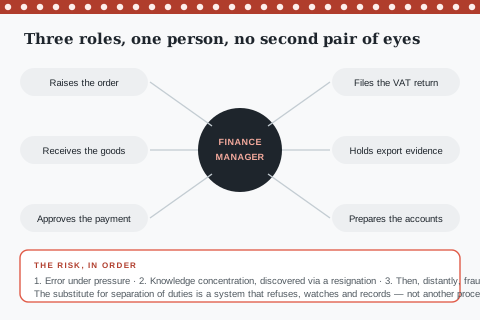
In a finance function of three or four, separation of duties is not achievable. The same person raises the order, receives the goods on a busy day, and approves the payment. Everybody knows this and most operators have quietly accepted it as a fact of size.
It is worth being precise about what that costs, because the usual framing — fraud risk — is the least likely of the three outcomes and the one that makes the conversation defensive.
- Error, not dishonesty. The overwhelmingly common outcome. One person doing three roles under time pressure makes mistakes that a second pair of eyes would have caught, and there is no second pair of eyes.
- Knowledge concentration. One person knows which agent handled which route, where the older declarations sit, which customers have unusual arrangements. That knowledge has no copy. This is the risk that actually materialises, usually via a resignation.
- Then, distantly, fraud. Real, but third on the list, and a business that fixes the first two has largely fixed the third as a side effect.
The substitute for separation of duties at this size is not more process. It is a system that records who did what and when, refuses rather than warns at a threshold, and makes retrieval independent of the person who filed things.
What to score
Seven things worth scoring, and how to test each one
All seven are testable before contract. A vendor unwilling to run one on your own data has answered a different question.
Can a document be made required, not merely possible?
Make them prove it: Ask them to configure an export treatment that will not apply without a customs entry attached. "You can upload files" is a shared drive with extra steps.
Does landed cost reach the unit?
Make them prove it: Add a clearance invoice three weeks after a receipt and ask whether the unit cost changes retrospectively. On distribution margins this is usually the biggest number in the evaluation.
Are registration expiry dates watched, or just stored?
Make them prove it: Ask what happens ninety days before a customer's registration lapses, and who is told. A field nobody is alerted about is a note.
Does an approval refuse, or only warn?
Make them prove it: Try to raise an order above your threshold. In a team with no separation of duties, a warning is not a control — it is a message to the person who is about to click past it.
Can you report on what is missing?
Make them prove it: "Show me every zero-rated supply this quarter with no attachment." If that is a spreadsheet exercise, exceptions are invisible by default.
Is there an audit trail worth the name?
Make them prove it: Who changed this price, and when. Ask to see it on a record that was edited twice, not on a clean one.
What happens when the finance manager leaves?
Make them prove it: Not a software question, but ask the vendor how retrieval works for somebody who did not file anything. If the answer depends on knowing where to look, nothing has changed.
Where we fit, and where we do not
AWRA OpsHub against a Bahraini requirement, row by row
Documents attached to transactions
Customs entries, origin certificates, transport documents and delivery proof held against the shipment, checksummed and access-logged.
Registration expiry watching
Customer and supplier registrations held as fields with expiry dates the system watches rather than a person remembers.
Landed cost
Freight, duty, clearance, port handling and haulage allocated onto the receipt at the rate actually paid, changing the unit cost retrospectively.
Procurement, approvals and matching
Requisition, approval that refuses above a limit, RFQ comparison, three-way matching with exceptions held.
Multi-location stock
Governed transfers, in-transit visibility, batch and expiry, blind counts and valued variance.
Access control and audit trail
Who changed what and when — the practical substitute for separation of duties in a team that cannot have it.
Missing-attachment reporting
A report rather than an exercise, which is the difference between an exception being visible and being theoretical.
Dinar and a 10% VAT preset
Base currency and rate ship as presets. Zero-rated and exempt treatments are yours to configure with your adviser.
Friday and Saturday working week
Set once, and leave arithmetic, workflow due dates, escalation timers and helpdesk clocks all read it.
NBR e-invoicing integration
None. No platform or format has been published, so there is nothing to build and no readiness to claim.
Customs integration and origin certification
No connection to Bahrain Customs or any port system, and we do not issue certificates of origin. Documents are held, not generated.
Arabic interface and RTL layout
English only, documents included. Often survivable in Manama; test it with whoever keys transactions.
SIO, LMRA wage files, Bahrainisation
Our maintained statutory payroll engine covers Kenya only. This stays with a Bahraini bureau.
End-of-service gratuity accrual
Not accrued on live employee records. A real gap rather than a boundary, across a largely expatriate workforce.
Corporate tax, top-up tax, statutory accounts
We hold the records a computation is built from. We calculate, apportion and file nothing.
Four questions, and what a vague answer usually means
Are you ready for Bahraini e-invoicing?
The answer you often get
Yes, we are compliant across the GCC.
What to press for instead
Ask which regime, built against which published specification. The mandates in this region are at genuinely different stages and no single integration covers them. A vendor treating the GCC as one compliance market has not built for any of it.
Can we attach documents?
The answer you often get
Yes, unlimited file uploads.
What to press for instead
Uploading is not attaching and neither is requiring. Ask whether an attachment can be made a precondition of a treatment, and whether you can report on what is missing. Those two turn a file store into a control.
Do you handle customs?
The answer you often get
We integrate with logistics providers.
What to press for instead
Ask which authority, in which country, exchanging what. Almost always this means a carrier tracking feed rather than a customs connection. Holding the customs document is genuinely useful and it is a much smaller claim — make sure you know which one is being made.
Is there local support in Manama?
The answer you often get
We have regional coverage.
What to press for instead
Ask where the person answering on a Tuesday afternoon sits and who employs them. Ours are in Nairobi, on the same clock as Manama, and we would rather say that than imply an office in Seef.
When you should not buy from us
- If gratuity accrual is your central problem. It is a real liability across an expatriate workforce and we do not accrue it. A Bahraini payroll provider will.
- If Arabic is the working language of whoever keys transactions. Test it with them, not with the finance director.
- If you sell only domestically from one site. Most of this page is about a cross-border documentary burden you do not have. Keep your spreadsheets.
- If you want statutory payroll and operations from one vendor. Reasonable preference; wrong vendor.
When we are worth a conversation
- If a meaningful share of turnover crosses the causeway and you could not produce the evidence pack for a random shipment in two minutes.
- If landed cost is currently sitting in overhead and your gross margin by product is therefore an estimate.
- If one person holds all the connections and you have noticed that this is a risk rather than an efficiency.
- If you hold stock in more than one place and the reconciliation is monthly, manual and occasionally disputed.
Our take
Do not buy in Bahrain the way a larger market buys. The features that matter here are the boring structural ones — can a document be required, is an expiry watched, does an approval refuse, can you report on what is missing — because those are what substitute for the people you do not have. Score on those five, keep the statutory layer local, and treat any vendor selling a single GCC compliance integration as having told you they have not built one.
What we can build for Bahrain on top of the standard product
Everything listed above as something we can add describes what ships in the standard product today — it is a starting point for Bahrain, not a limit on what AWRA OpsHub can do there. Kenya's eTIMS integration and its maintained payroll engine are in the product because Kenyan clients needed them and commissioned them; neither appeared by itself. The same door is open here. If an NBR e-invoicing pipeline once the format is published, an Arabic interface, a bank or mobile money feed, a statutory return format, a rule specific to how your operation runs, or a link to a system you already have is what stands between you and a decision, tell us and we will scope it as a build — written spec, timeline and price — before you commit to anything.
The zero rating, and the evidence that holds it up
Electronic invoicing against whatever the National Bureau for Revenue publishes, built when there is a format to build against. The nearer-term work is the one that costs Bahraini exporters real money: a zero-rated cross-border supply that carries its own proof — customs entry, transport document and delivery evidence attached to the invoice rather than filed somewhere else — so the rating survives a review instead of being reconstructed during one.
Arabic interface, banks and acquirers
Arabic interface text with right-to-left layout and bilingual document templates, plus bank statement feeds, card acquirer settlements and instant-payment files wired into the Payments Register.
The operational work, which is what most commissions actually are
An extra approval stage in a chain that does not match the standard one, a custom field set on employees or assets that only your sector needs, an expiry that has to block an order rather than send an email, a report your board asks for in a shape nothing produces, or a scanner or weighbridge feeding the goods-in door. These are the commissions we are asked for most often and the smallest ones we quote — and unlike a revenue-authority pipeline, none of them waits on a regulator.
Payroll and statutory returns
A Bahraini payroll engine with Social Insurance Organisation contributions on live employee records, wage files in the layout the Labour Market Regulatory Authority expects, and the Bahrainisation position visible before a deadline rather than after one.
Systems you already run
The accounting package, CRM, online store or custom database you intend to keep — connected through our API so a fact is entered once and appears everywhere it is needed.
How it works: you describe the requirement, we return a written scope, timeline and cost, and once agreed it is built into your environment and maintained as part of the product. No roadmap slide, and no pretending in a demo that something exists when it does not.
Tell us what you need integratedBring one zero-rated export
One shipment from last quarter and the four documents behind it. Two minutes, no asking anyone. Whatever that produces is the most useful number in your evaluation, and you keep it either way.
Talk to us about BahrainFrequently asked questions
What is Bahrain's VAT rate?
The standard rate has been 10% since 1 January 2022, up from 5%. The doubling matters for anybody with historical data — pricing rules and margin comparisons written before then need checking rather than assuming. Reduced, zero-rated and exempt categories exist and are the National Bureau for Revenue's to define. A software preset is a default you own; the treatment of any particular supply is a question for your adviser.
Is there an e-invoicing mandate in Bahrain?
Not in force at the time of writing. The National Bureau for Revenue has consulted on it and, as far as we can establish, has not published a platform, a technical format or a timetable. The sensible preparation is not to buy an integration — it is to get your records into the state any regime would assume: unbroken invoice sequences, tax on every line, counterparty identifiers as validated fields, and documents attached to transactions. Confirm the current position with the NBR rather than with a vendor.
We only have three people in finance. Is this too much system?
The honest test is whether you have the documentary exposure this guide describes. If a meaningful share of your turnover crosses the causeway and you could not evidence a random shipment quickly, the small team is an argument for structure rather than against it — you have no redundancy, so the discipline has to live somewhere other than in a person. If you sell domestically from one site, most of this does not apply and you should not buy it.
Do you handle Bahraini payroll?
Not statutorily. Our maintained payroll engine covers Kenya only, so no Social Insurance Organisation contribution is calculated, no wage file is produced in the layout the Labour Market Regulatory Authority expects, no Bahrainisation position is tracked, and end-of-service gratuity is not accrued on live employee records. That last one is a real gap across a largely expatriate workforce and we list it as such rather than hiding it in a payroll disclaimer. Employee records, contracts, leave with balances and payroll cost allocation all work.
What does it cost?
Pricing is published rather than quoted per deal, set in Kenya shillings with other currencies derived from a live rate, so what you see is what applies. There is no per-country premium and no separate charge for additional locations. What is not included is implementation effort where your item master or supplier list needs cleaning first — worth scoping honestly, because in a three-person finance function that cleaning is done by somebody who already has a full job.
Should we buy from a local Bahraini vendor instead?
For the statutory layer, unambiguously yes, and we would say so on the first call. For the operations layer it depends on which problems you actually have — a local firm bundling payroll and accounting will serve you better if compliance is the centre of gravity, and we will serve you better if the centre of gravity is landed cost, purchase control and documentary evidence across a border. It is worth asking both and comparing the honesty of the scope answers rather than the length of the feature lists.
