
Buying Operations Software in Saudi Arabia: A Straight Guide
Clearance ended the all-in-one purchase in this market, and nobody updated the shortlists. A guide to buying when you already know you are buying more than one thing — where the three seams fall, what to score vendors on, and where we would tell you to buy locally.
Most software buying advice assumes you are choosing one system. In Saudi Arabia that assumption stopped being true, and it did not stop gradually. Once a standard tax invoice has to be cleared by ZATCA before it can be issued, no vendor can honestly claim to be the single system of record for your sales — and once the integration phase reached the VAT registration threshold, that stopped being a large-enterprise problem and became everybody's.
So the useful question is not "which system should we buy". It is "where do the edges fall, and which of these purchases are we actually making today". This guide is written from the operations side of that question, by a vendor who is a candidate for exactly one of the three pieces and is going to be explicit about which.
Nothing here is tax, legal or customs advice. Confirm your ZATCA wave, your VAT position and your statutory obligations with ZATCA or your adviser — waves are notified to taxpayers individually and a vendor's summary is not a substitute for your own notification.
Start by admitting you are buying three things
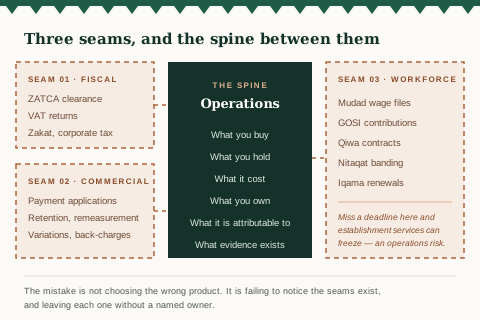
The word "ERP" is doing duty for three products here, each with a different natural supplier and a different consequence for getting it wrong. Confusing them is the most expensive mistake available on this shortlist, and it usually happens in the first meeting.
Seam one
The fiscal layer
Cleared XML, cryptographic stamping, certificate onboarding for each generation unit, the Fatoora exchange and its failure modes, VAT returns, Zakat and corporate income tax. Natural supplier: an accredited e-invoicing provider or a certified local package, plus your tax adviser. Buy this first, buy it separately, and do not let an operations vendor near the decision. We are not a candidate at all.
Seam two
The commercial layer, if you contract
Interim payment applications, bill-of-quantities remeasurement, retention, variations and subcontractor back-charges. Natural supplier: a measurement package, or whatever portal the main contractor obliges you to use. On a large project this may be decided for you regardless of what you bought, which is a good reason not to pay twice for it.
Seam three
The workforce layer
Mudad wage files, GOSI contributions, Qiwa contract registration, Nitaqat banding and iqama renewals. Natural supplier: a Saudi payroll bureau or an HR platform that lives inside those portals. Almost every established business already has this solved. Do not disturb it to satisfy a diagram — and note that a missed deadline here can freeze establishment services, which makes it an operations dependency rather than a back-office chore.
What is left after those three is the operations layer: what you buy, what you hold, what it cost, what you own, what it is attributable to, and what evidence exists for all of it. That is the layer we sell, and the only one on which we would ask you to compare us against anyone.
Where we actually stand, layer by layer
Rather than a feature list, here is the same ledger we would talk through on a first call. Four of these are things a Riyadh vendor would ship as standard.
AWRA OpsHub in Saudi Arabia, layer by layer
Currency
The riyal ships as a base currency preset. Because it is pegged, the interesting part is not the riyal at all — foreign-currency purchases are held in their own currency at the rate actually applied to that transaction, which is where an importing business's exposure genuinely lives.
Stock, procurement and landed cost
Locations for regional warehouses, site stores, branches and vans; governed transfers with documents attached; three-way matching with discrepancies flagged; a purchase order that cannot be closed until the goods are received; and freight, customs and clearing allocated per consignment into true unit cost. This is the layer we are actually selling. Note what is not in that list: there is no value ceiling on a purchase order. Stock write-offs do have a hard threshold — see the approvals row below.
Assets, plant and tools
An asset register with a named holder, check-out and check-in, location, condition recorded at each hand-over, last verification and warranty expiry. Worth more than it sounds on a multi-site operation, where the recurring cost is hiring equipment you already own but cannot locate. It holds no service schedule and no maintenance record, and its value trend is an indicative straight-line chart rather than accounting depreciation — keep upkeep and the fixed-asset ledger elsewhere.
Project cost attribution
Budget, hours, milestones, cost and bill rates, with cost carried from purchases, stock issues, expenses and payroll. The cost side of a project, not the valuation side — the distinction matters and is drawn again below.
VAT rate
A 15% preset ships built in and every line separates net, tax and gross at capture. We ship one preset rather than a maintained rate history, and we do not interpret zero-rating, exemption or reverse-charge treatment. A preset is a default you own.
Working week and public holidays
Set Friday and Saturday as non-working days once, add your holidays, and leave arithmetic, workflow due dates and escalation timers, and helpdesk response clocks all read that setting. Necessary here, because a system assuming a Saturday–Sunday weekend will land approval deadlines on your days off.
ZATCA e-invoicing
No generation unit, no certificate, no UBL 2.1 XML, no cryptographic stamping, no clearance call and no reporting call to Fatoora. Our only fiscal e-invoicing integration anywhere is Kenya's eTIMS and it does not travel. AWRA cannot be the system that issues your tax invoices in the Kingdom.
Arabic interface
English only, no right-to-left layout, documents in English. Do not read across from advice about the UAE here — Arabic is the working language for a far larger share of Saudi site and finance staff, and on the standard product this is the most common reason the fit fails here. It is also, for the same reason, the most requested build in the Kingdom: an Arabic interface with right-to-left layout and bilingual documents is a scope, a timeline and a price rather than a roadmap item, and unlike the ZATCA row above it waits on nobody but us.
Contractor valuation
No interim payment applications, no BOQ remeasurement, no retention held or released, no variation register, no subcontractor back-charge workflow. Keep your measurement package; agree the export between it and us at the start.
Payroll, Mudad, GOSI and Nitaqat
The maintained statutory payroll engine covers Kenya only. No wage file, no contribution calculation, no Qiwa registration, no Saudization tracking. The employee side — records, contracts, leave, and payroll cost attributed to projects — works anywhere.
Zakat and corporate income tax
Nothing computed, apportioned or filed, and no statutory accounts. We hold the costed records a computation is built from and your adviser does the rest, which is the boundary we would keep even if we could blur it.
Scoring a shortlist without being sold to
The trap in a mature market is that every vendor answers every criterion with a yes. Score the test, not the answer — what you would ask them to demonstrate, on your own data, before you believe it.
Weighting a Saudi shortlist
Score each vendor out of five on the test in the right-hand column. If a test cannot be run in a fortnight, the criterion is decoration.
The clearance identifier comes back onto the sales record
Make them prove it: Ask them to show a sales record carrying a UUID, hash and clearance status that originated outside their system. If the answer is that it is available in the provider's portal, the answer is no, and the reconciliation lands on your finance team by default.
Who owns each of the three seams, in writing
Make them prove it: Ask for a one-page boundary document naming the owner of clearance, valuation, wage files, customers, items, prices, stock and invoice numbering. A vendor who cannot produce one within a week has not thought about it, and you will be the one who does.
Language on the floor, not in the boardroom
Make them prove it: Put the receiving screen in front of the storekeeper who will actually key receipts, not the finance director who runs the evaluation. Their reaction is the answer. This is the criterion that most often eliminates us.
Site stores as real stock locations
Make them prove it: Ask for the stock position at one named site, as of a date in the past, without a spreadsheet. Many products can do this; a surprising number of implementations were never set up to.
Capture that works where the work happens
Make them prove it: Ask them to receive a delivery on a phone with the network off, then reconnect. Watch whether it duplicates. This is a five-minute test and it is remarkably discriminating.
What your own team can change without a consultant
Make them prove it: Pick a real change — an approval threshold, a new site, a custom field, a report — and ask whether your administrator can do it themselves. The answer predicts your third year far better than the feature list predicts your first.
Presence in the Kingdom
Make them prove it: Ask who attends when something breaks and how long it takes. We have no Saudi office and no on-site presence, which is a real disadvantage and one we would rather state than have you discover.
Four questions where our honest answer may end the conversation
What you will usually hear, and what we say instead
Are you ZATCA compliant?
What most vendors say
Yes, fully compliant with Phase 2 and integrated with Fatoora.
What we say
No, and not partially. No generation unit, no certificate, no XML, no stamping, no clearance call. In Saudi Arabia we cannot be the system that issues your tax invoices. Buy clearance from an accredited provider and then decide, separately, who runs your operations.
Do you support Arabic?
What most vendors say
Yes, the interface is available in Arabic.
What we say
No. English only, no right-to-left layout, documents in English. In the UAE this is often survivable because the commercial floor already runs in English. Here it much less reliably is, and if your storekeepers and site supervisors work in Arabic you should buy locally regardless of anything else on this page.
Can you handle our contracting projects?
What most vendors say
Yes, full project and contract management.
What we say
Half of it, and we will tell you which half. Materials, site stores, plant custody, procurement and cost attribution — yes, properly. Payment applications, retention, remeasurement, variations and back-charges — no, none of it. Keep your measurement package and agree the export at the start.
Do you handle Saudi payroll?
What most vendors say
Yes, localised payroll with WPS support.
What we say
No. Our maintained statutory engine covers Kenya only — no Mudad file, no GOSI, no Qiwa, no Nitaqat. Given that missing those deadlines can freeze work permits and iqama renewals, this belongs with someone who lives in those portals. The employee and cost side works here; the statutory side does not.
What AWRA OpsHub does today
- Riyal base currency and a 15% VAT preset, with net, tax and gross separated on every purchase and sales line at capture.
- Stock across regional warehouses, site stores, branches and vans, with governed transfers, in-transit visibility, blind counts and valued variance.
- Landed cost per consignment — freight, insurance, customs, clearing and handling carried into true unit cost at the rate actually paid.
- Procurement with RFQ comparison and three-way matching, and a purchase order that cannot be closed before the goods are received. Be precise about the limits: there is no value ceiling on a purchase order, there is no field recording why one quotation beat the others, and document-expiry reminders cover employee and contract documents rather than supplier ones. The hard value threshold in this product is on stock write-offs, where an amount above your figure needs an elevated permission and cannot be approved by the person who raised it.
- Assets with named custody, check-out and check-in, condition at each hand-over, and project or cost-centre attribution. No maintenance record and no accounting depreciation.
- Offline-first mobile capture and documents attached to the transactions that justify them, checksummed and access-logged.
More we can add to your workspace
- A ZATCA integration — generation unit, certificate, XML, stamping, clearance or reporting call.
- An Arabic interface and a right-to-left layout.
- A Mudad wage file, GOSI calculation, Qiwa registration or Nitaqat tracking.
- Interim payment applications, retention, remeasurement or subcontractor back-charges.
- A Zakat or corporate income tax computation and no statutory accounts.
- A Fasah or single-window customs integration. Customs paperwork is attached as evidence, not exchanged as data.
Six items, and three of them ship as standard from a Riyadh vendor. That is the honest shape of buying an international operations product in a well-supplied market, and it is why the next section is mostly about when not to buy from us.
What we can build for Saudi Arabia on top of the standard product
Everything listed above as something we can add describes what ships in the standard product today — it is a starting point for Saudi Arabia, not a limit on what AWRA OpsHub can do there. Kenya's eTIMS integration and its maintained payroll engine are in the product because Kenyan clients needed them and commissioned them; neither appeared by itself. The same door is open here. If a clean seam to your ZATCA provider, an Arabic interface, a bank or mobile money feed, a statutory return format, a rule specific to how your operation runs, or a link to a system you already have is what stands between you and a decision, tell us and we will scope it as a build — written spec, timeline and price — before you commit to anything.
The ZATCA seam, not a ZATCA integration
A two-way link to the accredited provider that clears your invoices: our sale handed over in the shape their generation unit expects, and the UUID, hash and clearance status written straight back onto our transaction with the cleared document attached. That turns "which sales have no clearance record?" into a daily report. We will not offer to become the clearing party ourselves — that certificate belongs with an accredited provider and we would rather say so than sell you the pipe.
Arabic interface, banks and acquirers
Arabic interface text with right-to-left layout and bilingual document templates, plus bank statement feeds, card acquirer settlements and SADAD or instant-payment files wired into the Payments Register so collections match invoices without anyone re-keying a statement.
The operational work, which is what most commissions actually are
An extra approval stage in a chain that does not match the standard one, a custom field set on employees or assets that only your sector needs, an expiry that has to block an order rather than send an email, a report your board asks for in a shape nothing produces, or a scanner or weighbridge feeding the goods-in door. These are the commissions we are asked for most often and the smallest ones we quote — and unlike a revenue-authority pipeline, none of them waits on a regulator.
Payroll and statutory returns
A Saudi payroll engine with GOSI contributions calculated on live employee records, Mudad wage files in the layout the Wage Protection System expects, and the establishment's Saudization position visible before a deadline rather than after one.
Systems you already run
The accounting package, CRM, online store or custom database you intend to keep — connected through our API so a fact is entered once and appears everywhere it is needed.
How it works: you describe the requirement, we return a written scope, timeline and cost, and once agreed it is built into your environment and maintained as part of the product. No roadmap slide, and no pretending in a demo that something exists when it does not.
Tell us what you need integratedWhen to buy locally, and when to call us
- If you want one accountable vendor for ZATCA clearance and everything else, buy a Saudi product. This is the single most common correct answer on this page and we say it on first calls more often than we sell anything.
- If your storekeepers, site supervisors or finance staff work in Arabic, buy locally regardless of everything else here. No amount of product quality survives a system your team cannot read.
- If what you need is payment applications and retention, buy a measurement package. We are not one and will not be.
- If on-site presence within a day is a first-order requirement, the Kingdom has plenty of it and we have none.
- We are worth a conversation when the fiscal layer is already settled with a provider, your operations team works comfortably in English, and the money is genuinely being lost in materials, plant, cost attribution and evidence rather than in compliance.
Our take
Stop shopping for one system, because clearance already decided you cannot have one. Settle the fiscal layer first and separately, work out whether the commercial layer is yours to buy or your main contractor's to impose, leave the workforce layer with whoever already handles it, and then — and only then — shop for the operations layer on the handful of tests that actually predict an implementation. Most Saudi businesses following that process will buy their operations layer locally too, and should. The minority whose real problem is materials, plant and cost across scattered sites should call us, and we will be direct about which of the three seams we cannot help with.
Draw the three seams with us
Bring one real project or one real month of purchasing. We will map the seams against whatever you already run, show you the middle working on your own numbers, and tell you plainly if a Riyadh vendor is the better buy.
Talk to us about Saudi ArabiaFrequently asked questions
Is AWRA OpsHub an ERP?
It is an operations platform with real accounting underneath, which covers most of what people mean by ERP in a distribution or contracting business — stock, procurement, sales, assets, projects, HR records and a general ledger. What it is not, in Saudi Arabia specifically, is a fiscal, statutory or valuation product: no ZATCA e-invoicing, no Zakat or corporate tax computation, no statutory accounts, no Mudad payroll and no contractor payment applications. If your definition of ERP includes those, we are a component rather than the answer, and the honest framing is a two- or three-vendor arrangement.
Why should we consider a Nairobi vendor at all?
Only for the operations layer, and only for a specific shape of problem. Saudi Arabia is well supplied with capable implementers and we have no office in the Kingdom, so we are not going to argue that we are a better default. Where we are genuinely strong is multi-location operations under real-world conditions — stock across sites hundreds of kilometres apart, receiving that works with no signal, plant under named custody, and cost attribution that holds up months later. If your problem is compliance, buy locally. If your problem is that nobody can say what is at site B or what a job has actually consumed, that is the conversation we are useful in.
What does 15% VAT support actually mean?
A 15% rate ships as a built-in preset and every sales and purchase line separates net, tax and gross at the point of capture, which is what makes the records behind a return reconstructable rather than assembled. Two caveats worth stating plainly. We ship one maintained preset rather than a maintained rate history, and we do not interpret zero-rating, exemption or reverse-charge treatment — those are questions for ZATCA or your adviser, and the preset is a default you own and keep current. We also do not produce or file a VAT return.
Can we run several entities or branches?
Two shapes, and the right one depends on how your books work. If the entities file separately and you want clean legal separation, run them as separate organizations, each with its own base currency, users, approvals and records, and no automatic group view between them. If what you need is one operational picture across Riyadh, Jeddah and Dammam, run one organization with each as a distinct location, which gives you a single stock and cost position with governed transfers between them. What we do not offer in either shape is intercompany elimination or consolidated statutory accounts. Decide this before go-live; it is far cheaper than deciding it afterwards.
What does implementation actually involve?
Remote onboarding and live training in English from Nairobi, and unusually for a cross-border purchase there is no time difference at all — Riyadh and Nairobi are both UTC+3, so your working hours and ours are the same hours. The working week differs and is configured rather than assumed: set Friday and Saturday as non-working days once and leave arithmetic, workflow due dates and escalation timers, and helpdesk response clocks all read it. What we do not have is anyone who can be on your site tomorrow, and if that is a first-order requirement you should weight it heavily against us.
What happens to the things you have not built?
They are described as not built because that is what ships in the standard product today, not because the door is closed. Kenya's eTIMS integration and its maintained payroll engine exist because Kenyan clients needed them and commissioned them as builds with a written scope, timeline and price. The same route is available here, with one deliberate exception: we will not offer to become the party that clears your invoices with ZATCA, because that certificate belongs with an accredited provider and pretending otherwise would be a promise we could not keep. What we would build is the seam around them — the identifier coming back onto our record, the failure that produces a visible exception.
