
Buying Operations Software in the Franc Zone Interior: A Straight Guide
Six markets, one currency, and three purchases that arrive bundled into one conversation. Two of the three are better bought locally, one of them should be bought before us, and the third is the one nobody sells you.
This guide covers Benin, Burkina Faso, Mali, Niger, Togo and Guinea-Bissau — the six members of the West African monetary union without a page of their own in this series. It opens with the thing most likely to end the conversation, because burying it would waste your afternoon.
The interface is English, and we say so first
Our product is English-only today. For a finance team that files in French, corresponds in French and is audited in French, that is a real cost and it may reasonably be decisive. We do not offer a machine-translated interface, because half-translated account labels are worse than an honest English one, and we will not promise a localisation date we cannot commit to. What we will do is quote it: French interface text and document templates as a scoped build with a spec, a timeline and a price, which is a different thing from a date on a roadmap slide. So this may end it, and if it does you have spent five minutes rather than five meetings finding out — but ask for the quote before you decide, because it is the most requested build in these six markets and the answer is a number rather than a maybe.
What follows is for readers for whom it does not end it: groups with English-comfortable operations staff, or businesses whose alternative is a spreadsheet rather than a French-language incumbent.
Three purchases, routinely confused
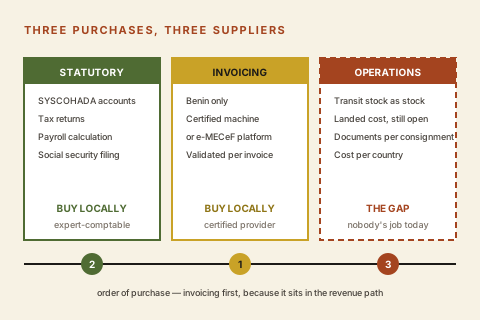
| What it is | Where to buy it |
|---|---|
| Statutory accounting and payroll. SYSCOHADA presentation, statutory accounts, tax returns, payroll calculation and social security filing, in the language your administration works in | Your expert-comptable and a local payroll firm. They are licensed, they are fluent, and they cost less than any software bought to displace them. We do none of it and are not proposing to |
| Invoicing, if you trade in Benin. Normalised invoices through a certified electronic invoicing machine or the e-MECeF platform, with the tax authority validating each one before it is valid | A certified provider. This is an accreditation, not an integration — a vendor either holds it or does not. We do not. Buy it first, because it sits in the path of your revenue |
| The operations layer. Stock in transit as stock, landed cost that stays open until the last invoice, documents against consignments, approvals recorded against what they authorised, cost attributed to a country | This is the one that is nobody's job. It is not accounting and it is not compliance, so it falls between the two providers you already have — and it is what we do |
Two of the three purchases above should be made from somebody other than us, and in Benin one of them should be made first. A guide that did not say so would not be worth reading.
Why the sequence matters more here than usual
If you invoice in Benin, invoicing sits in the path of your revenue: if an invoice cannot be validated it cannot be issued. Nothing else on the list has that property. You can adopt transit visibility, landed cost or approval controls next quarter without touching how you bill.
That asymmetry gives the order. Settle Benin invoicing first with a certified provider, keep your expert-comptable and your payroll firm where they are, and only then look at the operations layer. Do it the other way round and you can end up with a platform you like and an invoicing route bolted onto the side of it, in the one place where a bolt-on is expensive.
The question that tells you whether you have the third problem
One question, answerable this afternoon, with no vendor involved.
What is the value of stock you currently own that is not in any of your locations — and how was that number produced?
The number is not the interesting part. How it was produced is. If it came back as a report with the consignments listed, your records are in good shape and the third purchase is not urgent for you. If it came back after two days, a spreadsheet and a call to a clearing agent, then you have the problem, it recurs with every consignment, and it is currently held together by one person rather than by a system.
Five things worth asking us, and the answers
Published in advance so a demonstration does not have to be spent on them.
-
Can you make clearance faster or cheaper?
No, and treat this as a test question for every vendor you speak to. We hold no connection to any customs administration in the union, we lodge no declarations, we do not manage guarantees and we have no influence over how long a consignment waits or what it costs to move. What changes is what you know while you wait and what you can prove afterwards. Anyone implying otherwise should be asked to name the mechanism.
-
Do you produce SYSCOHADA statutory accounts?
No, and this is a design decision rather than a gap. The chart of accounts is prescribed by OHADA law and your expert-comptable owns the presentation and the filing. We post to a chart they define and hold the transaction detail their statements are built from, which makes the year-end an extraction rather than an excavation. A vendor claiming to replace an expert-comptable in an OHADA jurisdiction should be asked which auditor has accepted their output.
-
Do you run payroll in any of these countries?
No. No income tax calculation, no social security contributions, no returns. Our maintained payroll engine covers Kenya only, and six countries is six builds — we would rather say that than sell one as covering all of them. We do attribute labour cost to sites, projects and cost centres, which is the half of the problem this guide is about.
-
Does it handle the CFA franc, and the fact that we buy in dollars?
Yes, and the second half is the part worth checking on any shortlist. The XOF is pegged to the euro at a fixed rate, so euro suppliers carry no real exposure. Dollar and yuan suppliers do, and the peg covers none of it. The original amount and the rate actually applied stay on the transaction alongside the XOF figures, so a margin can be explained months later rather than recalculated.
-
Why would you support markets this far from you?
A fair question to ask every vendor. Support is remote from Nairobi, in English, and the working day overlaps almost entirely. There is no office and no implementation partner in any of these six countries. Ask us — and ask everybody else — what happens when the person who implemented your system leaves. That question separates vendors more reliably than any feature list.
What is genuinely different about buying here
Two things, and both cut against the usual advice in this series.
The first is that language is a harder constraint than capability. In most markets we write about, the question is whether a remote vendor understands the local rules. Here the local firms understand them better than any software vendor will, and the binding question is whether your team can work in English at all. That is not a question we can argue you out of, so we put it at the top instead of the bottom.
The second is that the problem worth solving is invisible on a feature list. Nobody sells "stock at a location you do not own" or "landed cost that stays open after receipt" as headline capabilities, because neither demonstrates well. They are nonetheless what turns a fortnight of uncertainty into a report, and they are the reason these six markets have a page in this series at all.
Where the boundary sits
Transit stock, landed cost and documents against consignments
Goods in transit carried as stock with value and position; costs attached to the consignment whenever they arrive, including after receipt; declarations, receipts and proof of discharge held against the shipment. The third purchase, and the one we would stand behind.
Per-country tax, cost attribution and multi-currency
A rate per jurisdiction rather than one regional default, cost coded to country and cost centre at entry, and the original currency and applied rate retained on the transaction.
Anything touching customs
Not built and not planned. No declarations, no guarantee management, no clearance integration, no connection to any customs system, and no claim to shorten a journey.
Benin's certified invoicing, statutory accounts and payroll
Not built. The first requires an accreditation we do not hold; the other two belong with providers who are better and cheaper at them than displacing them would be. If sequencing around the first means you never get to us, the advice was still correct.
A French interface
Not built today. Named here rather than buried because it is the single most-asked-for thing in these six markets and the honest answer is a no with no date attached.
The short version
If your team cannot work in English, stop here and keep looking — that is the honest answer and it costs you nothing. If it can: settle Benin invoicing first with a certified provider, keep your expert-comptable and your payroll firm, then ask one question internally — the value of stock you own that is not in any of your locations, and how the number was produced. If the answer is a report, you are done. If the answer is a person, that is the conversation, and it is the only one we are claiming to be useful in.
Nothing above needs a demonstration to verify and most of it can be checked against your own records this week. That is deliberate: a guide that can only be evaluated in a sales meeting is not a guide.
What we can build for the UEMOA member states on top of the standard product
Everything listed above as something we can add describes what ships in the standard product today — it is a starting point for the UEMOA member states, not a limit on what AWRA OpsHub can do there. Kenya's eTIMS integration and its maintained payroll engine are in the product because Kenyan clients needed them and commissioned them; neither appeared by itself. The same door is open here. If a French interface, Benin's certified invoicing connection, a bank or mobile money feed, a statutory return format, a rule specific to how your operation runs, or a link to a system you already have is what stands between you and a decision, tell us and we will scope it as a build — written spec, timeline and price — before you commit to anything.
Benin's normalised invoice, and a clean handoff everywhere else
In Benin, invoices issued through the certified electronic invoicing route with the tax authority validating each one and returning its unique number and QR code before the invoice is valid — held on the transaction, with retries, a failure queue and a daily report of sales carrying no reference. Stated precisely because the precision is the point: that is an accreditation rather than an integration, we do not hold it, and it is specific to Benin rather than to the union. Everywhere else this is a defined export mapped to your expert-comptable's chart of accounts. The statutory ledger stays with them by design; what we build is the pipe to it.
Mobile money, bank feeds and a French interface
Orange Money and other mobile money settlement files plus bank statement feeds pulled into the Payments Register, so collections reconcile against invoices without re-keying a statement. And French interface text and document templates — the single most-asked-for thing in these six markets, and the honest answer today is that it does not exist.
The operational work, which is what most commissions actually are
An extra approval stage in a chain that does not match the standard one, a custom field set on employees or assets that only your sector needs, an expiry that has to block an order rather than send an email, a report your board asks for in a shape nothing produces, or a scanner or weighbridge feeding the goods-in door. These are the commissions we are asked for most often and the smallest ones we quote — and unlike a revenue-authority pipeline, none of them waits on a regulator.
Payroll and statutory returns
National income tax and social security schedules per country, produced in the layout each filing body expects and generated from live payroll records. Six countries is six builds and we will say so rather than sell one as covering all of them.
Systems you already run
The accounting package, CRM, online store or custom database you intend to keep — connected through our API so a fact is entered once and appears everywhere it is needed.
How it works: you describe the requirement, we return a written scope, timeline and cost, and once agreed it is built into your environment and maintained as part of the product. No roadmap slide, and no pretending in a demo that something exists when it does not.
Tell us what you need integrated