
The Invoices That Arrive Three Weeks After the Goods
The freight was quoted, so the freight is in the cost. Everything else about a corridor consignment arrives later, on separate invoices, with no reference to the shipment — and gets posted to expense, where it silently stops being part of what the goods cost.
A consignment is costed once, at the point it is ordered, using the numbers available then: the supplier price and the freight quote. Those are the two figures that exist early, so those are the two figures that end up in the cost of the goods. Every other cost of moving something inland from a West African port arrives afterwards.
Nothing about that is careless. It is what happens when the accounting event and the cost event are separated by three weeks, and it produces a specific and expensive result: goods costed at less than they cost, and a margin that looks better than it is on every sale made from them.
The two kinds of cost, and why only one lands
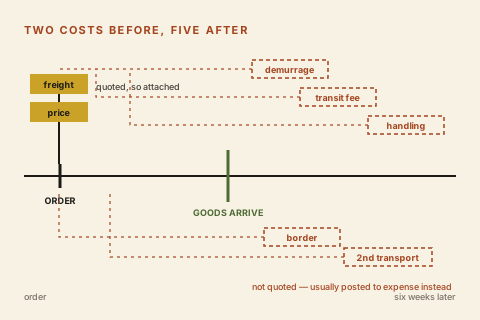
Quoted before the goods move
- Supplier price, on the invoice, in the supplier's currency.
- Sea freight, quoted per container.
- Sometimes insurance.
- All known at ordering, so all posted to the consignment.
- Result: these are in the unit cost, and they are the ones everybody checks.
Discovered after the goods move
- Port storage and demurrage, accruing per day, invoiced later.
- Transit and guarantee fees. Escort and crossing charges.
- The second transporter, when the first one stops at the border.
- Handling and offloading at arrival.
- Result: separate invoices, weeks later, no shipment reference — so they land in expense accounts and leave the unit cost alone.
The costs that get into the cost of goods are the ones that were quoted. The costs that were not quoted are the ones that vary — which is exactly the wrong way round.
Demurrage is the one that hurts most
It is the purest example, so it is worth taking on its own. Storage and demurrage accrue per day, on goods that are not moving, for reasons that are usually outside anybody's control — congestion, documentation, a queue for onward transport.
Three properties make it uniquely good at escaping the cost of the goods. It is unpredictable, so nobody budgeted a figure to compare it against. It is billed in aggregate, often on a monthly statement covering several shipments. And it arrives after the goods have been received, by which time the consignment is closed and the receiving clerk has moved on.
So the largest variable cost of the corridor is the one least likely to be attributed to the consignment that caused it. It gets reconciled against a statement instead — which balances the bank and tells you nothing about which shipment was expensive.
What it costs to get this wrong, stated concretely
| Consequence | How it shows up |
|---|---|
| Prices set from the wrong base | A margin calculated on an understated cost is overstated by the same amount. On thin-margin distribution that is the difference between a profitable line and a busy one |
| No way to compare routes | Whether Lomé is cheaper than Cotonou for your goods is an empirical question with an answer in your own records — but only if each consignment carries its full cost. Otherwise the comparison is done on freight quotes, which is the part that varies least |
| Stock valued below cost | Closing inventory carries the understated figure. The correction, if it happens, arrives as a period expense rather than as an inventory adjustment, so two sets of numbers are wrong in opposite directions |
| Nobody can name the expensive consignment | The total cost of moving goods is known monthly and in aggregate. Which shipment consumed it is not known at all, so there is nothing to learn from and nothing to renegotiate with |
The fix is one property, not a project
A consignment has to stay open to cost after the goods have arrived. That is the whole of it. If a demurrage invoice appearing three weeks after receipt can still be attached to the shipment it belongs to, and the unit cost recalculates, then everything above resolves. If it cannot, no amount of discipline elsewhere helps, because the person coding that invoice has nowhere correct to put it.
- Can a cost be added to a consignment after the goods have been received and put away?
- When it is added, does the unit cost recalculate, or is the original figure now fixed?
- Can you see, per consignment, every cost that landed on it and when each arrived?
- Can you compare two consignments on the same route by total landed cost rather than by freight?
- When a charge is paid in cash at a border, is there a place for it that is attached to the shipment rather than to a petty cash line?
That last one is not a technical question. It is the one that decides whether the rest of the list is theoretical, because border charges paid in cash are real, are legitimate, and are the single most commonly unattached cost in the whole journey.
One consignment, done properly, is the business case
Take the last shipment that arrived. Assemble every cost against it from every source — supplier invoice, freight, port, storage, transit, border, transport, handling — and compare the total to the figure the goods were booked at.
The gap is what a fortnight in the corridor costs you invisibly, per consignment, and it is the only number in this argument that matters. It takes a day to produce for one shipment and it is worth more than any demonstration, because it is your number rather than ours.
Where the boundary sits
Landed cost that stays open after receipt
Costs attached to the consignment whenever they arrive, with the unit cost recalculating, and a per-consignment view of what landed and when. The property this whole piece is about.
Cost attributed to a country, site and cost centre
Coded at entry rather than derived at reporting time, so a per-country or per-route total for any period is a filter rather than an extraction.
Original currency and the applied rate retained
A supplier invoiced in dollars keeps its amount and the rate actually used alongside the XOF figures. The euro peg removes one exposure and leaves the others untouched, so the rate has to survive on the record.
Documents against each cost
The receipt for a border charge or a demurrage invoice held against the consignment it belongs to, previewable without downloading.
Predicting demurrage, or reducing it
Not built and not a software problem. What causes a consignment to sit in a port is congestion, documentation and onward transport capacity. We can tell you afterwards what it cost and which route it happened on. We cannot forecast it and we would not claim to.
Choosing the route
Yours. Which corridor to use is a judgement about price, reliability, season and relationships. Our contribution is that the comparison can be made on your own numbers instead of on freight quotes.
The short version
Cost the consignment, not the order. Keep it open to cost until the last invoice has arrived, including the ones paid in cash at a border. Then the price you set, the stock you value and the route you choose all rest on the same number — which is the one thing this problem has been missing.
What we can build for the UEMOA member states on top of the standard product
Everything listed above as something we can add describes what ships in the standard product today — it is a starting point for the UEMOA member states, not a limit on what AWRA OpsHub can do there. Kenya's eTIMS integration and its maintained payroll engine are in the product because Kenyan clients needed them and commissioned them; neither appeared by itself. The same door is open here. If a French interface, Benin's certified invoicing connection, a bank or mobile money feed, a statutory return format, a rule specific to how your operation runs, or a link to a system you already have is what stands between you and a decision, tell us and we will scope it as a build — written spec, timeline and price — before you commit to anything.
Benin's normalised invoice, and a clean handoff everywhere else
In Benin, invoices issued through the certified electronic invoicing route with the tax authority validating each one and returning its unique number and QR code before the invoice is valid — held on the transaction, with retries, a failure queue and a daily report of sales carrying no reference. Stated precisely because the precision is the point: that is an accreditation rather than an integration, we do not hold it, and it is specific to Benin rather than to the union. Everywhere else this is a defined export mapped to your expert-comptable's chart of accounts. The statutory ledger stays with them by design; what we build is the pipe to it.
Mobile money, bank feeds and a French interface
Orange Money and other mobile money settlement files plus bank statement feeds pulled into the Payments Register, so collections reconcile against invoices without re-keying a statement. And French interface text and document templates — the single most-asked-for thing in these six markets, and the honest answer today is that it does not exist.
The operational work, which is what most commissions actually are
An extra approval stage in a chain that does not match the standard one, a custom field set on employees or assets that only your sector needs, an expiry that has to block an order rather than send an email, a report your board asks for in a shape nothing produces, or a scanner or weighbridge feeding the goods-in door. These are the commissions we are asked for most often and the smallest ones we quote — and unlike a revenue-authority pipeline, none of them waits on a regulator.
Payroll and statutory returns
National income tax and social security schedules per country, produced in the layout each filing body expects and generated from live payroll records. Six countries is six builds and we will say so rather than sell one as covering all of them.
Systems you already run
The accounting package, CRM, online store or custom database you intend to keep — connected through our API so a fact is entered once and appears everywhere it is needed.
How it works: you describe the requirement, we return a written scope, timeline and cost, and once agreed it is built into your environment and maintained as part of the product. No roadmap slide, and no pretending in a demo that something exists when it does not.
Tell us what you need integrated