Substance Is Real. Proving It Is a Records Problem.
Six things are assessed, and every one of them is evidenced by records an ordinary business already generates. The failure is almost never that the substance is absent. It is that nobody can produce the evidence without reconstructing the year from memory.
A Mauritian company that holds or manages operations elsewhere carries an obligation almost no mainland business has: it must be able to show that it is genuinely run from Mauritius. Not that it is registered here, which is a fact. That it is run from here, which is a demonstration.
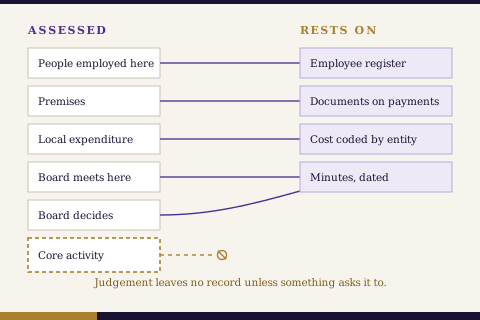
The assessment is holistic. People employed locally and whether they are suitably qualified, adequacy of premises, the level of expenditure incurred in Mauritius, how often the board meets here, whether the board genuinely decides rather than ratifying decisions taken somewhere else, and whether the core income-generating activity is carried out in or from Mauritius. There is no single number that passes it and no certificate that settles it.
What is striking, once you list those out, is how little of it is exotic. Every one of them is evidenced by records an ordinary business already generates. Payroll. Leases. Invoices from local suppliers. Minutes with dates on them. Approvals. Time booked against the work it relates to. This is not a tax problem dressed up as a records problem. It is a records problem that people meet for the first time through a tax adviser.
What this piece is and is not
It is a piece about record-keeping, written by people who build operations software. It is not advice about what your substance should look like, whether yours is sufficient, or how any requirement applies to your entity — those are questions for your management company and your adviser, who are licensed for them. We have deliberately printed no expenditure threshold and no employee count anywhere below, for the same reason: the tests are proportionate and assessed in the round, figures circulate secondhand, and a number from a software vendor is worth precisely nothing to you.
The six tests, and the record each one rests on
Read the middle column as a question about your own system. Not "do we do this" — you almost certainly do. "Could we produce the record for it this afternoon."
| Assessed | The record it rests on |
|---|---|
| People employed in Mauritius, suitably qualified for the activity | An employee register that distinguishes who is engaged by the Mauritian entity from who is engaged by a subsidiary or seconded in — with roles, locations and start dates that do not have to be remembered |
| Adequate premises | The lease, the rates, the utilities and the fit-out, held as documents against the transactions that paid for them, in the entity that paid |
| Expenditure incurred in Mauritius | Cost coded to the entity that incurred it and the jurisdiction it was incurred in, so a total for the year is a report rather than an exercise |
| Board meetings held in Mauritius | Minutes with a date, a place and an attendance list, filed where they can be found by date rather than by whoever circulated them |
| A board that decides rather than ratifies | Decisions with an authority behind them — an approval that had to happen before the commitment could, recorded against the commitment itself |
| Core activity carried out in or from Mauritius | The work visible as work: time and cost booked against the mandate, investment or engagement it relates to, by the people who did it |
The substance is almost always there. What is missing is a system that can say which jurisdiction each cost, each person and each decision belonged to, without a fortnight of reconstruction.
Where the evidence actually lives
This is the uncomfortable part, and it is worth saying that none of the arrangements below is carelessness. They are what a competent group ends up with when its systems were configured for the trading subsidiaries — the ones with stock, customers and invoices — while the Mauritian entity was treated as a holding structure with a bank account and an auditor.
| What it should rest on | Where it usually is instead |
|---|---|
| An employee register that knows who is engaged where | One combined staff list for the group, with the employing entity inferred from whichever payroll each person happens to appear on |
| Documents against the transactions that paid for them | Correct in the accounts and correct in reality, with the underlying documents in a folder somebody set up and a different person now maintains |
| Cost coded to entity and jurisdiction at entry | A group profit and loss, from which the Mauritian share is extracted annually by someone who knows which cost centres are which |
| Minutes findable by date | An email thread, a calendar invitation, and minutes that exist and are accurate and are in one person's mailbox |
| Approval recorded against what it authorised | Approval by message, executed immediately, minuted later. The decision was genuinely made; the sequence cannot be demonstrated |
| Time and cost against the mandate | Nowhere at all, in most cases |
The pattern is worth naming because it explains why this persists rather than getting fixed. Every one of those arrangements works perfectly for running a business and fails only when somebody outside it asks a question. They are not symptoms of a badly run company. They are what a well-run company looks like when nobody has ever needed the audit trail.
The last row is the interesting one
Five of the six tests rest on records almost everybody keeps somewhere. Core income-generating activity is different, and it is where most reconstruction effort actually goes.
The reason is that the activity is professional judgement — assessing an investment, setting the terms of a facility, monitoring a portfolio, deciding not to do something. Judgement does not naturally produce a record. A warehouse produces a receipt whether anybody wants one or not; a two-hour discussion about whether to extend a facility produces a decision and, if you are lucky, an email.
This is not an argument for timesheets in a professional business, which are widely and correctly disliked. It is a narrower point: if the work that generates your income leaves no trace against the thing it was about, then the one test that goes to the heart of the assessment is the one with the least behind it. Booking time and cost to a mandate is the cheapest available fix and it is unglamorous enough that nobody sells it to you.
Two ways to have a year of evidence
Both end with a file. They differ in when the work happens and how much of it survives a change of staff.
Reconstructed in March
- The request arrives from the administrator or the auditor with a deadline.
- One or two people who know the group's history assemble it, because only they can — the knowledge is the scarce input, not the data.
- Costs are extracted from a group ledger by judgement about which lines belong where, and the judgement is sound and undocumented.
- Minutes are gathered from mailboxes.
- It gets done, it is accurate, and none of it is repeatable.
Accrued as it happened
- Every cost carries the entity and jurisdiction that incurred it, because it was coded that way at entry.
- Headcount by entity is a filter rather than a question.
- Documents sit against the transactions they evidence.
- Approvals happened before the commitment, so the sequence is a record instead of a recollection.
- The file is a report — and the two indispensable people become merely useful.
The right-hand column is not more work in total. It is the same work moved to the moment when it costs almost nothing — coding a cost at entry rather than sorting a ledger in March. What makes the left-hand column expensive is not effort, it is that the effort is concentrated into a fortnight and depends on two people still being employed.
The risk nobody puts in the risk register
It is not that the substance is inadequate. For most businesses in this position, it is not.
It is that the ability to demonstrate substance is held by one or two people as knowledge rather than by the business as records — and that the exposure only becomes visible in the month after they resign. Until then everything works, every request is met, and the arrangement looks like competence rather than concentration.
- Can you produce total expenditure incurred by the Mauritian entity, in Mauritius, for the last financial year — as a report rather than as a calculation somebody performs?
- Does your employee register say which entity engages each person, or is that inferred from which payroll they appear on?
- If your administrator asked for every board minute from the last two years by date, where would you go and how many people would you ask?
- For a material commitment, can you show the approval preceded it rather than followed it?
- Who holds the answers to the four above in their head, and what happens the month after they leave?
Who owns which part
Graded honestly, and the first row is the one that matters most here because it is the row a vendor would most like to blur.
Whether your arrangements are sufficient
Not built, not buildable, and not a software question. Substance is assessed on what your business actually does. Whether yours meets the requirement is between you, your management company and your adviser — people licensed for it, as we are not. Any vendor offering a "substance solution" is describing a filing cabinet in language that should worry you.
Statutory filing and company secretarial
Not built. No annual return, no declaration, no statutory registers, no minute book, no share register, no board portal. Minutes can be held as documents against a period, which is storage and retrieval rather than company secretarial software, and the two get confused often enough to be worth separating.
Cost attributed to an entity and a jurisdiction
Expenditure coded to entity, cost centre and site at the point of entry, with reporting by any of them for any period. This is the whole argument of the piece and it is ordinary functionality rather than anything specialised.
Documents against the transactions they evidence
The lease, the invoice, the mandate, the minute — attached to the record they explain rather than filed in parallel to it, retrievable by date, entity or counterparty.
Approvals that precede the commitment
Thresholds that refuse rather than warn, delegation configured per entity, and the authorisation recorded against the thing it authorised, so a sequence is demonstrable rather than remembered.
What your own evidence pack should contain
Which records, in what form, to what depth, for your specific activity. Yours and your administrator's. We can make the records exist and be retrievable; deciding what is enough is not ours to decide and we would be wrong to try.
One number, this week
Ask for total expenditure incurred by the Mauritian entity, in Mauritius, for the last financial year. Not whether it is adequate — just the number.
Then ask the more useful question, which is where it came from. If it arrived as a report you can see the working of, your records are in better shape than most and none of this is urgent. If it arrived after two days and a conversation, you have found the gap, and it is the same gap every March. That is a one-question diagnostic and it will tell you more than an audit.
What we can build for Mauritius on top of the standard product
Everything listed above as something we can add describes what ships in the standard product today — it is a starting point for Mauritius, not a limit on what AWRA OpsHub can do there. Kenya's eTIMS integration and its maintained payroll engine are in the product because Kenyan clients needed them and commissioned them; neither appeared by itself. The same door is open here. If a certified EBS fiscalisation connection, a Mauritian payroll engine, a bank or mobile money feed, a statutory return format, a rule specific to how your operation runs, or a link to a system you already have is what stands between you and a decision, tell us and we will scope it as a build — written spec, timeline and price — before you commit to anything.
Real-time fiscalisation, through certification we do not hold
Invoice fiscalisation against the Revenue Authority in real time — structured invoices, a validation response held on the transaction, retries, a failure queue and a daily report of invoices carrying no reference. Stated precisely, because precision is the whole value of saying it here: this requires becoming a certified Electronic Billing System, which is an accreditation rather than an integration. We are not certified and hold no connection today. If you are in scope, choose your EBS first and fit everything else around it.
Banks, cards and genuinely multi-currency settlement
Bank statement feeds and card acquirer settlement into the Payments Register, across the several currencies a Mauritian entity actually operates in rather than one reporting currency with conversions bolted on. There is no exchange control to work around here, which makes this the ordinary version of a problem that is difficult almost everywhere else on the continent.
The operational work, which is what most commissions actually are
An extra approval stage in a chain that does not match the standard one, a custom field set on employees or assets that only your sector needs, an expiry that has to block an order rather than send an email, a report your board asks for in a shape nothing produces, or a scanner or weighbridge feeding the goods-in door. These are the commissions we are asked for most often and the smallest ones we quote — and unlike a revenue-authority pipeline, none of them waits on a regulator.
Payroll and statutory returns
PAYE, National Pensions Fund and National Savings Fund contributions and the associated returns, computed on live records and produced in the layout each body expects. Not built today — our maintained engine covers Kenya only, and the local providers here are good.
Systems you already run
The accounting package, CRM, online store or custom database you intend to keep — connected through our API so a fact is entered once and appears everywhere it is needed.
How it works: you describe the requirement, we return a written scope, timeline and cost, and once agreed it is built into your environment and maintained as part of the product. No roadmap slide, and no pretending in a demo that something exists when it does not.
Tell us what you need integrated