
The Clock Starts at the Transaction. The Network Starts Somewhere Else
A reporting window measured in days is an integration problem in a compact market. In a country of thousands of islands, where a good deal of the selling happens at the end of a connection that is not there, it becomes something else entirely.
When a reporting deadline is monthly, the gap between a sale happening and a sale being recorded is invisible. A rider takes an order on Tuesday, the paperwork reaches the branch on Friday, somebody keys it the following Monday, and none of that matters, because the return is not due for three weeks and the numbers are the same numbers whenever they are entered.
Shorten the window to days and every one of those steps becomes load-bearing. The gap did not get worse. It just stopped being free.
This piece is about that arithmetic, and about why the response to it is almost never a compliance purchase. Deadlines and classifications under the Bureau's electronic invoicing programme have been amended more than once, so no date appears here that you should plan against — confirm your own position with the Bureau or your accountant. The operational consequence of a short window does not change when a date moves.
Where the window actually goes
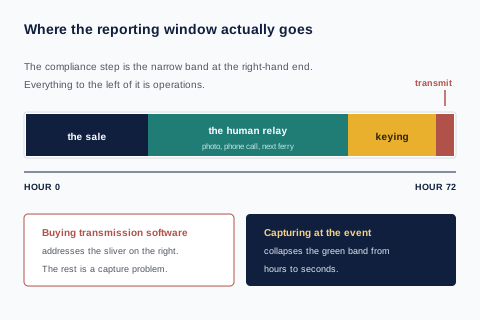
Take an ordinary sale in a distribution business with field staff and provincial branches, and account for the hours.
| What is happening | Elapsed | Where the data is |
|---|---|---|
| The sale happens | Hour zero | In a notebook, a carbon-copy book, or somebody's memory |
| It travels by human | Hours 1 to 40, on a normal week | A photograph in a group chat, a phone call, a stack of paper on the next ferry |
| Somebody keys the backlog | Hours 40 to 60 | Being reconstructed from the photograph by a person who was not there |
| It is transmitted | Hours 60 to 72 | Correct in structure, uncertain in content, with no time left to check |
Most of the window is consumed before anybody with a computer has heard about the sale. The transmission is the last four per cent of it.
Why the human relay is not a discipline problem
It is tempting to look at that sequence and conclude that people should simply record things sooner. In our experience that conclusion is wrong, and acting on it makes things worse rather than better.
The relay exists because it is the rational response to unreliable infrastructure. A rider who cannot connect cannot enter anything into a system, so the information travels by whatever channel does work — a photograph, a phone call, a paper book. Instructing people to be faster does not change the coverage map. It just moves the failure from "recorded late" to "recorded late and now also blamed for it".
-
The infrastructure is genuinely variable
Coverage is good in the cities and unreliable across a great many of the places where goods are actually sold and delivered. Power interruptions are routine rather than exceptional in parts of the country. This is the operating environment, not a temporary condition to be planned around.
-
So the process adapted, sensibly
Paper, photographs and phone calls are resilient. They work in a brownout, they work with no signal, and they work when the device is flat. The adaptation is not laziness — it is the only thing that functions.
-
And it was invisible while deadlines were monthly
Nobody measured the lag because nothing depended on it. A business could run this way indefinitely and produce perfectly good returns.
-
Then the window shortened
And a process optimised for resilience turned out to be optimised against speed. Every hop that made the information robust also made it slow.
-
The instinct is to buy transmission software
Which addresses the four per cent. The remaining ninety-six is a capture problem, and no amount of integration touches it.
What actually fixes it
The fix is not a faster connection, because you do not control the connection. It is capture that does not require one.
Record the event on the device, at the moment it happens, with no network. Hold it there. Reconcile when a connection returns — in the vehicle on the way back, at the branch, wherever coverage resumes. The gap between the event and the record goes from hours to seconds, and the gap between the record and the server goes from hours to however long it takes to reach signal, which is a much smaller and much more predictable number.
The relay
- Recorded by somebody who was not present.
- Reconstructed from a photograph or a memory.
- Counterparty details copied from the last order.
- Errors discovered when a document is rejected.
- Elapsed time: hours to days, unpredictable.
Offline capture
- Recorded by the person who was there.
- Entered once, against the actual customer and item.
- Counterparty details pulled from a current record.
- Errors visible at the point of entry.
- Elapsed time: seconds to the record, minutes to the server.
The honest limits of offline
It is worth being specific, because "works offline" is claimed loosely. What is realistic is capturing operational events on a device with no connection — a delivery, a receipt, a count, a scan, an expense — and reconciling them when one returns, with conflicts surfaced rather than silently resolved. What is not realistic is running an entire business disconnected for a week, or expecting a device to know about a price change or a credit hold that was made centrally while it was offline. Test it on your worst site rather than your best one, and test the reconnection rather than the disconnection — that is where the interesting behaviour is.
The second-order benefit nobody buys it for
Shortening the capture gap does something else that has nothing to do with compliance, and in most businesses it turns out to be worth more.
- Stock figures become current rather than accurate as at the last time somebody keyed a backlog.
- Deliveries have a confirmation attached to the person and the moment, rather than a signature on paper in a folder somewhere.
- Disputes shrink, because the quantity was recorded at the door instead of reconstructed a week later by two people who each remember it differently.
- Credit decisions improve, because the receivable reflects yesterday rather than last Thursday.
- Field staff stop being data entry clerks at the end of the week, which is the part they will actually thank you for.
None of that appears in a compliance business case. All of it appears in the operating numbers within a quarter.
Four questions for your own process
How long from a sale to it existing in the system?
The answer you often get
Same day, usually.
What to press for instead
Ask for a bad day rather than a usual one, and ask about the site with the worst coverage rather than the head office. "Usually" is doing the work in that sentence, and the deadline does not care about the average.
How many documents are keyed from a photograph?
The answer you often get
Some, in the provinces.
What to press for instead
Ask for a proportion, and ask who does the keying. If it is one person catching up on Fridays, the business has a single point of failure with a compliance deadline attached to it.
What happens during a typhoon week?
The answer you often get
We manage.
What to press for instead
Ask whether the plan is written down and who executes it. This is a country where several make landfall in a normal year — it is a planning input rather than an exception, and a process with no documented degraded mode has one that exists only in somebody's head.
Who finds out when a document is rejected?
The answer you often get
Finance would see it.
What to press for instead
Ask how quickly, and what happens next. A rejection nobody acts on for a week is a receivable nobody is chasing, and the customer usually notices before you do.
What AWRA OpsHub does today
- Offline capture on mobile — deliveries, receipts, counts, scans and expenses, reconciled on reconnect
- Conflicts surfaced on reconnection rather than silently resolved
- One current record per customer and supplier, with identifiers on the party
- In-transit stock as an owned, dated position
- Multi-branch stock with governed transfers and blind counts
More we can add to your workspace
- BIR EIS transmission — structured submission, acknowledgements or retry queue
- Accreditation as a computerised accounting system, and no permit to use
- SSS, PhilHealth, Pag-IBIG, withholding tax or thirteenth-month accrual
- Withholding tax certificate production
- A Filipino-language interface — English only
What we can build for the Philippines on top of the standard product
Everything listed above as something we can add describes what ships in the standard product today — it is a starting point for the Philippines, not a limit on what AWRA OpsHub can do there. Kenya's eTIMS integration and its maintained payroll engine are in the product because Kenyan clients needed them and commissioned them; neither appeared by itself. The same door is open here. If a BIR EIS connection, a Philippine payroll engine, a bank or mobile money feed, a statutory return format, a rule specific to how your operation runs, or a link to a system you already have is what stands between you and a decision, tell us and we will scope it as a build — written spec, timeline and price — before you commit to anything.
BIR EIS transmission
Structured JSON transmission to the BIR Electronic Invoicing System inside the reporting window, with the retries, the failure queue and the daily report of sales that never reached the platform — which is the part that actually decides whether you are compliant, and the part vendors describe least. Withholding at source handled on the purchase side, where the certificates come from.
InstaPay, PESONet and bank feeds
InstaPay and PESONet collection matched to the invoice, e-wallet settlement reconciled rather than exported, and bank statement feeds wired into the Payments Register.
The operational work, which is what most commissions actually are
An extra approval stage in a chain that does not match the standard one, a custom field set on employees or assets that only your sector needs, an expiry that has to block an order rather than send an email, a report your board asks for in a shape nothing produces, or a scanner or weighbridge feeding the goods-in door. These are the commissions we are asked for most often and the smallest ones we quote — and unlike a revenue-authority pipeline, none of them waits on a regulator.
Payroll and statutory returns
SSS, PhilHealth, Pag-IBIG and withholding tax computed on live records, with the contribution and remittance files produced in the layout each agency expects, and thirteenth-month pay accrued through the year rather than found in December.
Systems you already run
The accounting package, CRM, online store or custom database you intend to keep — connected through our API so a fact is entered once and appears everywhere it is needed.
How it works: you describe the requirement, we return a written scope, timeline and cost, and once agreed it is built into your environment and maintained as part of the product. No roadmap slide, and no pretending in a demo that something exists when it does not.
Tell us what you need integratedOur take
Time one transaction end to end, from a site with poor coverage, on a bad day rather than an average one. That number is your real reporting window, and everything left over is the margin you have to work with. In most businesses we have this conversation with, the transmission step is a small fraction of the elapsed time and the relay is almost all of it — which means the deadline is an operations problem wearing a compliance costume. Buy the transmission from somebody local who does it well. Then fix the ninety-six per cent.
Close the gap, not the connection
We do not transmit to the Bureau. We do capture the delivery, the receipt and the count where they happen, with no network, and reconcile when one returns — which is where the window actually goes.
Talk to us about the PhilippinesFrequently asked questions
What exactly is the reporting window?
The programme expects structured documents to reach the Bureau within a short period of the transaction rather than at the end of a reporting month, and the specifics — including who is covered and by when — have been amended by regulation more than once. We are deliberately not printing a date here that you might plan against; confirm your current obligations and your own classification with the Bureau or your accountant. The shape of the obligation is what this article is built on, and that has been stable: structured, and soon after the event.
Are small businesses in scope?
Coverage has been extended in stages and reaches beyond the largest taxpayers, with micro taxpayers broadly outside the mandate though able to adopt voluntarily and, in some cases, claim a deduction for setup costs. Where exactly you sit depends on your classification and your activity, and e-commerce activity has been treated specifically. This is a question for your accountant rather than a vendor, and it is worth settling before you evaluate software rather than after.
Will better transmission software fix a late document?
Only the last stretch of it. If the elapsed time from a sale to complete, accurate data in a system is forty hours, then transmission software makes the final step reliable and leaves the forty hours untouched. The uncomfortable version: a business that misses the window is usually not failing at transmission, it is failing to know about its own sales quickly enough — and that is a capture problem in the field, not an integration problem at head office.
How does offline capture handle conflicts?
When a device reconnects, records captured while it was disconnected are reconciled with the server, and where something has changed in the meantime the conflict is surfaced rather than resolved silently. That distinction matters more than it sounds: a system that quietly picks a winner will produce a stock figure nobody can explain. The honest limitation is that a device cannot know about a central change — a price update, a credit hold — that happened while it was offline, so the reconnection is where that gets applied.
Do you transmit to the BIR?
No. We do not generate the structured submission, transmit it, or handle acknowledgements and retries — and separately, we are not an accredited computerised accounting system and do not hold a permit to use. That second point is a threshold question rather than a preference: if your compliance position requires an accredited system as your book of record, settle it with your accountant before evaluating anybody. Where we fit is alongside such a system, as the layer that knows what physically happened.
What is the cheapest thing to do this week?
Time one transaction. Pick a sale made somewhere with poor coverage and measure the hours from the commercial event to the moment it exists as complete, accurate data — on a bad day, not an average one. It costs nothing, it needs no software, and it converts an abstract worry about a deadline into a specific number you can compare against the window you actually have. Almost everyone who does this is surprised by where the hours went.
