Twenty-Five Kilometres, Two Tax Regimes, One Finance Manager
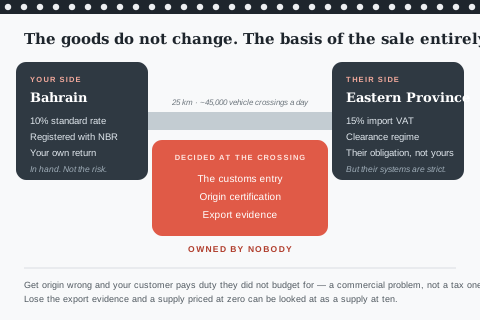
Twenty-five kilometres of causeway separates a ten per cent regime from a fifteen per cent one. Nothing about the operation changes as a truck crosses it. Everything about the documentary basis of the sale does.
Bahrain is the smallest market in the Gulf and one of the most externally facing. A great many operations here are, functionally, businesses that serve the Eastern Province from a lower-cost base twenty-five kilometres offshore — Dammam is closer to Manama than a lot of companies' warehouses are to their own head offices.
That geography produces a specific and under-discussed problem. Your operation is small. Your compliance surface is not, and it does not scale down to match.
Nothing here is tax advice. Rates, conditions and treatments are the National Bureau for Revenue's and the relevant authorities' to set. Confirm your own position with them or with your adviser.
The ratio nobody puts on a slide
Think about what a Bahraini exporter of moderate size is actually administering, and then think about who is administering it.
| What has to be managed | Who manages it in a large company | Who manages it here |
|---|---|---|
| Domestic VAT at 10%, returns and filings | A tax function | The finance manager |
| Export treatment and its evidence conditions | A trade compliance team | The finance manager |
| Origin documentation and customs entries | A logistics compliance role | The finance manager, and a clearing agent |
| Counterparty registration validity | A master data function | Nobody, usually |
| Landed cost allocation | A cost accountant | A spreadsheet, monthly, if at all |
| The management accounts, debtors and payroll | Three separate departments | The same finance manager |
Your obligations do not scale down with your headcount. They are the same obligations a company forty times your size has, minus the thirty-nine people.
This is not a complaint about regulation and it is not an argument that Bahrain is hard to operate in — by regional standards it is straightforward. It is an argument about where the risk actually sits, because it is not where most operators look for it.
What changes at the crossing, and what does not
Watch a pallet cross. The goods do not change. The driver does not change. The commercial relationship does not change. Three things do, and all three are documentary.
-
The tax treatment of the supply changes
A domestic sale at the standard rate becomes an export, treated at zero — but conditionally, on evidence you must be able to produce later. The tax is not in the price, which is the detail that makes the downside asymmetric.
-
Your customer acquires an import position
They account for import VAT at their own rate and recover it in the ordinary way. That is their problem, not yours — with one exception below.
-
Origin starts to matter, and it is your paperwork
Whether goods move within the customs union duty-free or attract the common external tariff turns on origin, evidenced by certification you obtain. Get it wrong and your customer pays duty they did not budget for. That is not a tax exposure. It is a commercial one, and it arrives as a phone call.
A precision worth having: you are not subject to clearance
This gets muddled constantly in vendor conversations, so it is worth stating cleanly. Saudi Arabia operates a clearance model for standard tax invoices — the document goes to the authority, is validated and stamped, and only then may be issued. That obligation sits on Saudi sellers issuing Saudi tax invoices.
As a Bahraini supplier you issue a Bahraini invoice under Bahraini rules. You are not clearing anything and no vendor should be selling you a clearance integration for this.
What is true is second-order and still worth planning for: your customer's systems were built for a clearance regime, and systems built for clearance validate counterparty data much more strictly than a paper process ever did. A missing or malformed registration number that used to be a shrug is now a rejection somewhere in their pipeline, and you become the supplier whose documents cause problems. That is a commercial cost with no tax dimension at all.
The one change that removes most of this
Hold your customer's registration identifier as a discrete, validated field with an expiry date on it — not typed into the second line of an address, and not in a comment box. It sounds trivially small. It is the single most common cause of a cross-border document being rejected, queried or disbelieved, and it costs one field on a form.
Where the money actually leaks
Three places, in descending order of size, based on what we see when operators of this profile open their books.
- Export evidence that cannot be produced. Covered at length in a separate piece, because the arithmetic deserves its own space. The short version: the exposure is a percentage of revenue rather than of profit, so a single-digit failure rate produces a double-digit margin hit.
- Landed cost sitting in overhead. Freight, clearance, port handling and causeway costs arrive weeks after the goods, on separate invoices, and get absorbed. On a distribution margin, pricing against an incomplete unit cost is not a rounding issue — it is the difference between the products you think make money and the ones that do.
- Gratuity accruing invisibly. End-of-service entitlement builds month by month across a largely expatriate workforce and, at this size, is almost always calculated at settlement rather than accrued. The balance sheet is confident and incomplete, and the discovery is always at the worst moment.
Only the first two are things we solve, and we would rather list the third than leave it off because it is inconvenient.
The small-team problem, stated properly
Every recommendation in this piece could be delivered by a process — a checklist, a monthly review, a named owner. In a finance function of three, processes decay, because the resource under most pressure is attention rather than time.
What survives is structure. A document that must be attached before a treatment can apply. An expiry date the system watches rather than a person remembers. A report that answers "what is missing" rather than a folder somebody has to go through. The difference between those two approaches is not thoroughness — it is whether the discipline survives one person going on leave.
Four questions worth asking yourself before you ask a vendor
Can we evidence a zero-rated export from last quarter?
The comfortable answer
Of course, it will all be on file.
The one worth testing
Pick one at random and time yourself. Two minutes, no asking anyone. Whatever that exercise produces is your actual position, and it is the only number in this article that matters to you specifically.
Who owns origin documentation?
The comfortable answer
The clearing agent handles it.
The one worth testing
Handling is not owning. Ask what happens when a shipment does not qualify, who notices, and who tells the customer before they discover it at the border. The answer is usually a person who is not in the room.
What is our landed cost per unit, really?
The comfortable answer
It is in the system.
The one worth testing
Take one consignment and add every cost that reached it after the goods did. If those sit in overhead, your gross margin by product is an estimate, and on distribution margins that estimate is frequently wrong by more than the margin.
What happens if our finance manager leaves?
The comfortable answer
We would manage.
The one worth testing
Ask specifically what only they know: which agent handled which route, where the older declarations are, which customers have unusual arrangements. Write the list down. If it is long, the risk on this page is not tax — it is concentration.
What AWRA OpsHub does today
- Dinar base currency and a 10% VAT preset, net and tax split at capture
- Documents attached to the transaction they justify, checksummed and access-logged
- Expiry dates on customer and supplier registrations, watched by the system
- Landed cost allocated onto the consignment at the rate actually paid
- Procurement approvals that refuse, and three-way matching
- Access control and an audit trail — the substitute for separation of duties in a small team
More we can add to your workspace
- A National Bureau for Revenue e-invoicing integration, once there is a published specification to build against
- A customs integration and a certificate of origin issuance
- An Arabic interface or right-to-left layout
- A Social Insurance Organisation, LMRA wage file or Bahrainisation tracking
- An end-of-service gratuity accrual — named in this piece as one of the clearer additions
- A corporate tax, top-up tax or statutory accounts
What we can build for Bahrain on top of the standard product
Everything listed above as something we can add describes what ships in the standard product today — it is a starting point for Bahrain, not a limit on what AWRA OpsHub can do there. Kenya's eTIMS integration and its maintained payroll engine are in the product because Kenyan clients needed them and commissioned them; neither appeared by itself. The same door is open here. If an NBR e-invoicing pipeline once the format is published, an Arabic interface, a bank or mobile money feed, a statutory return format, a rule specific to how your operation runs, or a link to a system you already have is what stands between you and a decision, tell us and we will scope it as a build — written spec, timeline and price — before you commit to anything.
The zero rating, and the evidence that holds it up
Electronic invoicing against whatever the National Bureau for Revenue publishes, built when there is a format to build against. The nearer-term work is the one that costs Bahraini exporters real money: a zero-rated cross-border supply that carries its own proof — customs entry, transport document and delivery evidence attached to the invoice rather than filed somewhere else — so the rating survives a review instead of being reconstructed during one.
Arabic interface, banks and acquirers
Arabic interface text with right-to-left layout and bilingual document templates, plus bank statement feeds, card acquirer settlements and instant-payment files wired into the Payments Register.
The operational work, which is what most commissions actually are
An extra approval stage in a chain that does not match the standard one, a custom field set on employees or assets that only your sector needs, an expiry that has to block an order rather than send an email, a report your board asks for in a shape nothing produces, or a scanner or weighbridge feeding the goods-in door. These are the commissions we are asked for most often and the smallest ones we quote — and unlike a revenue-authority pipeline, none of them waits on a regulator.
Payroll and statutory returns
A Bahraini payroll engine with Social Insurance Organisation contributions on live employee records, wage files in the layout the Labour Market Regulatory Authority expects, and the Bahrainisation position visible before a deadline rather than after one.
Systems you already run
The accounting package, CRM, online store or custom database you intend to keep — connected through our API so a fact is entered once and appears everywhere it is needed.
How it works: you describe the requirement, we return a written scope, timeline and cost, and once agreed it is built into your environment and maintained as part of the product. No roadmap slide, and no pretending in a demo that something exists when it does not.
Tell us what you need integratedOur take
Bahrain's characteristic operational risk is not competitive, operational or regulatory in the ordinary sense — it is documentary and concentrated. A small team carries a cross-border evidence burden sized for a much larger company, and the whole thing works because one person holds the connections in their head. Make the attachment structural, hold counterparty registrations as watched fields, get landed cost onto the unit, and the exposure largely disappears. None of that is expensive. It is just not urgent until it is.
Bring one zero-rated export and try to prove it
One shipment from last quarter and the four documents that hold its treatment up. If you can produce them in two minutes, your records are in better shape than most. If not, that gap is the conversation.
Talk to us about BahrainFrequently asked questions
Are Bahraini exporters subject to ZATCA e-invoicing?
No. ZATCA clearance is an obligation on Saudi sellers issuing Saudi tax invoices. As a Bahraini supplier you issue a Bahraini invoice under Bahraini rules, and no clearance integration is required of you. What is real is second-order: your Saudi customers run systems built for a clearance regime, and those validate counterparty data far more strictly than paper processes did — so a missing or malformed registration identifier that used to be tolerated is now a rejection in somebody's pipeline. That is a commercial problem rather than a tax one, and it is fixed by holding identifiers as validated fields.
Does Bahrain have an e-invoicing mandate?
Not in force at the time of writing. The National Bureau for Revenue has consulted on electronic invoicing and, as far as we can establish, has not published a platform, a technical format or a timetable. Large businesses are being advised to prepare, which is reasonable — but preparing means getting your records into the state any regime would assume rather than buying an integration to an unpublished specification. Confirm the current position with the NBR rather than with a vendor, including us.
What is Bahrain's VAT rate?
The standard rate has been 10% since 1 January 2022, having previously been 5%. That doubling matters more than it sounds for anybody with older data: pricing rules, margin comparisons and any hard-coded assumption written before 2022 needs checking rather than assuming. Reduced, zero-rated and exempt categories exist and are the National Bureau for Revenue's to define — a software preset is a default you own, not a treatment we interpret.
Does the domestic minimum top-up tax affect us?
Almost certainly not, and it is worth saying so plainly because it has generated more anxiety than it deserves among smaller operators. It applies to large multinational groups above a very high consolidated revenue threshold. If your group is anywhere near that threshold you have advisers who are already on it, and they, not a software vendor, are the right source. We do not compute it, apportion it or file it.
We are three people in finance. Is a system like this overkill?
The honest test is whether the documentary exposure described here is one you actually have. A single-site business selling domestically does not need any of it. An exporter with a third of turnover going across the causeway has the arithmetic in the related piece, and the smaller the team the more the discipline has to live in the system rather than in a person — because you have no redundancy at all. Size argues for structure here rather than against it, which is the opposite of the usual intuition.
Do you accrue end-of-service gratuity?
No, and it is listed as a gap on this page rather than buried in a scope note. End-of-service entitlement accrues month by month across what is, in most Bahraini operations, a largely expatriate workforce, and it is a genuine balance-sheet liability rather than a filing chore. We do not calculate or accrue it on live employee records; today that lives in your accountant's workbook, and it is discovered at settlement. If that is your primary problem, we are not currently the answer to it.