
Stock That Is Not at Either End
Goods spend days between your own warehouses, across several legs and more than one carrier. They have left one count and not yet entered another, and in a surprising number of businesses the honest answer to who is counting them is nobody.
In a market where a stock transfer takes an afternoon, in-transit inventory is a rounding error and nobody models it. The pallet leaves at nine and arrives at two, and if the figures are briefly wrong in between, they are wrong for five hours and then they are right again.
Move that transfer across water, across several legs, with a sailing schedule and a weather system in the middle of it, and the five hours become four days. Do that continuously, in both directions, across a distribution network, and there is a permanent quantity of your own inventory that is at neither end.
The question worth asking is not whether that stock exists. It is whose figures it is in.
The accounting gap, stated simply
Most stock systems do the obvious thing, and the obvious thing produces the gap.
-
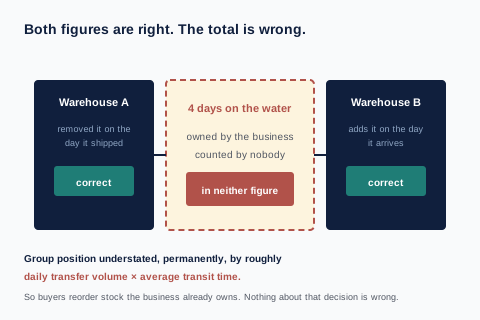
The dispatching warehouse removes it on the day it ships
Correct from that warehouse's point of view. The goods are gone, the storekeeper cannot sell them, and leaving them on the books would overstate what is available at that location.
-
The receiving warehouse adds it on the day it arrives
Also correct. You cannot count what has not turned up, and adding it early produces a location figure that promises stock nobody can pick.
-
Between the two dates, it is in nobody's figures
Both individual positions are right. The group position — the total the business owns — is understated by whatever is on the water, every day, permanently.
-
And the understatement is not small or random
It is roughly the daily transfer volume multiplied by the average transit time, which in an archipelago is a structural number rather than a fluctuation. It is the same size next month.
-
So people buy stock they already own
A buyer looks at a group figure, sees less than there is, and reorders. Nothing about that decision is wrong given the information available, which is what makes it expensive.
Both warehouse figures are right. The total is wrong. That is a modelling gap, not a counting error, and no amount of stocktaking closes it.
Four things that get harder over water
| What changes | What it costs |
|---|---|
| Several legs, one document | Truck to port, vessel, truck again, sometimes a smaller boat. A shortage discovered at the end cannot be attributed to a leg, so it becomes shrinkage rather than a claim against a specific carrier |
| Weather is normal, not exceptional | An average of around twenty tropical cyclones a year. Systems that treat transit as a fixed lead time record every closure as an error rather than as the operating environment |
| Branches run with real autonomy | Distance produces local purchasing, local pricing and local stock calls. Usually correct, and invisible centrally until the year-end count |
| Reorder points age quietly | Calculated from a lead time that was true two years ago. Nothing errors, and the buffer is either too big or too small in every location simultaneously |
What it costs, with a number on it
An illustrative distributor — figures for shape, not for planning
Every input above is illustrative and yours will differ — the transfer volume, the transit time and particularly the shrinkage rate are business-specific, and the shrinkage rate is the one people dispute. Take the disputed one out entirely and the figure is still over four hundred thousand pesos of stock bought unnecessarily, sitting somewhere, bought with borrowed money. The point of the arithmetic is not the total. It is that the whole thing follows from a modelling choice — where in-transit stock lives — rather than from anybody doing their job badly.
What "fixing it" actually means
Less than people expect, and none of it is clever.
Four changes, in order of return
- Make in-transit a position rather than a gap. Stock that has left one location and not arrived at another is owned, dated, and belongs to somebody. It should appear in the group figure because it is genuinely there.
- Require a receipt at the far end. A transfer stays open until the receiving location confirms what it actually got. Not stock appearing in a count — a confirmation against the dispatch.
- Record a receipt per leg where a leg has a responsible party. It will not stop a loss, but it turns "something went missing between two islands" into a leg, a date and a name, which is the difference between a claim and a write-off.
- Let expected arrivals be revised. A cancelled sailing is not an exception to be overridden, it is Tuesday. Transfers that auto-close on a planned date produce figures that are confidently wrong.
The branch autonomy question, which is not a control question
Provincial branches in this market often run with more independence than a central team realises — local purchasing, local pricing calls, private buffer stock held back because central figures have burned them before. The instinct is to see that as a control problem and centralise. Usually it is a rational response to bad information, and the buffer stock in particular is a direct symptom of the modelling gap in this article. Fix the figures first and see how much of the autonomy was really about distrust rather than distance. Autonomy with a record is delegation; the problem was never the autonomy.
Four questions worth asking inside your own business
What is the value of stock in transit right now?
The answer you often get
We could work it out.
What to press for instead
Ask for it, and time how long it takes. If the answer is assembled rather than reported, then it is not in any figure anybody makes decisions from, which is the entire subject of this article.
When a transfer arrives short, where is that recorded?
The answer you often get
The branch would raise it.
What to press for instead
Ask to see the last three. If shortages are handled as adjustments at the receiving end rather than as variances against the dispatch, nobody can tell you which lane or which carrier is losing goods.
What lead time do your reorder points assume?
The answer you often get
The standard transit time.
What to press for instead
Ask when it was last measured against actuals, by lane. Reorder points calculated from a lead time that has drifted are wrong in every location at once, and nothing in the system will ever flag it.
Do branches hold stock they have not told you about?
The answer you often get
They should not.
What to press for instead
A different question from whether they do. If central figures have been unreliable, holding a private buffer is the responsible thing for a branch manager to do, and it will persist for a year after the figures improve because trust lags data.
What AWRA OpsHub does today
- In-transit stock as an owned, dated, visible position rather than a gap
- Transfers that stay open until the receiving location confirms the quantity
- Expected arrivals that can be revised rather than assumed
- Every branch, warehouse and site store a distinct position with its own approvals
- Blind counts with valued variance, and landed cost on the consignment
- Offline capture, so an arrival is recorded at the wharf rather than at a desk
More we can add to your workspace
- Shipping, freight-forwarding or vessel-booking integration
- Carrier tracking, container visibility or port system connections
- Route optimisation or transport planning of any kind
- BIR EIS transmission, and no accreditation as a computerised accounting system
- Philippine statutory payroll
What we can build for the Philippines on top of the standard product
Everything listed above as something we can add describes what ships in the standard product today — it is a starting point for the Philippines, not a limit on what AWRA OpsHub can do there. Kenya's eTIMS integration and its maintained payroll engine are in the product because Kenyan clients needed them and commissioned them; neither appeared by itself. The same door is open here. If a BIR EIS connection, a Philippine payroll engine, a bank or mobile money feed, a statutory return format, a rule specific to how your operation runs, or a link to a system you already have is what stands between you and a decision, tell us and we will scope it as a build — written spec, timeline and price — before you commit to anything.
BIR EIS transmission
Structured JSON transmission to the BIR Electronic Invoicing System inside the reporting window, with the retries, the failure queue and the daily report of sales that never reached the platform — which is the part that actually decides whether you are compliant, and the part vendors describe least. Withholding at source handled on the purchase side, where the certificates come from.
InstaPay, PESONet and bank feeds
InstaPay and PESONet collection matched to the invoice, e-wallet settlement reconciled rather than exported, and bank statement feeds wired into the Payments Register.
The operational work, which is what most commissions actually are
An extra approval stage in a chain that does not match the standard one, a custom field set on employees or assets that only your sector needs, an expiry that has to block an order rather than send an email, a report your board asks for in a shape nothing produces, or a scanner or weighbridge feeding the goods-in door. These are the commissions we are asked for most often and the smallest ones we quote — and unlike a revenue-authority pipeline, none of them waits on a regulator.
Payroll and statutory returns
SSS, PhilHealth, Pag-IBIG and withholding tax computed on live records, with the contribution and remittance files produced in the layout each agency expects, and thirteenth-month pay accrued through the year rather than found in December.
Systems you already run
The accounting package, CRM, online store or custom database you intend to keep — connected through our API so a fact is entered once and appears everywhere it is needed.
How it works: you describe the requirement, we return a written scope, timeline and cost, and once agreed it is built into your environment and maintained as part of the product. No roadmap slide, and no pretending in a demo that something exists when it does not.
Tell us what you need integratedOur take
Ask for the value of stock in transit between your own locations, right now. If it takes more than a day to produce or comes back as an estimate, you have found working capital you own and cannot see — and everything downstream of it, from reorder decisions to unexplained shrinkage, is being decided against a figure that is structurally too low. The fix is not clever and it is not expensive: make in-transit a position, require a confirmed arrival, and let the expected date be revised when a sailing is cancelled. The rest follows.
Stock that is at neither end
In-transit as an owned position, transfers that need a confirmed arrival, and expected dates that can be revised when the weather has other ideas.
Talk to us about the PhilippinesFrequently asked questions
Whose balance sheet is in-transit stock on?
That depends on the terms of the movement and, for transfers between your own locations, generally it never leaves the business at all — which is exactly why it should appear in the group figure throughout. The accounting question is usually less interesting than the operational one: regardless of which entity or location carries it, somebody should be able to say how much of it there is and where it is. In many businesses nobody can, and that is a reporting gap rather than an accounting policy question.
Is this not just a stocktaking problem?
No, and this is the distinction worth being precise about. A stocktaking problem is when your records disagree with what is physically present. This is the opposite: both warehouse records are perfectly accurate, and the total is still wrong, because the model has no place for goods that are between locations. Counting more often will not close it. Only representing in-transit as a real position will.
How do we handle a shortage across multiple legs?
You cannot attribute one after the fact unless something was recorded at each handover — and the practical answer is to record a receipt at each leg that has a responsible party, rather than at every physical transfer. That will not prevent losses, but it converts an unattributable shrinkage figure into a specific leg, date and counterparty, which is the difference between a claim you can make and a write-off you absorb. Businesses that do this usually find the losses concentrated in one or two lanes.
Does weather really need modelling?
In a country that sees an average of around twenty tropical cyclones a year, treating transit as a fixed lead time is a modelling choice that guarantees your system is wrong for a meaningful part of every year. The practical requirement is modest: let an expected arrival be revised, do not auto-close a transfer on a planned date, and make reorder decisions against what is genuinely available rather than a theoretical arrival. That is not weather forecasting, it is refusing to pretend that the schedule is the reality.
Do you integrate with shipping lines or forwarders?
No. There is no carrier integration, no container tracking, no port system connection and no vessel booking. What we hold is your own record of the movement — what left, when, on what leg, and what was confirmed at the other end — which is deliberately a different thing. If real-time carrier visibility is the requirement, that is a freight visibility product and you should buy one; several are good. We would sit alongside it rather than replace it.
What is the one number to ask for this week?
The value of stock currently in transit between your own locations. Not last month's, not an average — right now. How long it takes to arrive is as informative as the figure itself: if it comes back in an hour, your model already handles this and the article does not apply to you. If it takes a week and three phone calls, then that value has been invisible to every reorder decision your buyers have made this year.
