
Financial Management Software in Kenya: What Ties the Modules Together
Most Kenyan businesses do not need better accounting software. They need their accounting to stop being a separate system that operations reports into weeks later — because that gap is where every number becomes negotiable.
There is a particular conversation that happens in Kenyan businesses around the 15th of every month. Finance has produced last month's numbers. Operations disagrees with them. Both are working from real data, both are competent, and the discrepancy takes a week to resolve — after which the numbers are correct, useless for decisions, and about to be superseded.
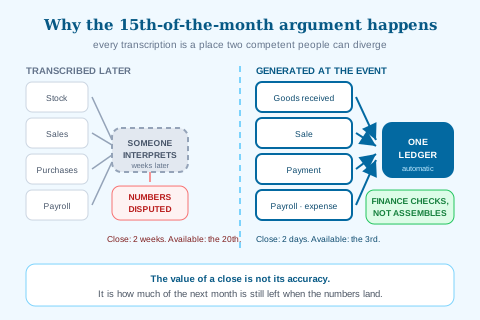
That gap is not an accounting failure. It is a structural one: stock lives in one system, sales in another, purchases in a third, and the accounts are assembled from all of them after the fact by a person interpreting descriptions. Every interpretation is a place the numbers can diverge, and there are hundreds of them a month.
What "integrated" actually has to mean
Integrated is the most over-claimed word in this category, so it is worth being concrete. It does not mean the systems exchange files nightly. It means a transaction is recorded once, by the person closest to it, and the accounting consequence is automatic rather than transcribed.
| Event | Recorded by | Accounting consequence that should be automatic |
|---|---|---|
| Goods received | Storekeeper, at the door | Stock value up, payable created, landed cost applied |
| Sale | Whoever serves the customer | Revenue, VAT, cost of sale, stock down, receivable created |
| Payment received | Whoever banks it | Receivable cleared against specific invoices, cash up |
| Stock adjustment | Whoever counted | Loss or gain recognised, with a reason and a name attached |
| Payroll run | HR or payroll | Cost allocated by department or project, statutory liabilities recognised |
| Expense claim | The employee | Cost coded to a project or cost centre, payable to the employee |
When that holds, the month-end close stops being a reconstruction project. Finance is checking and adjusting rather than assembling, which typically compresses a two-week close into a couple of days — and more importantly makes the figures available on the 3rd rather than the 20th, when they can still influence something.
Numbers produced on the 20th describe a month you can no longer affect. The value of a close is not its accuracy — it is how much of the next month is left when it lands.
The reconciliations that matter, and how often
Integration removes transcription errors. It does not remove the need to check, and three reconciliations do most of the work of keeping a Kenyan business honest with itself.
-
Bank, weekly
Not monthly. Weekly reconciliation catches an unrecorded payment or a duplicate while somebody still remembers the transaction — see bank reconciliation explained.
-
Cash and mobile money against system sales, daily
Per till, per shift, per branch, the same evening. This is the control that turns a discrepancy from an unanswerable question into a five-minute one — the retail daily close.
-
Stock, by cycle count
Continuously on a slice of the warehouse rather than annually on all of it. Book value against physical, with variances investigated while the trail is warm — cycle counting vs annual stocktake.
-
Statutory deductions against remittances, monthly
What payroll deducted against what was actually paid over, per obligation. A gap caught in one period is administrative; twelve periods later it is a liability.
-
Supplier statements against your payables, monthly
The mirror image of sending customers statements. It catches duplicate invoices and credits you were owed and never claimed.
Where Kenyan finance teams actually lose time
Not in the ledger. In four specific places, each of which is a records problem rather than an accounting one.
- Chasing what a cost was for. An expense coded to "general" three weeks ago now requires an archaeology exercise. Fixed by coding at entry — see expense claims and approvals.
- Reconstructing stock movements. Adjustments made without reasons, transfers recorded at one end only. Fixed by stock adjustments that require a reason and a name.
- Matching payments to invoices after the fact. Receipts applied to balances, so nobody can reconcile a statement. Fixed at the point of receipt.
- Assembling the same report every month by hand. Usually because the underlying data cannot be trusted without manual adjustment, which is a records problem masquerading as a reporting one.
None of those are solved by better accounting software. They are solved by operational records that arrive complete, which is the argument for the accounting sitting inside the operational system rather than downstream of it.
What we do and do not do
What AWRA OpsHub does today
- Accounting consequences generated from operational events — receipts, sales, payments, adjustments, payroll, expenses.
- eTIMS integration for Kenya, plus VAT-aware records with net, tax and gross separated per line.
- Receivables and payables with ageing, and payments matched to specific documents.
- Budget controls, with commitment visible at approval rather than at invoice.
- Landed cost folded into stock value, so margin is measured against real cost.
- Cost allocation by department, project, cost centre or grant across every module.
- Reporting from live records, including a report builder for your own views.
More we can add to your workspace
- Statutory consolidation with eliminations. Management consolidation ships today; intercompany elimination and a group statutory presentation on top of it is a build.
Where we point you to a specialist
- We do not file your returns. eTIMS transmission is integrated; VAT, corporation tax and other filings remain your accountant's work.
- We are not a substitute for an accountant. Treatment, judgement and statutory financial statements are theirs.
- We do not produce audited statements — we produce the records an auditor examines.
- We do not offer treasury, hedging or investment management.
Tax rates, thresholds and filing obligations are set by KRA and change. Confirm the treatment of anything specific with KRA or your accountant. This is not tax or accounting advice.
Anything above that you need, we can build for you
Everything listed above as something we can add describes what ships in the standard product today — it is a starting point, not a limit on what AWRA OpsHub can do for your organisation. Kenya's eTIMS integration and its maintained payroll engine are both in the product because clients needed them and commissioned them; neither appeared by itself, and the same door is open for whatever you just read about. One qualification so this is worth what it claims: a small number of things on this blog we deliberately leave to a specialist rather than build — a statutory ledger we will not sign our name to, a rule that would decide a tax question for you, a clinical or member-funds record that belongs in a regulated system — and where that is true the post says so in those words. Everything else is a scope, a timeline and a price.
The operational work, which is what most commissions actually are
An extra approval stage in a chain that does not match the standard one, a custom field set on employees or assets that only your sector needs, an expiry that has to block an order rather than send an email, a report your board asks for in a shape nothing produces, or a scanner or weighbridge feeding the goods-in door. These are the commissions we are asked for most often and the smallest ones we quote — and unlike a revenue-authority pipeline, none of them waits on a regulator.
The module-shaped additions, which are the ones readers ask for most often
A price list with real discount authority, a customer-facing quotation that expires, a bill of materials or recipe costing, a staff advance that is issued, acquitted and chased, a member or unit ledger, a matching rule that holds a payment. Each of these is a build rather than a setting, and each has been quoted before — a bigger piece of work than a custom field, with a written spec and a date instead of a roadmap slide.
The report, document or pack nothing currently produces
The board pack in the shape your board actually asks for, a donor or funder layout, an invoice or receipt template carrying what your regulator or your customer expects, a dataset the report builder cannot reach yet. Usually the fastest thing on this list to deliver, because the data is already in the system.
Systems, rails and hardware you already run
The accounting package, CRM, online store, core banking or custom database you intend to keep — connected through our API so a fact is entered once and appears everywhere it is needed. Plus the physical edge: a scanner, a scale, a weighbridge or a till peripheral feeding the door it belongs to.
How it works: you describe the requirement, we return a written scope, timeline and cost, and once agreed it is built into your environment and maintained as part of the product. Nothing here waits on a regulator or a published specification, which is why operational builds are the ones we quote fastest. Tell us the requirement that would otherwise rule us out — that is a better first conversation than a demo.
Tell us what your operation needsWhat to fix in what order
Finance teams asked to improve reporting usually start with the reports, which is the wrong end. The sequence that works runs from the records upward.
If your numbers are disputed
Fix the records first
Link sales to stock, require reasons on adjustments, code costs at entry. Reporting improves automatically because it stops needing manual correction.
If your close is slow
Fix the reconciliation rhythm
Bank weekly, cash daily, stock by cycle count. A close is slow mainly because everything is being reconciled at once at the end.
If you cannot see profitability
Fix cost allocation
Every cost coded to a project, branch or department at entry — see project cost allocation. Overhead is where profitability hides.
If cash is the worry
Fix the forecast
Receivables ageing and payables timing into a rolling forward view — cash flow forecasting.
Our take
Stop treating accounting as a downstream reporting function. Every accounting entry should be a by-product of an operational event recorded once by the person closest to it — and then the monthly argument about whose numbers are right simply stops happening, because there is only one set. That is worth more than any reporting feature.
See accounting that comes from operations
Receipts, sales, payments, adjustments, payroll and expenses each producing their accounting consequence automatically — with eTIMS, ageing, budgets and cost allocation on one ledger.
Explore AWRA AccountingFrequently asked questions
Do we still need an accountant?
Yes, and we would be suspicious of any vendor suggesting otherwise. What changes is what your accountant spends time on: reconstructing a quarter from bank statements, invoices and memory is expensive and adds no insight, while reviewing, adjusting and advising on records that arrived complete is where their judgement is actually worth paying for. Treatment decisions, statutory financial statements and filings remain theirs.
How does this differ from accounting software we already have?
Conventional accounting software is a destination — operational data is transcribed into it, usually later and usually by someone interpreting descriptions. Here the accounting entry is generated by the operational event itself: goods received creates the payable and the stock value, a sale creates revenue, VAT, cost of sale and the stock movement together. The difference shows up as a close that takes days instead of weeks, and numbers that operations does not dispute.
Does it handle eTIMS and VAT?
Kenya is the one country where we integrate with the fiscal e-invoicing regime directly — eTIMS — rather than reconciling against it, and records separate net, tax and gross on every sales and purchase line. What it does not do is file your VAT or corporation tax returns; that remains your accountant's work. Rates and rules are set by KRA and change, so confirm current requirements with them or your adviser.
How often should we reconcile the bank?
Weekly. Monthly reconciliation is a habit inherited from when statements arrived by post, and it means an unrecorded payment or a duplicate sits undiscovered for up to four weeks — by which point nobody remembers the transaction. Weekly reconciliation takes a fraction of the time per session because there is less to look at, and it is the difference between a question someone can answer and one they cannot.
Can it produce group consolidated accounts?
It does management consolidation across branches and entities, including across countries with local currencies, which is what most groups need for running the business. What it does not do is statutory consolidation with eliminations for formal group financial reporting — that involves judgement and treatment decisions that belong with your auditor. We would rather draw that line clearly than let you find it during a group audit.
