
A Grant Budgeted Net of Tax Is Short by the Tax
Where the consumption tax cannot be reclaimed, somebody has to pay it out of the grant. A budget line has a ceiling that good intentions do not raise, and the arithmetic is discovered late.
A restricted grant is a set of ceilings. Each budget line has a figure, the figure was agreed before the work started, and exceeding it is a variance to be explained rather than a cost to be absorbed. That structure is what makes grant management different from ordinary budgeting: the number is not a target, it is a limit, and it belongs to somebody else.
Into that structure comes a consumption tax that cannot be reclaimed. In South Sudan the standard sales tax rate is 18% and there is no input credit mechanism, so tax paid on a procurement is not recovered later — it is part of what the procurement cost. Which means it has to come out of a budget line.
If the line was budgeted net of tax, the line is short by the tax. That is the whole argument and the arithmetic takes ten seconds. What makes it worth a piece is that it is almost never discovered in the tenth second.
Why the assumption gets made
Not through carelessness. Three ordinary things line up.
-
The proposal was written by somebody who has worked in VAT jurisdictions
And in a VAT jurisdiction, budgeting net of tax is frequently correct, because the organisation reclaims it. The habit is right where it was learnt. It transfers to a country whose headline rate looks identical to its neighbours' and whose instrument is not the same.
-
The exemption question was asked and got an encouraging answer
Many organisations have agreements that bear on this, and the answer is often genuinely favourable for some taxes, for some activities, at some points in the chain. "We are exempt" then propagates through a budget as though it were unqualified, because the person repeating it is not the person who read the agreement.
-
The first invoices arrive after the budget is locked
Procurement happens months into the period. By the time somebody sees tax charged on a purchase order they expected to be clean, the budget has been signed, the donor has approved it, and the variance is now a reporting problem rather than a planning one.
Nobody guessed. A correct habit crossed a border, an exemption was repeated more broadly than it was granted, and the first contradicting invoice arrived after the document was signed.
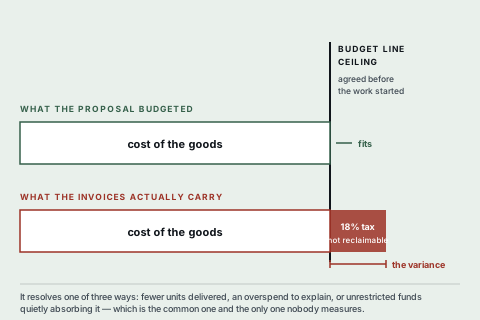
What the shortfall does downstream
| Consequence | How it shows up |
|---|---|
| Fewer units than were promised | The line buys what the line can buy. If the budget assumed a quantity net of tax, the quantity delivered is lower by roughly the tax — and the target in the proposal was written against the original quantity |
| A variance that looks like poor control | On a donor report an overspend against a line reads as weak budget discipline unless it can be attributed to something. "Tax we could not reclaim" is a complete explanation, but only if the tax was coded separately rather than buried in a supplier total |
| Cost silently shifted to unrestricted funds | The most common resolution, and the least visible. Core or unrestricted funds absorb the gap. That is a real subsidy from the organisation to the grant, it is rarely quantified, and it recurs on every grant with the same assumption |
| A recovery claim that cannot be evidenced | Where the agreement does allow the tax to be charged or reimbursed, doing so needs the tax identified per transaction with the document behind it. Where it was posted as part of the invoice total, the claim is arithmetic rather than evidence |
The question to ask internally, this week
Not "are we exempt". That question produces a summary of somebody's recollection. Ask the version that has a document behind it.
On our three largest current grants, was each budget line built gross or net of consumption tax — and which line is the tax being charged to today?
Two useful answers. If the budgets were gross, you are in good shape and the rest of this piece is a reassurance rather than a warning. If they were net, you now know the size of the gap before the donor report does, which is the only time that information is worth anything.
What we will not tell you
Whether your organisation is exempt, from what, and on which activities. That depends on your registration, your agreement and how your specific work is treated, and an unverified exemption printed on a software vendor's page is worse than silence because somebody will build a budget on it. What we will say without qualification is that every organisation formally present requires a TIN — the National Revenue Authority issues them through eTax to individuals, businesses and NGOs alike — and that payroll withholding applies to employees regardless of what the organisation itself pays. The rest is in a document your adviser has and we have not read.
The four things that make this manageable rather than annual
None of them are large, and none of them are about tax software. They are about where a number is recorded at the moment it is incurred.
- Tax identified separately on the transaction rather than absorbed into a supplier total, so it can be reported, claimed or explained without reconstruction.
- Every cost coded to grant, budget line, project and location at entry — because a per-grant total assembled at reporting time is a reconstruction, and a reconstruction cannot be audited.
- The budget line's ceiling visible at the point of commitment, so a requisition that will breach it is refused when it is raised rather than discovered when it is paid.
- The document attached to the disbursement, particularly for field spending settled in cash, where the receipt is the only evidence that will ever exist.
- A per-grant, per-period view that matches the donor's reporting shape rather than your financial year, because those two calendars are rarely the same and the difference is where reports go wrong.
The third item is the one that changes outcomes rather than reporting. A threshold that warns is a threshold that gets clicked through; a threshold that refuses turns a variance into a conversation before the money moves.
Two auditors, two questions, one record
A grant-funded organisation here answers to two different reviews and they want different things. The statutory side asks whether the returns filed with the National Revenue Authority are supported. The donor asks whether expenditure charged to a grant was within the budget, within the period, and evidenced.
Those questions are answerable from the same underlying detail, but only if the detail carries both dimensions from the start: the tax identified, and the grant and period coded. Retrofitting either one means going back through transactions with somebody's memory as the source, which is the expensive version of this work and the one that happens under deadline.
Where the boundary sits
Cost coded to grant, project, site and cost centre at entry
Coded when it is incurred rather than derived at reporting time, so a per-grant or per-period total for any window is a filter instead of an excavation.
Approvals that refuse rather than warn
Requisitions checked against a threshold that blocks above it, with the full trail of who authorised what and against which line. This is what turns a breach into a decision made in advance.
Documents against every disbursement
The receipt, the invoice and the supporting paperwork held against the transaction, previewable in place — which matters most for field spending settled in cash, where the document is the only evidence there is.
One register for money out
Transfers, cash and mobile disbursements captured in the same place rather than in three, so a grant's spending is one list.
Donor report formats
Not built. No pre-built template for any particular funder and no automatic mapping to a donor chart of accounts. We hold cost coded to grant and period; turning that into a specific funder's layout is work, and we have not done it for you in advance.
Any view on your exemptions
Not built and not offered. What you are exempt from is in your agreement and your registration. We hold the amounts and the documents and we will not interpret either.
The budgeting decision itself
Yours, and it is made before any of this matters. Whether a proposal is built gross or net of tax is a conversation with your donor, not a setting. What we can do is make sure the answer is visible in the records afterwards.
The short version: ask whether your three largest grants were budgeted gross or net, and ask which line the tax is landing on now. Both answers exist in records you already hold, and knowing them before the next report is the entire value of reading this.
What we can build for South Sudan on top of the standard product
Everything listed above as something we can add describes what ships in the standard product today — it is a starting point for South Sudan, not a limit on what AWRA OpsHub can do there. Kenya's eTIMS integration and its maintained payroll engine are in the product because Kenyan clients needed them and commissioned them; neither appeared by itself. The same door is open here. If an eTax filing connection, a South Sudanese payroll engine, a bank or mobile money feed, a statutory return format, a rule specific to how your operation runs, or a link to a system you already have is what stands between you and a decision, tell us and we will scope it as a build — written spec, timeline and price — before you commit to anything.
Filing output to eTax, and no opinion about what is recoverable
Return output against the National Revenue Authority's eTax platform, produced from live records with a reconciliation report rather than a black box. Worth being precise about what this is and is not: eTax is registration, filing and payment, not a requirement that each invoice be validated before it can be issued, so this is a filing pipeline rather than a fiscalisation one and the two are often confused. What we will not build at any price is a rule that decides whether a particular charge is creditable. The 18% here is a single-stage sales tax with no input credit, where the amount belongs is your adviser's call, and software that made that call for you would be selling a tax opinion.
Mobile money, bank feeds and multi-currency at the applied rate
Mobile money settlement files and bank statement feeds pulled into the Payments Register so collections match invoices without re-keying, alongside genuine multi-currency where the original amount and the rate actually applied stay on the transaction. That second half matters more here than the first: a purchase committed at one rate and settled at another leaves a difference that belongs to the order which caused it.
The operational work, which is what most commissions actually are
An extra approval stage in a chain that does not match the standard one, a custom field set on employees or assets that only your sector needs, an expiry that has to block an order rather than send an email, a report your board asks for in a shape nothing produces, or a scanner or weighbridge feeding the goods-in door. These are the commissions we are asked for most often and the smallest ones we quote — and unlike a revenue-authority pipeline, none of them waits on a regulator.
Payroll and statutory returns
Personal income tax and statutory contribution schedules produced in the layout each filing body expects, generated from live payroll records. Not built today — our maintained engine covers Kenya only, and a local payroll provider will be cheaper and correct.
Systems you already run
The accounting package, CRM, online store or custom database you intend to keep — connected through our API so a fact is entered once and appears everywhere it is needed.
How it works: you describe the requirement, we return a written scope, timeline and cost, and once agreed it is built into your environment and maintained as part of the product. No roadmap slide, and no pretending in a demo that something exists when it does not.
Tell us what you need integrated