
XOF, the Euro Peg & the Dollar: Multi-Currency Without the Usual Drama
Every multi-currency instinct imported from Lagos, Accra or Nairobi is wrong here, and wrong in an unusual direction: the exposure you are trained to watch does not exist, and the one that does exist looks harmless.
Almost everything written about currency risk in African business assumes a floating local currency that generally weakens. That describes most of the continent and it does not describe the CFA franc. The franc is fixed against the euro at a parity that has not moved in decades, and it floats against everything else only because the euro does.
The result is a currency situation that is genuinely simpler than the regional average, and a set of imported habits that are actively counterproductive. A finance manager arriving from Lagos will spend their first quarter guarding against an exposure that is not there, while a real one accumulates unremarked.
This post sorts out which is which. Nothing here is financial, tax or accounting advice, and none of it is a forecast — confirm treatment with your expert-comptable and your bank.
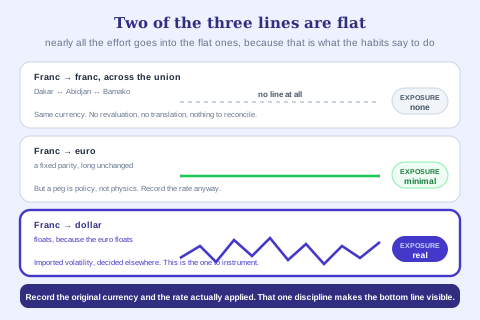
Three currencies, three completely different problems
A franc-zone business typically touches three currency relationships, and they behave nothing alike.
Franc to franc, across the union
- There is no exchange rate. Not a stable one — none. The same currency is legal tender in all eight member states.
- No revaluation of intercompany balances between member states, ever.
- No translation adjustment when you consolidate a Dakar entity with an Abidjan one.
- No argument about which rate applied on the day of an internal transfer, because no rate applied.
- Practical effect: the single hardest part of multi-country finance elsewhere on the continent simply does not arise. Budget none of your team's time for it.
Franc to euro
- A fixed parity, unchanged for a very long time, and the reason European trade here feels unlike European trade anywhere else in Africa.
- Euro-denominated purchases and sales carry effectively no revaluation risk while the arrangement holds.
- This makes euro pricing genuinely safe to quote and hold, which is a commercial advantage exporters elsewhere would pay for.
- But: a peg is policy, not physics. Reform of the zone has been publicly discussed for years. Treat stability as a current condition rather than a permanent property.
- Practical effect: relax about euro exposure, and still record the rate applied on every transaction so that history exists if the condition ever changes.
Franc to dollar
- Fully floating, because the euro floats against the dollar and the franc goes wherever the euro goes.
- Neither your treasury nor anyone in the region influences it. It is imported volatility, decided elsewhere.
- This is where the actual exposure sits — and it is systematically underestimated because it feels like someone else's problem.
- Dollar-priced inputs are common: equipment, some commodities, freight, software, and much internationally funded procurement.
- Practical effect: this is the relationship to instrument. If you track one thing, track this.
The exposure you were trained to watch does not exist here. The one that does exist arrives through the euro, from a market nobody in the zone participates in.
Worked example one: the exposure that is not there
A distribution group with entities in Dakar and Abidjan moves stock between them monthly and settles internally. The finance manager, recently arrived from a floating-currency market, sets up a monthly revaluation routine and a policy of settling intercompany balances quickly to limit exposure.
Intercompany between two franc-zone entities, one month
The revaluation routine ran for eleven months and produced zero every time, and the fast-settlement policy tied up working capital to hedge a risk that does not exist. Meanwhile the same group bought dollar-priced equipment twice that year with no rate recorded on either purchase. The effort was real. It was pointed at the wrong currency.
Worked example two: the exposure that is
The same group orders processing equipment priced in dollars, paid in two instalments five months apart. Nobody treats this as a currency decision, because the invoice arrives, the bank converts, and the francs leave the account. The exposure is real, it is material, and it is invisible unless somebody records it.
A dollar-priced purchase, francs paid, five months apart
Illustrative rates, not a forecast or a recommendation. The point is structural: nobody in this business will ever see that figure unless the original currency and the rate applied were recorded on each payment. If both payments are booked only in francs, the asset simply cost what it cost, and a number worth a junior salary disappears into the capital cost of a machine.
What the system does, and does not, do
Being precise here matters, because "multi-currency support" is one of the least meaningful phrases in enterprise software.
What AWRA OpsHub does today
- The CFA franc as a built-in base currency, resolved from the organization's country, in which everything is stored, invoiced, printed and reported.
- Transactions recorded in a foreign currency with the rate actually applied stored on the record — which is the single feature that makes the second worked example visible.
- An optional organization-wide display currency for dashboards and on-screen reports, giving an indicative conversion for a head office reading in euros or dollars.
- Supplier and customer records that keep their own trading currency, so a dollar supplier stays a dollar supplier without anyone remembering.
- Landed cost built up on a purchase from freight, duty and handling, so a dollar-priced import arrives in stock at what it genuinely cost rather than at its invoice line.
More we can add to your workspace
- A treasury system. Hedging, forward contracts, exposure limits and position management belong with a treasury function and probably a bank product, and we would point you there.
- Rate forecasting or any advice about which currency to hold. We record what happened; we express no view on what will happen.
- Multiple base currencies inside one organization. The base currency is locked, and the display currency is indicative only — it never appears on an invoice, statement, receipt or export.
- Automatic revaluation postings into a statutory ledger. Revaluation for statutory purposes is your expert-comptable's work, from records we provide.
- An assumption about the peg. We hold no special logic for fixed-rate currencies, which is deliberate — the day a fixed rate stops being fixed, a system that hardcoded it becomes the problem.
The last line is the design principle for this whole area: record what actually happened, at the rate that was actually applied, and hold no opinion about monetary policy.
What we can build for Senegal on top of the standard product
Everything listed above as something we can add describes what ships in the standard product today — it is a starting point for Senegal, not a limit on what AWRA OpsHub can do there. Kenya's eTIMS integration and its maintained payroll engine are in the product because Kenyan clients needed them and commissioned them; neither appeared by itself. The same door is open here. If DGID declarations, a bank or mobile money feed, a statutory return format, a rule specific to how your operation runs, or a link to a system you already have is what stands between you and a decision, tell us and we will scope it as a build — written spec, timeline and price — before you commit to anything.
DGID declarations and e-invoicing
Declaration output in the format the administration expects and electronic invoicing against any prescribed interface, with retries, a failure queue and a reconciliation report.
Wave, Orange Money and bank feeds
Mobile money settlement files and bank statement feeds pulled into the Payments Register, so collections match invoices without anyone re-keying a statement.
The operational work, which is what most commissions actually are
An extra approval stage in a chain that does not match the standard one, a custom field set on employees or assets that only your sector needs, an expiry that has to block an order rather than send an email, a report your board asks for in a shape nothing produces, or a scanner or weighbridge feeding the goods-in door. These are the commissions we are asked for most often and the smallest ones we quote — and unlike a revenue-authority pipeline, none of them waits on a regulator.
Payroll and statutory returns
IR, IPRES and CSS schedules produced in the layout your filing body expects, generated from live payroll records rather than rebuilt in a spreadsheet each month.
Systems you already run
The accounting package, CRM, online store or custom database you intend to keep — connected through our API so a fact is entered once and appears everywhere it is needed.
How it works: you describe the requirement, we return a written scope, timeline and cost, and once agreed it is built into your environment and maintained as part of the product. No roadmap slide, and no pretending in a demo that something exists when it does not.
Tell us what you need integratedWhat to do about it
-
Stop revaluing intra-zone balances
It produces zero every time and it trains the team to treat currency review as a ritual rather than a control. Reclaim the hours and put them on the dollar side.
-
Record the original currency on every foreign transaction
Not the franc amount your bank debited — the price you actually agreed, in the currency you agreed it in, with the rate applied. Without this the second worked example is unrecoverable.
-
Mark your dollar-exposed suppliers explicitly
Flag them on the supplier record so the exposure is a list you can pull rather than a fact three people happen to remember. Most businesses find this list is longer than they expected.
-
Watch the gap between commitment and payment
The exposure is not created by buying in dollars. It is created by the time between agreeing a price and settling it. Shortening that gap is usually cheaper than any instrument, and it is entirely within your control.
-
Build landed cost properly on dollar imports
A dollar invoice plus francs of freight, duty and handling is what the goods actually cost. If your stock valuation only carries the converted invoice line, your margins are wrong in a direction that always flatters you.
A one-hour exercise worth doing this quarter
Pull every purchase over the last twelve months that was priced in a currency other than francs. For each, find the rate that applied on the day the price was agreed and the rate that applied on the day it was paid. If you cannot find those rates, that is the finding — and it is more useful than the number would have been.
Where to go next
The wider structure of operating across several franc-zone countries is in one currency, eight tax authorities. Where currency meets stock valuation on the corridor, see distribution from Dakar and Abidjan. The accounting boundary — including who does revaluation for statutory purposes — is in OHADA, SYSCOHADA and your operations system.
Our take
Move your attention from where habit puts it to where the exposure actually is. Intra-zone currency risk does not exist and should consume none of your team's month. Euro exposure is minimal while the current arrangement holds, and worth recording anyway precisely because arrangements are policy rather than physics. Dollar exposure is real, imported, unremarked and routinely material — and it becomes visible the moment you record the original currency and the rate applied on every foreign transaction. That one discipline is worth more here than any amount of multi-currency functionality.
Curious what your dollar exposure actually was?
It is usually a short conversation and an uncomfortable number. We can show you how the records need to be shaped to produce it.
Talk to usFrequently asked questions
Do we need multi-currency features if we operate only in the franc zone?
For trade between member states, no — there is no exchange rate at all, so there is nothing to convert, revalue or translate. You need multi-currency capability for what crosses the zone boundary: euro and dollar purchases and sales. The distinction matters because businesses often buy and configure heavy multi-currency machinery for intra-zone trade where it produces zero every month, then fail to record the rate on the dollar purchases where it would have mattered.
Can AWRA hold more than one base currency for one organization?
No. Each organization has a single locked base currency, resolved from its country, in which all amounts are stored, invoiced, printed and accounted. There is an optional organization-wide display currency that gives an indicative conversion on dashboards and on-screen reports, but it is explicitly never used on invoices, statements, receipts, exports or any document. In the franc zone this constraint costs regional groups nothing, because one base currency genuinely covers all eight member states.
Does the system know the CFA franc is pegged to the euro?
No, deliberately. We hold no special logic for fixed-rate currencies. Foreign-currency transactions record the rate actually applied at the time, whatever that rate is. Hardcoding a parity would create a system that silently produces wrong numbers on the day the arrangement changed, and monetary arrangements are policy rather than permanent properties. Recording what actually happened is both simpler and safer.
Do you provide exchange rates?
Rates are available for indicative display conversion, and foreign-currency transactions store the rate applied to them. What we do not do is act as a rate authority for accounting purposes, provide forecasts, or express any view on which currency to hold or when to settle. For statutory revaluation and the rates used for it, work with your expert-comptable — that is their domain and their professional responsibility, not ours.
How should we handle dollar-priced imports?
Record the purchase in dollars with the rate actually applied, rather than entering only the franc amount your bank debited, so the two rates in a deposit-and-balance arrangement remain visible afterwards. Then build landed cost properly — freight, duty and handling on top of the converted invoice — so the goods enter stock at what they genuinely cost. Businesses that skip the second step carry stock at below its true cost and consistently overstate margin.
Does AWRA do hedging or treasury management?
No. There is no hedging, no forward contracts, no exposure limits and no position management. We are an operations system that records transactions accurately, including their original currency and applied rate, which gives you the raw material for a treasury conversation with your bank or adviser. The conversation itself, and any instrument that comes out of it, is not something we provide or advise on.
