
Distribution from Dakar and Abidjan: Stock That Lives on a Corridor
Ports on the coast, customers a thousand kilometres inland, and a truck that is not a rounding error. Corridor distribution asks one question your stock report is quietly refusing to answer.
Dakar and Abidjan are not just cities with warehouses in them. They are the sea entrances for a landlocked interior, and a great deal of what lands there is destined for Bamako, Ouagadougou or somewhere further still. That geography produces a distribution business with a specific shape: long legs, few of them, high value per movement, and multi-day gaps between dispatch and arrival.
Systems designed for urban distribution handle this badly, and they fail in a particular way. They assume the interval between "it left" and "it arrived" is short enough to ignore. On a corridor it is not short. It is three days, or six, and during that window a substantial share of your inventory exists in a state your stock report has no word for.
The question nobody can answer on a Tuesday
Here is the diagnostic. Walk into your operation on an ordinary Tuesday afternoon and ask one question: how much stock do we own right now that is neither in a warehouse nor delivered to a customer?
In most corridor businesses this produces a pause, then a phone call, then an estimate. The estimate is usually low, because it is assembled from what people happen to remember dispatching, and there is no report behind it. Which means the answer to "what do we own" is currently a matter of recollection.
That gap is not a reporting inconvenience. It is where shrinkage hides, where a customer's order gets promised twice, and where a monthly stock count turns into an argument.
On a corridor, in-transit stock is not an edge case. It is routinely the second-largest location you own, and the only one with no shelf.
Three ways to model the road
There are only three real options, and most businesses have chosen the first without ever deciding to.
Option one
It stays at origin until someone confirms arrival
The default in most systems and the source of most of the trouble. The Dakar warehouse shows stock it does not physically hold, sometimes for a week. Anyone allocating from that figure is allocating goods already on a truck to Bamako. Counts at origin never agree, and the discrepancy is explained away monthly by the same person.
Option two
It leaves at dispatch and appears at receipt
Better in one respect and worse in another. Origin is now accurate, but for three to six days the stock exists nowhere at all. Group stock is understated, insurance questions have no answer, and a loss in transit is discovered as a difference rather than as an event. This is the option that quietly loses goods.
Option three
The corridor is a location and the truck is in it
Stock leaves origin at loading, occupies a named in-transit location for the days it is genuinely there, and arrives on receipt and count. Every location is accurate at all times, group stock always reconciles, and the quantity on the road is a number on a report. This is the only one that survives a serious stock count.
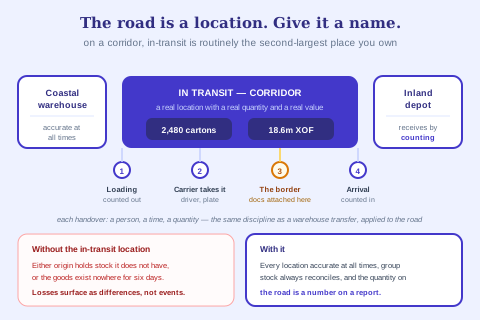
Custody is a chain, and the border is a link in it
The in-transit location fixes the accounting shape of the problem. It does not, by itself, tell you who is responsible for the goods at any given moment, and on an international corridor that question has several answers in sequence.
Between loading and arrival, custody typically passes from your warehouse team to a driver, sometimes to a transporter who is not your employee, through a border process where the goods are neither moving nor in anyone's useful control, possibly to a second transporter, and finally to a receiving team. Each of those handovers is a point where a loss can occur and where, later, nobody can say on whose watch it happened.
The fix is not sophisticated. It is that each handover produces a record with a person, a time and a quantity — the same discipline as a warehouse transfer, applied to the road.
-
Loading, at origin
Quantity dispatched, confirmed by a named person, against the transfer document. This is the last moment the goods are unambiguously yours and countable. If this record is weak, nothing downstream can be investigated.
-
Departure and carrier acceptance
Who took the goods — the driver, the transporter, the plate. If the carrier is external, this is a change of custody and not merely a change of place, and the distinction matters when a claim is made.
-
The border
A crossing generates documents and a delay of unpredictable length. Record that it happened and attach the paperwork to the movement. We do not produce customs documentation, but the movement record is the correct place for it to live so that it is findable in eight months.
-
Any transfer between carriers
Often invisible in the system and disproportionately where problems begin. If goods change vehicle or operator mid-corridor, that is a custody event and should look like one.
-
Arrival and count
Received quantity against dispatched quantity, counted rather than assumed, by someone other than the driver. A receipt that simply confirms the dispatch note is not a control, it is a formality.
-
The variance, if there is one
Recorded as a variance against that specific movement, not absorbed into the next stock count. A shortage tied to a movement, a carrier and a date can be investigated. A shortage discovered at month end cannot.
A worked case: the shortage nobody could place
A distributor moving consumer goods inland from the coast runs four corridor movements a month. Stock is relieved at origin on dispatch and added at destination on receipt, with no in-transit location. Receipts are entered from the driver's delivery note.
One month, four corridor movements, no in-transit location
The receipts were entered from the delivery note rather than from a count, so each movement matched perfectly and the loss surfaced only at the monthly count — by which point it could not be attached to a movement, a date or a carrier. The system was not wrong. It recorded exactly what it was told. Counting at receipt, against a movement, would have located this inside three days and made it somebody's conversation with a specific transporter.
The upcountry depot problem
The other half of corridor distribution is what happens at the far end. An inland depot is not a small warehouse. It is a location with intermittent connectivity, staff who are not finance people, no supervisor on site most days, and a strong practical incentive to keep goods moving rather than to keep records tidy.
Software evaluated exclusively at head office consistently fails here, because head office has good connectivity, trained users and someone to ask. The honest test of any distribution system is the worst site, not the best one.
Take these to the depot, not to the demo room
- Can a depot user receive a transfer and count it without being able to see or change anything else? Restricted access is what makes depot data trustworthy.
- What happens mid-capture when the connection drops? Ask specifically, and treat a vague answer as a no — it means nobody tested it.
- Can a receipt be entered as a count rather than a confirmation of the dispatch note? If the system pre-fills the dispatched quantity and invites a tap, you will never detect a shortage.
- Can the depot see what is currently on the road toward it? This is the single most useful screen a depot manager can have, and it removes most of the phone calls.
- Does a photo attach to a receipt? Damaged goods argued about six weeks later are settled instantly by a photograph taken at the tailgate.
- Can somebody at head office see depot stock without telephoning the depot? If not, the depot is not in your system, it is merely reporting to it.
The pre-filled receipt is the most expensive default in distribution software
When a receipt screen pre-fills the dispatched quantity, receiving becomes confirming and counting stops happening entirely. Every shortage then migrates to the monthly count, where it can no longer be attributed to a movement or a carrier. Check this specific behaviour in every system you evaluate, including ours, and prefer one that makes the receiver enter the number.
What we handle here
Concretely, for a corridor distributor: multi-location stock with in-transit locations, so the road is a place with a quantity and a value. Transfers with dispatch, receipt and variance against the movement. Documents attached to the movement, which is where customs paperwork should live even though we do not produce it. Batch and lot handling where it matters. Restricted depot access. Landed cost on imports so goods enter stock at what they genuinely cost rather than at their invoice line. And an audit trail showing who dispatched, who received and what the record said before it was changed.
What we do not do: customs documentation, transit declarations, rules of origin, clearing, or anything a freight forwarder does. We record that the crossing happened and hold the evidence. We also do not do route optimisation or fleet telematics — if you need to know where the truck is right now, that is a different product and we integrate with none of them.
Where to go next
The multi-country structure behind a regional corridor operation is in one currency, eight tax authorities. Landed cost on dollar-priced imports is covered in XOF, the euro peg and the dollar. Country-level buying advice is in the Côte d'Ivoire buyer's guide and the Senegal buyer's guide.
Our take
Make the road a location and make receipt a count. Those two changes fix most of what is wrong with corridor distribution, and neither requires new software to appreciate — you can test both against whatever you run today. Then judge every candidate system on your worst depot rather than your head office, and check the receipt screen specifically for a pre-filled quantity. A distributor who can state, on any Tuesday, exactly how much stock is on the road and which movement it belongs to has solved the thing that makes this business hard.
Test us on your longest leg
Bring the corridor with the most crossings, the most carriers and the worst connectivity at the far end. That is the honest demo.
Explore AWRA for distributionFrequently asked questions
How does AWRA handle stock in transit between countries?
As a location. Stock leaves the origin warehouse when it is loaded, occupies a named in-transit location for the days it is genuinely on the road, and arrives at the destination when it is received and counted. That means origin and destination are accurate at all times, group stock always reconciles, and the quantity currently on the corridor is a figure on a report rather than something reconstructed from memory. Any variance is recorded against the specific movement rather than absorbed into a later count.
Do you produce customs or transit documentation?
No. We do not produce customs declarations, transit documents, certificates of origin or anything else a clearing agent or freight forwarder handles, and we do not integrate with customs systems in any franc-zone country. What we do is record that a crossing occurred as part of the movement and hold the associated paperwork attached to that movement, so it is findable months later when someone asks. The documents themselves come from your agent.
Can an upcountry depot with poor connectivity use this?
This is the right question to press every vendor on, including us, and the answer should be tested at the depot rather than in a demo room. What matters is whether a depot user can be given genuinely restricted access, what the system does mid-capture when a connection drops, whether receipts can be entered as counts rather than as confirmations of a dispatch note, and whether a photo can be attached at the tailgate. Judge the system on the worst site you run.
Why does receiving against a count matter so much?
Because a receipt that pre-fills the dispatched quantity turns receiving into confirming, and no shortage is ever detected at the point where it could still be investigated. It then surfaces weeks later at a physical count, by which time it cannot be attached to a movement, a date or a carrier. The difference between counting and confirming is the difference between a shortage that becomes a conversation with a specific transporter and a shortage that becomes a monthly write-off nobody can explain.
Do you track vehicles or optimise routes?
No. There is no fleet telematics, no GPS tracking, no route planning and no integration with tracking providers. We are a records system, not a logistics platform — we can tell you what is on the road, what it is worth, which movement it belongs to and who accepted custody of it, but not where the truck is at this moment. If live vehicle position is what you need, that is a separate product and you should buy it separately.
Does landed cost work for goods imported through the port?
Yes, and it matters more here than most places. Freight, duty, handling and other charges can be built onto a purchase so that goods enter stock at what they genuinely cost rather than at the invoice line alone. For imports priced in dollars, combine that with recording the original currency and applied rate on the purchase — otherwise the stock value understates the true cost and every margin calculated from it flatters you in the same direction.
