
ERP Software in Côte d'Ivoire: A Practical Buyer's Guide (2026)
Abidjan carries more multi-site industry than anywhere else in the franc zone, and the shortlist is usually one French-language incumbent against one English-language platform. That trade has a real price. Here it is, without the marketing.
Côte d'Ivoire is the industrial weight of the West African monetary union, and it shows in the software conversations. Where a Dakar buyer is often a services business or a regional office, an Abidjan buyer is frequently a processor, a distributor with depots upcountry, an exporter with foreign customers who audit them, or a group with several sites and a genuine consolidation problem. The operational complexity is higher, which changes what is worth paying for.
It also produces a characteristic shortlist: a French-language product from a local or regional integrator, against an English-language international platform. Buyers usually treat this as a feature comparison. It is not. It is a decision about who does what, in which language, and who is accountable when something is wrong.
Nothing here is tax, accounting or legal advice. Confirm all obligations with the Direction Générale des Impôts, your expert-comptable or your own adviser.
The axis you are actually moving along
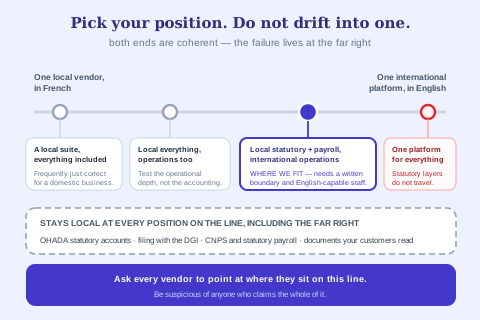
Rather than a feature grid, here is the real spectrum, with what you gain and give up at each position. Decide deliberately where you want to sit before anyone demos anything.
Local French-language suite to international English-language platform
A local suite, everything included
Statutory accounts, payroll and operations from one Ivorian or regional vendor, in French, with support in your timezone. For a domestic business with moderate operational complexity this is frequently just correct, and we will tell you so.
Local statutory and payroll, local operations too
The same, but scrutinise the operations depth specifically. Multi-site stock, in-transit visibility, three-way matching and asset custody are where local suites vary most. Make them demonstrate the operational side on your actual scenario, not the accounting side they lead with.
Local statutory and payroll, international operations
Your expert-comptable or a local package keeps the OHADA books, a local provider runs payroll, and an international system runs stock, procurement, assets, projects and cost. Where we fit. Needs a written boundary and a team genuinely comfortable in English.
One international platform for everything
The position most likely to end badly. Statutory accounting and payroll under OHADA and Ivorian law do not travel, whatever a global price list suggests. Groups arrive here by inertia and discover the gap at year end.
Both ends of this axis are coherent. The failure lives at the far right, where a buyer selects an international platform believing the statutory layer came with it. Ask every vendor to point at where they sit on this line, and be suspicious of anyone who claims the whole of it.
What Abidjan operations actually demand
The operational requirements here are heavier than elsewhere in the zone, and they are worth naming because they are what should drive the evaluation.
Multiple sites that are genuinely different. A plant, a central warehouse, depots upcountry, and often a retail or wholesale front. These are not copies of each other, and a system that treats a depot as a smaller version of the warehouse will produce stock figures nobody trusts within two quarters.
Corridors to landlocked neighbours. Abidjan serves Burkina Faso and Mali, and that traffic is days on the road. Stock in transit is a real position with real value, not a rounding difference.
Export customers who audit you. Exporters here are frequently subject to customer audits, and the demand is traceability — which inputs went into which output, and, harder, which outputs contain a given input. That is an operational records question that no accounting package answers.
Procurement volume with real exposure. More suppliers, larger orders and more people able to commit money. Approval chains and three-way matching stop being nice-to-haves at this scale.
Group structure. Several entities, sometimes across borders, needing a consolidated operational view while each keeps its own statutory books.
Our status, layer by layer
The same graded frame we apply across this series, scored for Côte d'Ivoire. Apply it to every vendor on your shortlist, local or international — the value is in the grading, not in our answers.
Côte d'Ivoire: which parts are actually covered?
The CFA franc
Resolved automatically as the base currency from the organization's country, and everything is stored, invoiced and printed in it. Within the monetary union there is no exchange rate to manage at all.
An Ivorian VAT rate and VAT-aware records
Ships as a maintained preset, with net, tax and gross separated line by line on purchases as well as sales at the point of capture rather than derived at reporting time.
Additional tax components
Further lines can be configured with their own rates, effective dates and inclusive or exclusive treatment. Configurable means yours to maintain — we ship one maintained preset per country, not a maintained rate history.
Multi-site operations and traceability
Locations, transfers, in-transit positions, lot and batch handling, and consumption recorded against a production job. This is the layer Abidjan buyers should be evaluating us on.
Foreign-currency trade
Transactions in euros or dollars record the rate actually applied on the record, which matters for exporters even though intra-zone trade has no rate at all.
OHADA statutory accounts
Our chart of accounts has no account-number field. Not a partial implementation — no code column exists. A statutory presentation is impossible by construction, deliberately.
Ivorian statutory payroll
CNPS, the tax scale and sector collective agreements are not maintained calculations here. Employee records, leave, attendance and payroll cost posting all work; the statutory computation does not.
Filing with the DGI
We integrate with nothing and submit nothing. Our only fiscal e-invoicing integration anywhere is Kenya's eTIMS, it is Kenya-only, and it does not travel.
A French interface
English only. No translation files exist in the product and no setting enables one. Printed documents are in English. For many Ivorian businesses this decides the matter, and it should decide it early.
Four of the nine are marked against us. If the first four matter most to your operation, we are a serious candidate. If any of the last four are your central problem, buy locally for that layer and possibly for all of them.
The vocabulary problem, and why it is not trivial
When an English-language system meets a French-language business, the friction is rarely conceptual. Your team knows what a purchase order is. The friction is that the document has a name, a legal weight and a customary format here, and the system prints a different word.
The same control, under two names
What your business calls it What the screen says
Bon de commande Purchase order
Identical control, identical position in the chain. The system will produce it correctly and print it with the English label — which your supplier will still understand, but which looks foreign on a document that normally does not.
Bon de livraison Delivery note / goods received note
Here the mapping needs care: one French document often covers both the note that travels with goods and the record of receipt. Decide which of your two system records is the one your driver carries, and be consistent from day one.
Facture Invoice
Straightforward as a concept, and the single most consequential document to get right, because it leaves your building and goes to a customer and possibly to the administration. This is the item to test in a demo, printed, in front of you.
Avoir Credit note
Same instrument. Confirm the vendor supports it as a linked reversal against the original invoice rather than as a negative invoice typed by hand — the difference matters when someone reconciles a customer account.
Devis Quotation
Same document. Worth checking that it converts into an order without re-keying, since re-keying is where prices and quantities silently diverge.
Expert-comptable External accountant
Not a translation issue but the most important word here. They are the statutory holder in the arrangement we recommend, and any vendor without a clear view of their role has not implemented in this market.
None of these are hard to learn. The point is that they are all documents that leave the building, and the language on them is a commercial matter rather than a preference. Test each one printed, in the demo, before you sign.
A scorecard weighted for Ivorian operations
Evaluating an operations system in Côte d'Ivoire
Weighted for multi-site industry and distribution. Score us on it too — we expect to lose points on the last two rows.
Documents printed in French, demonstrated live
Make them prove it: Generate an invoice, a delivery note and a credit note during the demo. Look at them.
A stated position on the OHADA statutory boundary
Make them prove it: Ask what they expect your expert-comptable to do, and ask to see account numbers in their chart of accounts.
Multi-site stock that treats sites as genuinely different
Make them prove it: Model your actual site structure in their demo, including a depot with no permanent finance staff.
Stock in transit as a visible position
Make them prove it: Ask for a report showing quantity and value currently on the road between two locations.
Traceability in both directions
Make them prove it: Ask which finished batches contain a given input lot — not just which inputs went into a given batch. The second question is the hard one.
Three-way matching that blocks rather than warns
Make them prove it: Try to pay an unmatched invoice and see whether it is prevented or merely flagged.
Approval chains that survive an absent approver
Make them prove it: Ask what happens when the person who must approve is on leave. Listen for delegation with an audit trail, not a shared password.
Consolidated operational view across entities
Make them prove it: Filter one report by entity and by country, live, without an export.
Works on a depot connection
Make them prove it: Ask what happens mid-capture when the connection drops upcountry.
Named local implementation capacity
Make them prove it: Ask who will actually be in the room during rollout and in what language.
Where to go next
The statutory boundary in detail is in OHADA, SYSCOHADA and your operations system. Corridor and depot logistics are in distribution from Dakar and Abidjan. Exporters dealing in euros and dollars should read XOF, the euro peg and the dollar. The language decision is unpacked in a French-language business buying English-language software, and the regional structure in one currency, eight tax authorities.
Our take
Pick your position on the axis deliberately. If your operation is domestic, moderately complex and works entirely in French, a good local suite is likely the better purchase and we will say so early. If you are multi-site, running corridors, exporting to customers who audit you, or part of a group with an operations standard — and you can genuinely staff the system in English — then the split is the strongest arrangement available: statutory books and payroll local and accountable, operations on a platform built for the operational problem. What nobody in Abidjan should buy is an international platform sold as covering a statutory layer that no international platform covers.
What we can build for the CFA franc zone on top of the standard product
Everything listed above as something we can add describes what ships in the standard product today — it is a starting point for the CFA franc zone, not a limit on what AWRA OpsHub can do there. Kenya's eTIMS integration and its maintained payroll engine are in the product because Kenyan clients needed them and commissioned them; neither appeared by itself. The same door is open here. If a national e-invoicing pipeline, a French interface, a bank or mobile money feed, a statutory return format, a rule specific to how your operation runs, or a link to a system you already have is what stands between you and a decision, tell us and we will scope it as a build — written spec, timeline and price — before you commit to anything.
National tax pipelines and a clean handoff to your ledger
Electronic invoicing against your administration's published interface, and a defined monthly export mapped to your expert-comptable's chart of accounts — with retries, a failure queue and a reconciliation report rather than a black box. The statutory ledger itself stays with them, by design; what we build is the pipe to it.
Mobile money, banks and French interface
Wave, Orange Money and bank statement feeds into the Payments Register, plus French interface text and document templates.
The operational work, which is what most commissions actually are
An extra approval stage in a chain that does not match the standard one, a custom field set on employees or assets that only your sector needs, an expiry that has to block an order rather than send an email, a report your board asks for in a shape nothing produces, or a scanner or weighbridge feeding the goods-in door. These are the commissions we are asked for most often and the smallest ones we quote — and unlike a revenue-authority pipeline, none of them waits on a regulator.
Payroll and statutory returns
National income tax and social security schedules produced in the layout your filing body expects, generated from live payroll records rather than rebuilt each month.
Systems you already run
The accounting package, CRM, online store or custom database you intend to keep — connected through our API so a fact is entered once and appears everywhere it is needed.
How it works: you describe the requirement, we return a written scope, timeline and cost, and once agreed it is built into your environment and maintained as part of the product. No roadmap slide, and no pretending in a demo that something exists when it does not.
Tell us what you need integratedBring us your hardest site
Not the head office — the depot upcountry with the bad connection and no finance staff. That is the honest test, and we would rather run it before you sign.
Explore AWRA for Côte d'IvoireFrequently asked questions
Does AWRA produce OHADA statutory accounts in Côte d'Ivoire?
No. Our chart of accounts has no account-number field at all, so a numbered SYSCOHADA plan cannot be represented and a statutory presentation cannot be produced. This is a deliberate design decision rather than an unbuilt feature, explained fully in our OHADA post. Your statutory books belong with a local accounting package or your expert-comptable, working from the governed operational records we hold. Confirm obligations with them or the DGI.
Does it support the CFA franc and Ivorian VAT?
Yes, both as built-in presets. The CFA franc is resolved automatically as the base currency from the organization's country and everything is stored, invoiced and printed in it, with no exchange rate anywhere inside the monetary union. An Ivorian value added tax rate ships as a maintained preset, with net, tax and gross separated line by line on purchases as well as sales. Additional lines are configurable but yours to keep current; confirm current rates with the DGI or your adviser.
Is the interface available in French?
No. English only, with no translation files in the product and no setting to enable one, so this is not a roadmap answer in disguise. Printed documents — invoices, delivery notes, purchase orders, credit notes — are produced in English. For many Ivorian businesses this is decisive and we raise it in the first conversation. Our post on running English-language software in a French-language business separates the workarounds that genuinely hold from the ones that only appear to.
Can it handle traceability for our export customers?
This is the layer we would most like to be judged on. Lot and batch handling, consumption recorded against a production job at the time it happens, and both directions of trace — from a finished batch back to its input lots, and from an input lot forward to every batch and customer that received it. Forward trace is the harder one and the one customer audits actually test, and it only works if consumption was recorded at the time rather than reconstructed. We are not a quality management system and not a manufacturing execution system.
Do you run Ivorian payroll?
Not as turnkey statutory payroll. CNPS, the tax scale and sector collective agreements are not maintained calculations that we update when rules change — Kenya is our only market where that is true. Employee records, contracts, leave, attendance and posting payroll cost into operational records and project costing all work. The statutory computation and declarations belong with an Ivorian payroll provider or your expert-comptable, and our payroll post says so bluntly.
We have depots in Bouaké and Korhogo with poor connectivity. Does that work?
Bring that scenario to the demo specifically, because it is the honest test and head-office demos hide it. What matters is what happens mid-capture when a connection drops, whether a depot without permanent finance staff can be given genuinely restricted access, and whether stock moving between sites occupies an in-transit position rather than vanishing from one report and appearing later in another. Judge every vendor, including us, on the worst site rather than the best one.
When is a local vendor the better choice?
When your operation is domestic, works entirely in French, and your complexity sits in accounting and payroll rather than in stock, procurement and multi-site operations. In that case a good Ivorian or regional suite gives you one accountable vendor, French documentation and support in your language, and the split we recommend would add coordination cost for no operational gain. We say this on first calls regularly and would rather say it than sell into a poor fit.
