
ERP Software in Senegal: A Practical Buyer's Guide (2026)
Most Dakar buyers are shopping for three different products at once and calling all of them "un ERP". Separating them takes twenty minutes and usually changes the shortlist entirely.
A conversation with a Senegalese business about software almost always begins in the same place: the current arrangement is Excel, a local accounting package, a payroll provider and a great deal of WhatsApp, and everyone agrees this cannot continue. The word used for the solution is "un ERP". The trouble is that three completely different purchases are hiding inside that phrase, and buying the wrong one is the most common expensive mistake in this market.
This guide separates them, then tells you honestly which of the three we are — and, just as importantly, which two we are not.
Nothing here is tax, accounting or legal advice. Confirm obligations with the Direction Générale des Impôts et des Domaines, your expert-comptable or your own adviser.
The three purchases
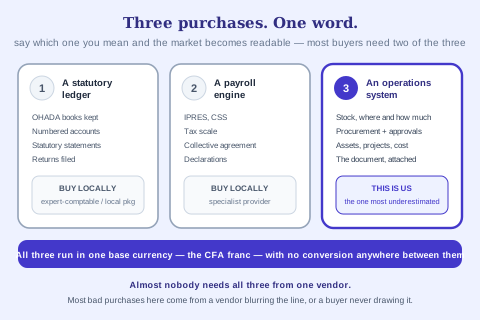
Before any demo, work out which of these you actually need. Most businesses need two of the three, and almost nobody needs all three from one vendor.
Purchase one
A statutory ledger
You need OHADA books kept, statutory accounts produced and returns filed. This is a numbered chart of accounts, a prescribed presentation and professional accountability. Buy this locally — from a Senegalese accounting package, from your expert-comptable, or both. No foreign operations platform does this, whatever the demo implies.
Purchase two
A payroll engine
You need net pay calculated correctly against IPRES, CSS, the tax scale and whichever collective agreement covers your sector, with declarations produced. Buy this locally too. A specialist Senegalese payroll provider or your expert-comptable will be right and will stay right when a rule changes.
Purchase three
An operations system
You need to know what stock you hold and where, which purchases were approved and by whom, what a project cost, which assets exist, and what a customer actually owes — with the document attached to every one of those answers. This is us. It is also the purchase most businesses underestimate and most vendors bundle away into a footnote.
Two of the three are local by nature. The third is not. Almost every disappointing purchase in this market comes from a vendor blurring that line, or a buyer never drawing it.
Why Dakar is its own kind of buyer
A few features of the Senegalese market shape what is worth buying, and they are not the ones a generic guide would list.
The professional accounting relationship is strong. Most established businesses already have an expert-comptable, and that relationship is not a stopgap awaiting software. It is the correct place for the statutory layer to live, and a vendor who treats it as an obstacle to be replaced has misread the market.
Dakar is a regional headquarters. A great many organizations here — commercial groups, NGOs, programme offices — run operations in Mali, Burkina Faso, Guinea, Mauritania or further afield from a Dakar office. That means the operations layer often has to be genuinely multi-country while the statutory layer stays resolutely national.
The port serves a landlocked hinterland. Cargo landing in Dakar for Bamako spends days on the corridor. Businesses whose stock lives on a road for a week have an inventory problem that no accounting package addresses, and it is frequently the real reason they started looking.
The working language is French. This is the objection that ends many conversations, including with us, and it is dealt with plainly further down rather than buried.
What is genuinely built for Senegal
Specifics, not adjectives. Everything in the left column below was checked in the product rather than recalled from a sales deck.
What AWRA OpsHub does today
- The CFA franc as a built-in base currency, resolved automatically from the organization's country. No configuration, no conversion, and no exchange rate anywhere inside the monetary union.
- A Senegalese value added tax rate as a maintained preset, with net, tax and gross separated line by line on purchases as well as sales at the point of capture.
- Additional tax lines configurable with their own rates, effective dates and inclusive or exclusive treatment — configurable meaning yours to keep current.
- Multi-location stock with transfers and in-transit positions, which is what a Dakar-to-Bamako corridor actually needs.
- Procurement with requisition, approval chain, purchase order, goods receipt and three-way matching, documents attached to the transaction.
- Assets with named custody, condition, location history, verification dates and recorded retirement — the part NGOs and programme offices usually need first. Purchase date and cost are held; the depreciation schedule itself is not, and belongs in your accounting workpapers.
- Project and cost-centre attribution captured as work happens, and an audit trail showing who captured, approved or changed each record.
More we can add to your workspace
- OHADA statutory accounts. Our chart of accounts carries no account-number field, and that is a design decision rather than an oversight — the full reasoning is in the OHADA guide linked below.
- A filing with the DGID. We submit nothing and integrate with nothing there.
- Fiscal electronic invoicing. Our only such integration is Kenya's eTIMS, and it is Kenya-only. Confirm Senegal's current position with the DGID or your adviser; where an obligation applies you will need a compliant solution elsewhere.
- Turnkey Senegalese payroll. IPRES, CSS, the tax scale and sector collective agreements are not maintained calculations in our product.
- A French interface, with translation files and printed documents to match. The system is in English today.
- Customs, transit documents and clearing for the corridor. We record the crossing and hold the paperwork today; producing it is a licensed agent's work.
The last two entries on the right rule us out for a meaningful share of Senegalese businesses. We would rather that surfaced in your first call than in your third month.
What we can build for Senegal on top of the standard product
Everything listed above as something we can add describes what ships in the standard product today — it is a starting point for Senegal, not a limit on what AWRA OpsHub can do there. Kenya's eTIMS integration and its maintained payroll engine are in the product because Kenyan clients needed them and commissioned them; neither appeared by itself. The same door is open here. If DGID declarations, a bank or mobile money feed, a statutory return format, a rule specific to how your operation runs, or a link to a system you already have is what stands between you and a decision, tell us and we will scope it as a build — written spec, timeline and price — before you commit to anything.
DGID declarations and e-invoicing
Declaration output in the format the administration expects and electronic invoicing against any prescribed interface, with retries, a failure queue and a reconciliation report.
Wave, Orange Money and bank feeds
Mobile money settlement files and bank statement feeds pulled into the Payments Register, so collections match invoices without anyone re-keying a statement.
The operational work, which is what most commissions actually are
An extra approval stage in a chain that does not match the standard one, a custom field set on employees or assets that only your sector needs, an expiry that has to block an order rather than send an email, a report your board asks for in a shape nothing produces, or a scanner or weighbridge feeding the goods-in door. These are the commissions we are asked for most often and the smallest ones we quote — and unlike a revenue-authority pipeline, none of them waits on a regulator.
Payroll and statutory returns
IR, IPRES and CSS schedules produced in the layout your filing body expects, generated from live payroll records rather than rebuilt in a spreadsheet each month.
Systems you already run
The accounting package, CRM, online store or custom database you intend to keep — connected through our API so a fact is entered once and appears everywhere it is needed.
How it works: you describe the requirement, we return a written scope, timeline and cost, and once agreed it is built into your environment and maintained as part of the product. No roadmap slide, and no pretending in a demo that something exists when it does not.
Tell us what you need integratedThe language question, answered directly
Our interface is English. Not partially, not pending translation — there are no language files in the product at all. Every screen, every field label, every printed invoice and purchase order is in English.
For a Senegalese business this is a serious objection and deserves a serious answer rather than a deflection. The honest version has two parts. Inside the building it is a staffing question: which of your roles can you reliably fill with someone comfortable working in English, this year and after the next resignation. Outside the building it is a document question: your customers, suppliers and the administration expect French, and an English delivery note is not a small inconvenience.
Some organizations clear both — group subsidiaries, NGOs with international reporting, exporters, businesses whose operational team is small and bilingual. Many do not, and for those the standard product as it ships is the wrong purchase. The distinction matters because the remedy is known rather than hypothetical: French interface text and document templates are the single most-asked-for build in the franc zone, and we will scope and price it in writing. What we will not do is hand you a machine translation and call the market covered. We have written that out at length in a French-language business buying English-language software, including where the workarounds genuinely hold and where they only appear to.
Put this on your evaluation checklist, for every vendor
Ask to see a printed invoice and a printed purchase order, in the language your customers will receive them in, generated live. Not a mockup, not a promise, not "that can be customised". A vendor who cannot produce a document in your customers' language during a demo will not produce one after the contract is signed either.
A scorecard for the operations purchase
Assuming you have separated the three purchases and are now evaluating the third, here is the rubric. Weight it yourself; the tests matter more than the weights.
Evaluating an operations system in Senegal
Score every vendor, including us. Anything marked deal-breaker should end the conversation if it fails.
A stated, unprompted position on the statutory boundary
Make them prove it: Ask what they expect your expert-comptable to do. A vendor who has sold in an OHADA country answers instantly and specifically.
Documents produced in the language your counterparties read
Make them prove it: Generate an invoice and a delivery note live, in the demo, in French.
CFA franc as a genuine base currency, not a display setting
Make them prove it: Ask what currency amounts are stored and printed in, not merely shown in.
Stock visible while it is in transit
Make them prove it: Ask them to show stock currently on the road between two locations, as a quantity on a report.
Three-way matching that actually blocks
Make them prove it: Try to pay an invoice with no matching receipt. Watch whether the system stops you or merely notes it.
Documents attached to transactions, not filed separately
Make them prove it: Open a purchase from six months ago and ask to see its supporting document in one click.
Country as a real dimension, if you operate regionally
Make them prove it: Filter a report to one country live. If it needs a spreadsheet export, it is not a dimension.
An audit trail that survives a determined question
Make them prove it: Change an approved record and ask to see what it said before, and who changed it.
Usable on a poor connection
Make them prove it: Ask what happens mid-transaction when the connection drops. Vague answers mean nobody tested it.
Honest about what it does not do
Make them prove it: Count the things the vendor volunteers that their product cannot do. Zero is a warning, not a strength.
Warning signs specific to this market
- "Yes, we handle OHADA." Ask to see the account numbers and a statutory presentation that was actually filed. This claim rarely survives two questions.
- "French is on the roadmap." A roadmap is not a language. Ask for a date, a scope and a written commitment, and treat the answer as a no until all three exist.
- A single vendor for all three purchases. Possible, but interrogate it hard. It usually means one competent product and two thin ones.
- No opinion about your expert-comptable. Anyone who has implemented here knows exactly where that boundary falls and raises it before you do.
- Payroll thrown in. Statutory payroll is a maintenance commitment, not a feature. Ask when they last updated a Senegalese rate and what changed.
- A regional pitch that never mentions the border. If they think one currency means one market, they have not run stock from Dakar to Bamako.
Where to go next
The accounting boundary in full, including why we will not add account numbers, is in OHADA, SYSCOHADA and your operations system. For regional operations see one currency, eight tax authorities. Corridor logistics are in distribution from Dakar and Abidjan, payroll in payroll in Senegal and Côte d'Ivoire, and the neighbouring market in the Côte d'Ivoire buyer's guide.
Our take
Separate the three purchases before you look at a single demo, and expect to buy from more than one supplier. Statutory accounts and payroll belong with Senegalese providers who are accountable for them and will still be right after the next rule change. The operations layer — stock, procurement, assets, projects, cost, evidence — is where a system like ours earns its place, provided you can genuinely staff it in English and can live with documents that print in English. If you cannot, buy locally for that layer too, and we will say so on the first call rather than the third month.
Twenty minutes to find out if we fit
Tell us your working language, who keeps your books and whether you operate outside Senegal. That is usually enough for a straight answer either way.
Explore AWRA for SenegalFrequently asked questions
Does AWRA handle OHADA accounting for Senegal?
No. Our chart of accounts has no account-number field at all, so a numbered SYSCOHADA plan cannot be represented even manually, and we cannot produce a statutory presentation. This is a deliberate design decision explained in full in our OHADA post. Your statutory books belong with a Senegalese accounting package or your expert-comptable; we hold the governed operational records they work from. Confirm your obligations with them or the DGID.
Does it support the CFA franc and Senegalese VAT?
Yes to both, as built-in presets. The CFA franc is resolved automatically as the base currency from the organization's country, and everything is stored, invoiced and printed in it. A Senegalese value added tax rate ships as a maintained preset with net, tax and gross separated line by line on purchases as well as sales. Additional tax lines are configurable with their own rates and effective dates, but configured lines are yours to keep current. Confirm current rates with the DGID or your adviser.
Is the interface available in French?
No. The interface is English only. There are no translation files in the product and no setting waiting to be enabled, so this is not a roadmap item presented as a limitation. Printed documents — invoices, purchase orders, delivery notes — are produced in English. For many Senegalese businesses this is a decisive objection and we raise it early rather than late. Our post on running English-language software in a French-language business sets out honestly where the workarounds hold.
What about electronic invoicing and the DGID?
We have no integration with the DGID and submit nothing. Our only fiscal e-invoicing integration anywhere is Kenya's eTIMS, which is Kenya-only and not portable. Requirements in this region have been evolving, so confirm the current position, scope and timing with the DGID or your adviser rather than relying on any vendor's summary. Where an obligation applies to you, you will need a compliant solution from someone else alongside us.
Can you run our payroll in Senegal?
Not as turnkey statutory payroll. IPRES, CSS, the income tax scale and sector collective agreements are not maintained calculations that we update when rules change — Kenya is our only market where statutory payroll works that way. What does work is employee records, contracts, leave, attendance, and posting the resulting payroll cost into your operational records and project costing. The computation and declarations belong with a Senegalese payroll provider or your expert-comptable.
We run operations in Mali and Guinea from Dakar. Does that work?
The operational layer travels well, and the shared currency across the monetary union removes exchange rates between member states entirely. What has to be right is structure: country as a first-class attribute on every transaction, tax configured per country rather than copied because the currency matches, in-transit locations for stock on the corridor, and statutory books kept per entity locally. Our post on operating across the XOF zone covers the structure in detail.
Should a small Dakar business buy this?
Often not, and we will say so. If your main need is statutory accounts and payroll, and your operations are simple — one location, modest stock, a handful of suppliers — a local accounting package plus a payroll provider is the better purchase and an operations layer would be premature. We earn our place when the operational side carries the complexity: stock across locations or borders, procurement that needs governing, assets to track, projects to cost, or funders who audit you.
