
Payroll in Senegal & Côte d'Ivoire: What to Buy, and What Not to Buy From Us
IPRES, CSS, CNPS, a progressive tax scale and a collective agreement that changes by sector. The most useful thing a foreign software vendor can tell you about Francophone payroll is precisely where its competence ends.
This is the post in the series where we argue hardest against selling you something. Payroll in Senegal and Côte d'Ivoire is a specialist, locally-maintained obligation, and an international operations platform is a poor place to put it. We will explain why, describe what we do instead, and give you the questions that expose a vendor overclaiming here — because they do overclaim, routinely, and the cost lands on you rather than on them.
Nothing here is tax, legal or payroll advice, and this post contains no rates, thresholds, bands or percentages — deliberately. Anything specific you read about Francophone payroll in a vendor's marketing is a snapshot of a moving target. Confirm every figure with the relevant institution, a local payroll provider or your expert-comptable.
Why this is harder than it looks from outside
A software person looking at payroll sees a calculation: gross, deductions, net. Anyone who has actually run payroll in these markets knows the calculation is the small part. Here is what surrounds it.
- More than one institution, each with its own base. Retirement and social security are administered separately, and what counts as the base for one is not necessarily the base for another. Getting the calculation right means getting several different definitions of "salary" right simultaneously.
- Sector collective agreements. Much of employment here is governed by a convention collective covering a whole industry — seniority steps, allowances, notice, categories of worker. Two employers with identical staff and identical salaries can owe different amounts because they are in different sectors.
- Allowances and benefits in kind with their own treatment. Transport, housing, meals. Each with rules about what is included in which base and up to what limit. This is where most in-house payroll actually goes wrong.
- Declarations, not just payments. Periodic returns to each institution, in a prescribed form, on a prescribed schedule. A correct calculation with a late or malformed declaration is still a problem.
- Rules change, and they change without consulting your software vendor. A payroll system is not a feature you build once. It is a maintenance commitment renewed every time a rule moves, forever.
Payroll software is not a product you ship. It is a subscription to somebody else's legislature, and the subscription never lapses.
What we actually do, stated without hedging
What AWRA OpsHub does today
- Employee records — contracts, categories, start and end dates, positions, reporting lines, documents attached to the person rather than to a folder somebody maintains.
- Leave: entitlement, accrual, requests, approvals, balances, and a calendar of who is absent when. Public holidays are configurable, which matters because they are not the same in both countries.
- Attendance capture and its relationship to leave, so absence is a record rather than a recollection.
- Payroll cost posted into your operational records — into projects, cost centres, departments — so that the cost of work appears where the work happened.
- Payslip records held against the employee, and payments recorded in the payments register alongside every other outflow.
- The organizational data a payroll provider needs from you each month: who joined, who left, who changed category, who was absent and for how long.
More we can add to your workspace
- The statutory calculation. IPRES, CSS, CNPS, the income tax scale and their interaction are not maintained calculations in our product for either country.
- Collective agreement logic. Sector-specific seniority, categories and allowances are not modelled and would be yours to construct and maintain if you tried.
- Statutory declarations. We produce no returns for any institution in either country and submit nothing to anyone.
- Rate maintenance. When a rule changes, nothing in our product updates, because there is nothing in our product that encodes it.
- Assurance that a figure we display is correct under local law is something we decline to give. Where you configure a deduction yourself, its correctness is yours.
- A French interface, including on payslips. Everything printed is in English — for a payslip handed to an employee this is a real consideration, not a cosmetic one.
Kenya is the only market where we operate turnkey statutory payroll, and the reason is narrow: it is where we maintain the rules, watch for changes and carry the consequences of getting them wrong. We are not going to claim that standard in a market where we do not do the work.
What we can build for Senegal on top of the standard product
Everything listed above as something we can add describes what ships in the standard product today — it is a starting point for Senegal, not a limit on what AWRA OpsHub can do there. Kenya's eTIMS integration and its maintained payroll engine are in the product because Kenyan clients needed them and commissioned them; neither appeared by itself. The same door is open here. If DGID declarations, a bank or mobile money feed, a statutory return format, a rule specific to how your operation runs, or a link to a system you already have is what stands between you and a decision, tell us and we will scope it as a build — written spec, timeline and price — before you commit to anything.
DGID declarations and e-invoicing
Declaration output in the format the administration expects and electronic invoicing against any prescribed interface, with retries, a failure queue and a reconciliation report.
Wave, Orange Money and bank feeds
Mobile money settlement files and bank statement feeds pulled into the Payments Register, so collections match invoices without anyone re-keying a statement.
The operational work, which is what most commissions actually are
An extra approval stage in a chain that does not match the standard one, a custom field set on employees or assets that only your sector needs, an expiry that has to block an order rather than send an email, a report your board asks for in a shape nothing produces, or a scanner or weighbridge feeding the goods-in door. These are the commissions we are asked for most often and the smallest ones we quote — and unlike a revenue-authority pipeline, none of them waits on a regulator.
Payroll and statutory returns
IR, IPRES and CSS schedules produced in the layout your filing body expects, generated from live payroll records rather than rebuilt in a spreadsheet each month.
Systems you already run
The accounting package, CRM, online store or custom database you intend to keep — connected through our API so a fact is entered once and appears everywhere it is needed.
How it works: you describe the requirement, we return a written scope, timeline and cost, and once agreed it is built into your environment and maintained as part of the product. No roadmap slide, and no pretending in a demo that something exists when it does not.
Tell us what you need integratedThe arrangement that works
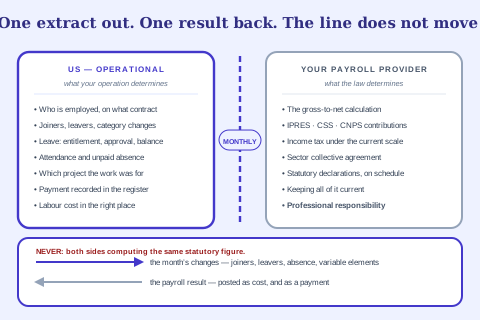
Given all that, here is the shape we recommend and the one most of our clients in these markets end up with. The boundary is not a compromise; it is the same division of labour that makes the accounting arrangement work.
Payroll: where the line falls
Us — the operational side
Everything about the employee that changes because of what happened at work.
- Who is employed, in what role, on what contract, from when
- Joiners, leavers, category changes and transfers, dated
- Leave taken, approved and remaining
- Attendance and unpaid absence
- Which project or cost centre the person worked against
- The payment recorded once made, in the payments register
- Payroll cost landing in the right place in your operational reporting
Your payroll provider or expert-comptable
Everything that is defined by law rather than by your operation.
- The gross-to-net calculation itself
- Social security and retirement contributions, employer and employee
- Income tax under the current scale
- Collective agreement entitlements for your sector
- Statutory declarations to each institution, on schedule
- Keeping all of the above current when a rule changes
- Professional responsibility for the result
What crosses, monthly
- To your provider: the month's changes — joiners, leavers, category changes, absence, any variable element — as a defined extract on an agreed date, from records that were captured as events rather than assembled at month end.
- Back from your provider: the payroll result, which is recorded as cost against the right projects and cost centres and as a payment in the register.
- Never: us calculating a statutory deduction and your provider trusting it. If both sides compute, both sides are wrong eventually and nobody can say which.
The arrangement is stable because each side does what it is accountable for. The failure mode to avoid is the ambiguous middle, where an operations system computes something payroll-shaped and a provider assumes it was checked.
When to move, and when not to
Organizations ask when they should bring payroll in-house or change providers. The honest answer depends on where you sit on a spectrum, and most people sit further left than they think.
Who should run your payroll
Your expert-comptable does everything
Common for smaller organizations and frequently correct. One relationship, professional responsibility clearly located, and no internal capability to maintain. The cost is turnaround time and dependence on their availability at month end.
A specialist payroll provider
A dedicated local provider rather than a general accounting firm. Faster, usually better on collective agreements, and the sensible step up once headcount makes payroll a monthly project rather than a monthly task. Where we recommend most of our clients sit.
In-house on local payroll software, provider on standby
You run it, on software built and maintained for the country, with professional review. Viable at scale with a competent payroll person who is not going anywhere. Note what this position requires: local payroll software. Not us.
Fully in-house, general-purpose software, no local support
The position to avoid. Someone configures deductions in a system that does not maintain them, it is right in year one, and it drifts silently thereafter. Errors here compound quietly and surface as arrears, which is the expensive way to find out.
The far-right position is where the damage happens, and organizations arrive there by accident rather than by decision — usually by configuring payroll into a system that was bought for something else. If you are reading this because you were about to do that with our product, please do not.
When the boundary is worth revisiting
| Signal | What it usually means |
|---|---|
| Payroll takes more than a couple of days of internal effort each month | The cost is now in your team's time rather than the provider's invoice, and it is invisible in your budget. Worth pricing properly before deciding anything. |
| You cannot answer "what did this project cost in labour" without a spreadsheet | This is an operational gap rather than a payroll one, and it is the specific thing we fix. Cost attribution belongs on our side of the line and does not require moving payroll at all. |
| Joiners and leavers reach your provider late or incompletely | Your employment records are not being captured as events. Fixing this improves payroll accuracy immediately and does not involve changing provider. |
| Leave balances are disputed by employees | Almost always a records problem rather than a calculation problem. Entitlement, accrual and approval need to live somewhere both sides can see. |
| You are operating in a second country | The strongest argument for keeping statutory payroll local in each country and keeping only employment records central. Two providers, one set of employee data. |
| A vendor has offered to include statutory payroll for both countries | Ask the questions in the next section before anything else. This offer is far more often optimistic than fraudulent, and the outcome is the same either way. |
How to test a vendor claiming Francophone payroll
"When did a rule last change in Senegal or Côte d'Ivoire, and what did you do?"
What you will hear
A specific change, a specific date, and a specific release.
How to read it
Maintenance leaves evidence. A vendor who genuinely maintains statutory payroll has a history of doing so and can produce it without preparation. Vagueness here answers the question completely.
"Which collective agreements do you support?"
What you will hear
Named sectors, or a straight admission that agreements are not modelled.
How to read it
An honest "we do not model collective agreements" is a fine answer. "It is fully configurable" means you will be modelling them, and maintaining them, forever.
"Show me a statutory declaration your system produced."
What you will hear
An actual document, in the prescribed form, that was actually submitted.
How to read it
A report titled after a return is not the return. This question ends most conversations about statutory payroll in markets a vendor does not really serve.
"If a deduction is wrong, who is responsible?"
What you will hear
A clear answer, and a look at the contract.
How to read it
Almost every software contract places this entirely on you. Which is reasonable — and it means the vendor's confidence is costing them nothing, while an error costs you arrears and penalties.
"Who maintains this, and where are they?"
What you will hear
A named team with local presence or a named local partner.
How to read it
Statutory payroll maintained by a team with no presence in the country is maintained by whoever raises a support ticket. That is you.
One detail we can be positive about
Leave calculation excludes non-working days, and which days those are is set per organization — the default of Saturday and Sunday already matches the standard working week in both Senegal and Côte d'Ivoire, so most organizations here will never touch it. Public holidays are separately configurable, which you will need, since the two countries do not share a calendar. A small thing, but it is the kind of detail that is either right or quietly wrong all year.
Where to go next
The equivalent boundary for accounting — the same logic, a larger subject — is in OHADA, SYSCOHADA and your operations system. Country buying advice is in the Senegal buyer's guide and the Côte d'Ivoire buyer's guide. Organizations operating in several franc-zone countries should read one currency, eight tax authorities.
Our take
Buy statutory payroll locally, from someone accountable for it, and keep buying it locally as you grow. Use an operations system for the part that is genuinely operational — employment records, leave, attendance, and getting the cost of labour onto the right project — and let the monthly extract be the only thing that crosses the line. If a vendor offers to include Francophone statutory payroll, ask them when a rule last changed and what they did about it, and let the answer decide. We do not offer it, we do not intend to, and we would rather lose the line item than be the reason someone is calculating contributions with a formula nobody has revisited since implementation.
Keep your payroll provider. Fix the records around them.
Most of what frustrates people about payroll is upstream of the calculation. That part we can help with, and it does not require changing anything about your provider.
Talk to us about HR recordsFrequently asked questions
Does AWRA run statutory payroll in Senegal or Côte d'Ivoire?
No. IPRES, CSS, CNPS, the income tax scale and sector collective agreements are not maintained calculations in our product for either country, and we produce no statutory declarations and submit nothing to any institution. Kenya is the only market where we operate turnkey statutory payroll, and that is because it is where we maintain the rules and carry the consequences of getting them wrong. We are not willing to claim that standard where we do not do the work.
What HR and payroll-adjacent things do you actually do?
Employee records with contracts and documents, categories, joiners and leavers, leave entitlement and approval with balances, attendance, and the posting of payroll cost into projects and cost centres so labour appears in the right place in your operational reporting. Payslip records are held against the employee and payments recorded in the payments register. In short: everything about employment that your operation determines, and nothing that the law determines.
Could we configure Senegalese or Ivorian deductions ourselves?
Technically you could construct something, and we advise strongly against it. A configuration you build is a configuration you maintain, forever, without notification when a rule changes. It will be right in year one and drift silently afterwards, and payroll errors compound into arrears rather than announcing themselves. If you are considering this because a provider feels expensive, price the arrears risk and the internal time before deciding. This is the one place in our product where we would rather you did not use a capability that exists.
How does this work alongside our payroll provider?
A defined monthly exchange in both directions. Out to them: the month's employment changes — joiners, leavers, category changes, absence and any variable element — captured as events when they happened rather than assembled at month end. Back from them: the payroll result, which is recorded as cost against the right projects and cost centres and as a payment in the register. Agree the format and the date once, at implementation, and the arrangement runs itself.
Are payslips available in French?
No. All printed output including payslips is in English, because the interface is English only with no translation files. For a document handed directly to an employee this is a genuine consideration rather than a cosmetic one, and in practice most organizations in these markets have their payroll provider produce the payslip while we hold the employment record. That is a reasonable division and it is what we would suggest.
Does leave calculation handle the local working week and holidays?
Yes for both, and both are configurable per organization. Leave days exclude the non-working days you set; the default of Saturday and Sunday matches the standard working week in both countries, so most organizations here leave it alone. Public holidays are set separately, which you will need since Senegal and Côte d'Ivoire do not share a calendar — enter them at the start of each year rather than discovering the gap when a balance is disputed.
We operate in both countries. Should we centralise payroll?
Our view is no for the statutory calculation and yes for the records. Keep a local provider in each country, because the obligations, institutions and collective agreements are genuinely different and local accountability is the thing that keeps them right. Centralise the employee data — one place where employment, leave, attendance and cost attribution live for both countries — so you have a single view of your people and each provider receives a clean monthly extract. That combination gets you consistency without pretending two legal regimes are one.
