
Procurement for NGOs and Programmes in Senegal & Côte d'Ivoire
Francophone commercial practice already has a stronger three-way match than most NGOs implement. The problem is not the controls. It is that they are on paper, and that the best-value supplier often cannot issue a compliant invoice.
A donor auditor arriving in Dakar or Abidjan usually expects to find weak procurement controls and is often mildly surprised. The commercial document tradition here is strong: the order, the delivery note and the invoice are distinct documents with distinct standing, and staff treat them that way without being trained to. What an anglophone procurement manual spends three pages establishing, a Senegalese storekeeper regards as simply how business is done.
So the interesting problems in this market are not the ones the manual anticipates. They are two others, and both are specific enough to be worth a post of their own.
Nothing here is legal, tax or audit advice. Donor rules govern, and your funding agreement is the authority — confirm everything against it.
The controls you already have
Start by noticing what is working, because implementations here frequently damage it by importing a workflow that ignores existing practice.
The three-way match, in the vocabulary your team already uses
The document in the file The control it performs
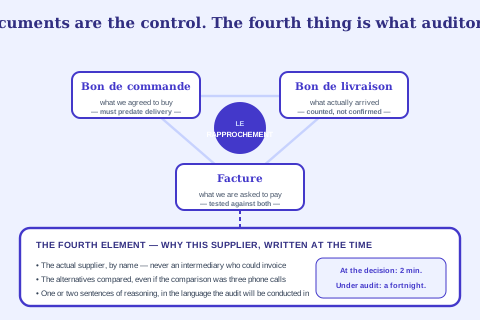
Bon de commande What we agreed to buy
Issued before the goods exist, which is the whole point. A commitment made in advance, at an agreed price, by someone with authority to make it. If this document is created after delivery, no procurement control has taken place regardless of what the file looks like afterwards.
Bon de livraison What actually arrived
Signed at the point of receipt by someone who was there. The control is that this is an independent observation, not a restatement of the order — which is exactly what it becomes when a storekeeper signs a pre-filled form without counting.
Facture What we are being asked to pay
The supplier's claim, which must be tested against the other two rather than accepted because it arrived. Three documents that agree are evidence. Three documents produced on the same afternoon are a formality wearing the costume of evidence.
Le rapprochement The match itself
The comparison is the control — not the existence of the three documents. Ask any team how many payments last quarter went out where the three did not agree, and what happened to them. If nobody knows, the match is decorative.
A system implemented here should reinforce this vocabulary rather than replace it. Teams that recognise their own process in the software adopt it; teams told their long-standing practice is now called something else in English quietly keep the paper version running alongside.
Problem one: the controls are on paper
Strong paper controls have a specific failure mode, and it is not fraud. It is that a paper file answers questions one at a time, slowly, in one place, to whoever is holding it.
When a donor asks how much was spent with a particular supplier across two programmes over eighteen months, a paper system cannot answer. When a programme manager in a field office wants to know whether an order has been received, they telephone. When an auditor asks to see the three documents for a transaction from fourteen months ago, someone goes to a cupboard, and the answer depends on whether that cupboard survived the last office move.
None of that is a control weakness in the strict sense. Every control operated. It is an evidence-retrieval weakness, and under donor audit the two are not distinguished — evidence you cannot produce is evidence you do not have.
The controls here are usually good. The retrieval is usually terrible. Auditors do not grade those separately.
Problem two: the supplier who cannot issue an invoice
This is the genuinely hard one, it is specific to markets with a large informal sector, and most procurement guidance simply pretends it does not arise.
A programme needs transport, or timber, or the repair of a borehole pump, or catering for a training in a rural commune. The best supplier — cheapest, fastest, closest, most reliable, sometimes the only one — is not formally registered and cannot issue a compliant invoice. Your funding agreement requires supporting documentation. Your finance officer requires something to file. The activity happens next Tuesday.
What follows is one of four outcomes, and three of them are bad.
| What organizations actually do | What it costs |
|---|---|
| Use a formal supplier instead, at a higher price. Clean file, defensible, straightforward. | Programme money spent on compliance rather than on the programme. Sometimes correct — but it should be a decision someone made, not a default nobody examined. |
| Route the purchase through an intermediary who can invoice. A registered trader buys and re-invoices with a margin. | The file looks clean and the record is now inaccurate about who supplied what. Under a determined audit this is worse than the original problem, because it looks like concealment even when it was convenience. |
| Pay and file whatever the supplier can produce, sometimes a handwritten receipt, sometimes nothing. | The most common outcome and the one that surfaces months later as a disallowed cost. The honest transaction is indistinguishable from the dishonest one, because neither has evidence. |
| Build the evidence yourself, at the time, and keep the real supplier on the record. | Ten minutes of work per transaction, and a file that survives. This is the only outcome that is both accurate and defensible. |
The fourth is what a system should make easy, and it is worth being concrete about what "build the evidence yourself" actually means, because it is not complicated and it is almost never done.
-
Record the actual supplier, by name
Not an intermediary, not "divers fournisseurs", not a category. The person or business that genuinely supplied the goods or service, with whatever identifying detail exists — a telephone number is better than nothing and much better than a placeholder.
-
Record the comparison you made
Two or three alternatives with their prices, even if the comparison was three phone calls. This is the single most valuable line in the file and it takes two minutes at the time. Reconstructed at audit, it takes a week and looks like it was reconstructed at audit.
-
Write the justification in one or two sentences
Why this supplier: nearest, only one available at short notice, previously reliable, half the price. Written at the decision, by the person who made it. This is the sentence that turns an awkward transaction into a documented one.
-
Photograph the evidence that does exist
The handwritten receipt, the goods on arrival, the completed repair, the training attendance sheet. Attached to the transaction itself rather than emailed to a colleague. A photograph taken at the time is worth more than a form completed afterwards.
-
Get the approval on the record, before payment
Someone with authority approving this specific purchase from this specific supplier at this specific price, timestamped. Approval after the fact is not approval; it is agreement, and auditors can tell the difference from the dates.
-
Keep all of it on one transaction
Supplier, comparison, justification, photographs, approval, payment, in one place, retrievable by anyone with permission in eight months. Scattered across a cupboard, a phone and an inbox, the same evidence is worthless.
The asymmetry that makes this worth doing
Written at the moment of decision, the justification takes two minutes and reads as an ordinary business record. Reconstructed under audit eighteen months later, the same two sentences take a fortnight to assemble, require chasing people who have left, and read as something composed for the auditor — which, visibly, it was. Identical content. Entirely different standing.
The language boundary in the file
One further complication, briefly, because it compounds everything above. In an internationally funded programme the grant agreement and the reporting are frequently in English, the approvals and the field records are in French, and the supplier documentation is in French or in nothing at all.
That is workable, but it has one non-obvious consequence: the person eventually assessing your file may not read the language most of it is written in. Nothing is missing, and yet the file does not defend itself.
The practical answer is narrow and cheap. Keep every original document exactly as it is — the original is the evidence and must not be replaced by a translation. But write the justification line, the one sentence explaining why this supplier at this price, in the language the audit will be conducted in. One sentence, at the time, on the transaction. It is the only part of the file that carries reasoning rather than fact, and it is the only part that genuinely needs to cross the language boundary.
What we do and do not do here
What AWRA OpsHub does today
- Requisition, approval chain, purchase order, goods receipt and three-way matching, with the match enforced rather than merely reported.
- Documents and photographs attached to the transaction itself, retrievable by anyone with permission, years later, without a cupboard.
- Supplier records that persist, including small and informal suppliers, so spend with a given supplier across programmes and years is a query rather than an exercise.
- Approval thresholds and delegation, with an audit trail showing who approved what, when, and what the record said before anyone changed it.
- Project and donor attribution captured at the point of purchase, which is the only time it is reliably known.
- A free-text justification held on the transaction, which sounds trivial and is the most audit-relevant field in the whole module.
- Budget visibility against the programme line at the point of committing, not after.
More we can add to your workspace
- Assessing whether a price is reasonable needs a market reference we decline to assert. We record three quotes; whether they are good ones is your judgement.
- Detection of collusion, conflicts of interest or related parties. A ring of suppliers who are the same person will pass every control we operate.
- Supplier vetting, sanctions screening or due-diligence checks of any kind. If your donor requires screening, that is a separate obligation and a separate provider.
- Compliance with any particular donor's procurement rules as a certified feature. We provide the records and the controls; whether your thresholds and processes satisfy your agreement is between you and your funder.
- A French interface, with documents printed in French. The system is in English today, and translation files are part of the build.
- Statutory accounting or tax filing of any kind — see our OHADA post for where that boundary falls.
The second and third entries deserve emphasis because procurement software is frequently sold as though it prevented fraud. It does not. It makes an honest transaction defensible and a dishonest one harder to hide. Those are worth having and they are not the same claim.
What we can build for Senegal on top of the standard product
Everything listed above as something we can add describes what ships in the standard product today — it is a starting point for Senegal, not a limit on what AWRA OpsHub can do there. Kenya's eTIMS integration and its maintained payroll engine are in the product because Kenyan clients needed them and commissioned them; neither appeared by itself. The same door is open here. If DGID declarations, a bank or mobile money feed, a statutory return format, a rule specific to how your operation runs, or a link to a system you already have is what stands between you and a decision, tell us and we will scope it as a build — written spec, timeline and price — before you commit to anything.
DGID declarations and e-invoicing
Declaration output in the format the administration expects and electronic invoicing against any prescribed interface, with retries, a failure queue and a reconciliation report.
Wave, Orange Money and bank feeds
Mobile money settlement files and bank statement feeds pulled into the Payments Register, so collections match invoices without anyone re-keying a statement.
The operational work, which is what most commissions actually are
An extra approval stage in a chain that does not match the standard one, a custom field set on employees or assets that only your sector needs, an expiry that has to block an order rather than send an email, a report your board asks for in a shape nothing produces, or a scanner or weighbridge feeding the goods-in door. These are the commissions we are asked for most often and the smallest ones we quote — and unlike a revenue-authority pipeline, none of them waits on a regulator.
Payroll and statutory returns
IR, IPRES and CSS schedules produced in the layout your filing body expects, generated from live payroll records rather than rebuilt in a spreadsheet each month.
Systems you already run
The accounting package, CRM, online store or custom database you intend to keep — connected through our API so a fact is entered once and appears everywhere it is needed.
How it works: you describe the requirement, we return a written scope, timeline and cost, and once agreed it is built into your environment and maintained as part of the product. No roadmap slide, and no pretending in a demo that something exists when it does not.
Tell us what you need integratedA short diagnostic for your own file
Pick one purchase from last year and test it
- Can you produce the order, the receipt and the invoice for it in under five minutes, without telephoning anyone?
- Does the order predate the delivery? Check the dates rather than assuming — this is the first thing an auditor tests and the most common failure.
- Is there a written reason why that supplier was chosen, written at the time, by the person who chose them?
- Was the receipt an independent count, or a signature on a pre-filled form?
- Can you say what else you bought from that supplier across every programme in the last two years?
- If the file is in French and your auditor reads only English, is the reasoning — not the documents, the reasoning — available to them?
- Would the answer to all of the above change if the person who handled it has since left? If yes, the knowledge is in a person rather than in a record.
Where to go next
Programme offices running operations across several franc-zone countries should read one currency, eight tax authorities. The accounting boundary and what your expert-comptable needs from you is in OHADA, SYSCOHADA and your operations system. The language question in full is in a French-language business buying English-language software, and country-level buying advice is in the Senegal buyer's guide.
Our take
Do not import a procurement workflow that ignores the document practice already in place — reinforce it, in the vocabulary your team uses, and you will get adoption instead of a parallel paper system. Then fix the two things that actually fail: move the evidence somewhere retrievable, and settle in advance how you document a purchase from a supplier who cannot invoice. That second decision, made deliberately and written down, prevents more disallowed costs than any amount of workflow. And write the justification at the time. Always at the time.
Show us your hardest procurement file
The informal-supplier one you are not sure about. That conversation is more useful than a demo, and we will tell you plainly what a system can and cannot fix.
Talk to us about procurementFrequently asked questions
Does AWRA support the bon de commande, bon de livraison and facture process?
Yes — that is exactly the three-way match, and the controls map one to one onto requisition, purchase order, goods receipt and supplier invoice. The match can be enforced rather than merely reported, so an unmatched invoice is blocked instead of flagged. The one thing to be clear about is language: the process is fully supported, but the printed documents carry English labels, because the interface and all output are English only.
How should we handle suppliers who cannot issue a compliant invoice?
Decide the policy in advance rather than transaction by transaction, and whatever you decide, keep the real supplier on the record — routing purchases through an intermediary who can invoice makes the file look cleaner and the record less true, which is worse under a determined audit. The defensible approach is to record the actual supplier, the alternatives you compared, a one-or-two-sentence justification written at the time, a photograph of whatever evidence exists, and an approval dated before payment. Confirm the approach against your funding agreement.
Will this satisfy our donor's procurement rules?
We cannot answer that, and any vendor who does is overreaching. Donor rules vary by funder, by instrument and by grant, and compliance depends on your thresholds, your delegation of authority and your written procedures rather than on software. What we provide is the underlying capability — enforced approval chains, three-way matching, thresholds, attached evidence, project attribution and an audit trail. Whether your configuration of those satisfies your agreement is a question for your funder and your own compliance function.
Can it detect fraud or collusion?
No, and this matters enough to say plainly. We cannot detect collusion between bidders, identify that three suppliers are the same person under different names, spot a conflict of interest, or judge whether a price is reasonable. A well-constructed fraud will pass every control we operate. What the system does is make honest transactions easy to defend and dishonest ones harder to conceal, because everything carries a timestamp, an approver and an unalterable history. That is worth having; it is not fraud detection.
Do you provide supplier vetting or sanctions screening?
No. There is no vetting, no sanctions or watchlist screening, no beneficial-ownership checking and no due-diligence service of any kind. If your donor requires screening against particular lists, that is a separate obligation requiring a separate provider, and you should not assume any procurement system covers it unless the vendor states specifically which lists and how often they are refreshed. We hold supplier records; we do not investigate them.
Our file is in French and our auditor reads English. What do we do?
Keep every original document exactly as it is — the original is the evidence and a translation must never replace it. What is worth doing is writing the justification line, the sentence explaining why this supplier at this price, in the language the audit will be conducted in, at the time of the decision, on the transaction. That single sentence is the only part of the file that carries reasoning rather than fact, and it is the part that genuinely needs to cross the language boundary. It costs two minutes and it is the difference between a file that defends itself and one that requires you present to explain it.
