
The Stock You Own and Cannot See
A consignment moving inland under inter-state transit is on your balance sheet, in nobody's stock count, and carrying a duty that has been suspended rather than paid. Most systems have no place to put it. The mirror image — goods you can see perfectly well that are not yours at all — is [stock that is not yours](/blog/stock-that-is-not-yours).
Ask an importer in Ouagadougou, Bamako or Niamey what stock they are holding and you will get the warehouse figure. Ask what they own and the number is larger, sometimes by a great deal, and almost nobody can produce it without a phone call. The difference is the goods that have cleared a port they do not operate in and are somewhere on a road between there and here.
This piece is about why that gap is structural rather than sloppy, and what closing it is actually worth. None of it is an argument that anybody is doing their job badly. It is an argument that the tools were built for businesses whose goods arrive the same week they are bought.
Why a system has nowhere to put it
Inventory systems model locations you operate. A warehouse, a shop, a yard, a bin. Each has a quantity and each quantity can be counted by somebody standing in it.
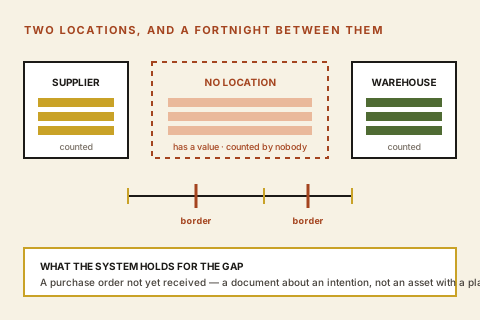
A consignment sitting in a foreign port for eleven days fits none of that. It has left the supplier, so it is not theirs. It has not arrived, so it is not in any location. It is not lost. So it gets recorded as the only thing left available: a purchase order that has not been received yet — which is a document about an intention, not an asset with a value and a place.
That works while transit is short. Where the journey is a fortnight across two borders, the largest single block of inventory a business owns can spend most of its life represented as paperwork.
The goods are not missing and nobody has made a mistake. They are simply in a state the software has no word for, so they are described as an intention instead of an asset.
The four things you cannot answer while it is in the gap
| The question | Why it is hard today |
|---|---|
| What is it worth? | The purchase order carries the supplier price. It does not carry freight, port charges or anything else already incurred, so the figure understates the asset — and the correction arrives weeks later attached to a different document |
| Where is it? | Somebody knows. That somebody is usually the person who last spoke to the transporter, and the knowledge is in a chat thread rather than in a record anyone else can query |
| Is it committed? | Stock in transit is frequently already sold. Whether a customer order is covered by goods on a road is a question the sales team asks by walking over and asking, which does not scale and does not survive that person being on leave |
| Is the duty still open? | The duty was suspended against a guarantee, not paid. It stays open until the transit is discharged. Nothing about the warehouse tells you whether that has happened, and the answer normally lives with the clearing agent |
The suspended duty is the part that surprises people
Under an inter-state transit regime, goods move from a customs office in one country to a customs office in another on a single declaration with duties and taxes suspended against a guarantee. The word doing the work is suspended. Nothing has been forgiven; the obligation is held in abeyance on the condition that the journey is completed and proved.
Which means a consignment carries a contingent liability for the whole of its journey, and that liability ends at exactly one moment — when discharge is proved. Not when the truck arrives. Not when the goods are put away. The operational instinct is that a shipment is finished when it is in the warehouse, and for this purpose it is not.
What this piece is not saying
Nothing here suggests transits routinely go undischarged, that guarantees are commonly called, or that anybody should be alarmed. In the ordinary case the agent does their job and the paperwork completes. The narrow point is that the business usually cannot demonstrate this from its own records, and cannot say today how many transits are open — which is a different problem from having a problem.
What changes if you model it as stock
Not the journey. The journey is what it is, and no system shortens it. What changes is what is true in your own records while you wait.
-
Give transit a location
A place that is not a warehouse and is not the supplier: in transit, with a route and a current position if you have one. Stock there behaves like stock — it has a quantity, a value and an owner — so the balance sheet and the stock report stop disagreeing for a fortnight at a time. This is a modelling decision rather than a feature, and it is most of the fix.
-
Let cost accumulate onto it while it moves
Port charges, storage, transit fees and transport added to the consignment as they are incurred rather than at the point of order. The value of the asset then rises as the real cost does, and the landed cost at arrival is a total rather than an estimate to be corrected later.
-
Attach the documents to the consignment
The transit declaration, the guarantee reference, each border receipt and eventually the proof of discharge, held against the shipment rather than in the folder of whoever received them. Retrieval by consignment is the only retrieval that survives a change of staff.
-
Make open transits a list
Not a memory and not a phone call. Every consignment whose discharge has not been evidenced, visible in one place, ageing. Most of the value of this whole exercise is that the list is usually short and can be seen to be short.
A shipment is operationally finished when the goods are on the shelf and administratively finished when the discharge is proved. Two different dates, and only one of them gets celebrated.
The number worth producing this week
One figure, and it needs nobody's software: the value of stock you currently own that is not in any of your locations, with the consignments listed.
If it comes back in an afternoon, your records are in better shape than most and none of this is urgent. If it takes several days and three phone calls, you have just measured the thing this piece is about — and you measured it without buying anything, which is the right order.
Where the boundary sits
Stock at a location you do not own
Goods in transit carried as stock with quantity, value and position, in the same place as everything on a shelf. Also covers stock held at a third party and goods handled without being owned.
Landed cost that stays open
Freight, port, storage, transit, border and handling charges accumulated onto the consignment as each invoice arrives, however late, so the unit cost is what the goods actually cost.
Documents held against the consignment
Declaration, guarantee reference, receipts and proof of discharge attached to the shipment and previewable without downloading, retrievable by consignment rather than by filer.
Anything that touches a customs administration
Not built and not planned. No transit declarations, no guarantee management, no clearance integration, no connection to any customs system. Your clearing agent does this work; we record what they did and what it cost, which is a different job.
Making the journey shorter
Not possible, by us or by anybody selling software. Port congestion, convoys, guarantee funds and border formalities are not addressable from a database. Any vendor implying otherwise should be asked to name the mechanism.
Deciding how much transit stock to carry
Yours. How much cover the corridor needs, which route to use and what a delay is worth are commercial judgements about your market. We can make the current position visible; the policy is not ours to have an opinion about.
Everything above is checkable against records you already hold, which is deliberate. The fortnight is not going anywhere. What it costs you in visibility is a choice, and it is a cheaper one to change than most people expect.
What we can build for the UEMOA member states on top of the standard product
Everything listed above as something we can add describes what ships in the standard product today — it is a starting point for the UEMOA member states, not a limit on what AWRA OpsHub can do there. Kenya's eTIMS integration and its maintained payroll engine are in the product because Kenyan clients needed them and commissioned them; neither appeared by itself. The same door is open here. If a French interface, Benin's certified invoicing connection, a bank or mobile money feed, a statutory return format, a rule specific to how your operation runs, or a link to a system you already have is what stands between you and a decision, tell us and we will scope it as a build — written spec, timeline and price — before you commit to anything.
Benin's normalised invoice, and a clean handoff everywhere else
In Benin, invoices issued through the certified electronic invoicing route with the tax authority validating each one and returning its unique number and QR code before the invoice is valid — held on the transaction, with retries, a failure queue and a daily report of sales carrying no reference. Stated precisely because the precision is the point: that is an accreditation rather than an integration, we do not hold it, and it is specific to Benin rather than to the union. Everywhere else this is a defined export mapped to your expert-comptable's chart of accounts. The statutory ledger stays with them by design; what we build is the pipe to it.
Mobile money, bank feeds and a French interface
Orange Money and other mobile money settlement files plus bank statement feeds pulled into the Payments Register, so collections reconcile against invoices without re-keying a statement. And French interface text and document templates — the single most-asked-for thing in these six markets, and the honest answer today is that it does not exist.
The operational work, which is what most commissions actually are
An extra approval stage in a chain that does not match the standard one, a custom field set on employees or assets that only your sector needs, an expiry that has to block an order rather than send an email, a report your board asks for in a shape nothing produces, or a scanner or weighbridge feeding the goods-in door. These are the commissions we are asked for most often and the smallest ones we quote — and unlike a revenue-authority pipeline, none of them waits on a regulator.
Payroll and statutory returns
National income tax and social security schedules per country, produced in the layout each filing body expects and generated from live payroll records. Six countries is six builds and we will say so rather than sell one as covering all of them.
Systems you already run
The accounting package, CRM, online store or custom database you intend to keep — connected through our API so a fact is entered once and appears everywhere it is needed.
How it works: you describe the requirement, we return a written scope, timeline and cost, and once agreed it is built into your environment and maintained as part of the product. No roadmap slide, and no pretending in a demo that something exists when it does not.
Tell us what you need integrated