Three Zeros Mean Yes
A statutory e-invoicing interface answers every request with the same four fields, and one of them decides everything. Three zeros mean it was filed. Anything else is a code you look up — and the connector puts the code in front of you rather than translating it away.
Integrating with a revenue authority is not like integrating with a software company. There is no developer relations team, the documentation is a specification rather than a guide, and the interface reflects the tax law rather than any idea of developer experience. It is also, once you accept that, an unusually clear thing to build against — because a specification does not change to suit anybody, and everything it does is written down.
Four fields, every time
Every response has the same shape: a result code, a message, the time the result was produced, and a data section that is populated when there is something to return.
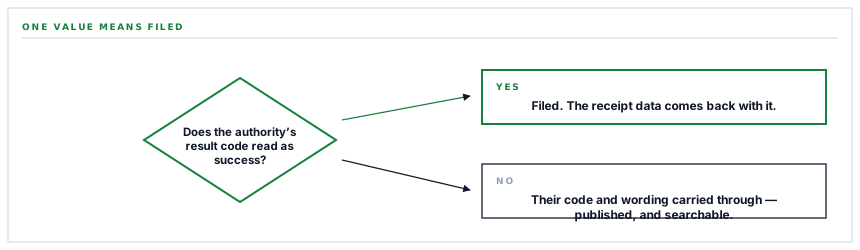
One value of the result code means success. It is three zeros — a string, not a number, which matters because the leading zeros carry meaning and a numeric comparison would lose them.
So success is a comparison against that exact string. Not the response status, which is the same pattern that appeared with the mobile money connector and the chat provider whose body can refuse inside a healthy reply: the transport can be entirely fine while the answer is no.
A tax filing that reports success because the network worked is a filing that did not happen, on a record that says it did.
And the code stays in the message
When something is refused, the reported error carries the authority's own code alongside its own message. Deliberately, and against the usual instinct to translate.
The reason is that these codes are published. They are in the specification, they are searchable, and they are what anybody helping you — an accountant, a consultant, the authority's own support — will ask for. A code is a shared reference between parties who otherwise have no common vocabulary.
Translating it into a friendly sentence would make the message nicer to read and strictly less useful, because the friendly sentence is ours and appears in no document anybody else has. In a regulated interface, the provider's vocabulary is the useful one.
And where there is no code at all — a network failure, a response that is not the expected shape — the status is carried in its place, so the message never comes back empty.
Every workspace is its own taxpayer
This is the structural point, and it is what makes this connector different from every other one in the series.
There is no platform account. Each workspace files under its own tax identity: its own taxpayer identifier, its own branch, its own device.
-
A taxpayer identifier
Whose tax obligation this is. It appears on every call, because every submission is a filing by that taxpayer.
-
A branch
Which registered place of business. A company with several branches files separately for each.
-
A device serial
The identity of the thing doing the invoicing. This is a device-based regime — the concept comes from physical tax registers, and the interface inherits it.
-
A key returned at initialisation
Handed back when the device is registered and required on every subsequent call. It is what proves this device was enrolled.
The consequence is worth stating plainly: a filing is made by you, not on your behalf. The submission carries your identifier and your device, and what is filed is your record with the authority. That is the correct arrangement for a statutory obligation, and it means the setup involves your own registration rather than a key we could issue.
Initialisation is a one-way step
Registering the device is its own operation, done once, and it is the only call that does not carry the authorising key — because the point of it is to obtain that key.
The connector refuses to treat it as successful unless a key actually came back. That check is worth having: a response that is well formed, carries a success code and contains no key would otherwise be recorded as a completed initialisation, leaving a connector that believes it is enrolled and fails on every subsequent call for reasons that point elsewhere.
It is the same instinct as refusing a storage connection with no refresh token, or a messaging credential with no routing suffix. A configuration missing the thing that makes it work reads as unconfigured rather than as connected.
The test that files nothing real
Proving a statutory connection is awkward, because the obvious test — file something — has consequences.
So the connection test submits a minimal, well-formed document carrying a clearly marked test reference. It exercises the credentials, the device enrolment, the payload shape and the authority's validation, which is everything that can be wrong.
And it is run against the test environment, which is a per-workspace setting rather than a deployment-wide one — so a workspace can be testing while another is filing live, and going live is a deliberate switch rather than a consequence of where the software is running.
A tax code decided by a rule, not a lookup
One mapping detail worth surfacing, because it is a real business rule sitting in the connector.
Every invoice line has to carry a tax type. The connector derives it: a line taxed at nothing is marked zero-rated, and everything else is marked at the standard rate.
That is correct for the great majority of trade and it is a simplification, and the honest way to describe it is as a rule rather than as a classification. A business dealing in genuinely exempt supplies — which is a different thing from zero-rated, in law and in the codes — is a business whose invoices need that distinction made deliberately rather than derived from a rate.
Naming the rule is the point. A derived value that is right almost always is exactly the kind that nobody checks, and the person who needs to know is the one for whom it is not right.
What is in place, layer by layer
The eTIMS connector as it stands
Success judged on the result code
The authority's own code decides the outcome, not the response status, so a filing that was refused is never recorded as made.
The code carried into the message
Refusals report the authority's code and wording, because those are published, searchable, and the shared vocabulary with anyone helping you.
A fallback when there is no code
A transport failure or an unexpected response reports the status instead, so a failure never comes back with an empty reason.
Filing under your own tax identity
Your taxpayer identifier, your branch and your device on every call. There is no platform account and no filing on your behalf.
Device enrolment as its own step
Registration is done once and returns the key every later call carries, which is what proves the device was enrolled.
Enrolment refused without a key
A response with no key is not treated as a completed registration, so a connector never believes it is enrolled when it is not.
A test that exercises the whole path
A minimal well-formed document with a marked test reference, proving credentials, enrolment, payload and validation together.
Test and live as a per-workspace setting
Going live is a deliberate switch by the workspace rather than a consequence of where the software happens to be running.
Credentials encrypted at rest
The device key and identifiers are stored on the row for one workspace and never written into a log line.
The tax type on a line is derived from its rate — nothing is zero-rated and anything else is standard. That is right for most trade and it is a rule rather than a classification, which matters if you deal in genuinely exempt supplies.
Three positions held on purpose
- The authority's codes and wording are surfaced rather than translated. A friendly sentence of our own appears in no document anybody else holds, and a published code is the only shared vocabulary between you, your accountant and the authority.
- Filing happens under your own tax identity, with no platform account in the middle. A statutory obligation is yours, and an arrangement where a vendor's credentials sit between you and the authority is the wrong shape for one.
- A derived tax classification is described as a derived rule. It is right for most trade, it is what nobody checks precisely because it is usually right, and the business it is wrong for is the one that most needs to know.
Five questions about a statutory e-invoicing connector
Whose tax identity is used?
A good answer sounds like
Yours.
What ours actually is
Your taxpayer identifier, branch and device on every call. There is no platform account.
How is success decided?
A good answer sounds like
The authority's code.
What ours actually is
The specific success code in the body, never the response status.
What do we see when a filing is refused?
A good answer sounds like
Their code and words.
What ours actually is
Carried through as given, because the code is what anybody helping you will ask for.
Can we test without filing something real?
A good answer sounds like
Yes.
What ours actually is
A minimal marked test document against the test environment, which is a per-workspace setting.
How is the tax type on a line decided?
A good answer sounds like
A stated rule.
What ours actually is
Derived from the rate — zero is zero-rated, anything else standard. Named as a rule rather than a classification.
Our take
Building against a revenue authority teaches a discipline worth carrying back to ordinary integrations. There is no negotiating with the specification, no support channel that will make an exception, and no version of success other than the one they define — so you read what they wrote, implement exactly that, and surface their vocabulary rather than inventing your own. Most commercial APIs would be better handled the same way. The habit of translating a provider's precise refusal into a friendlier sentence is almost always a downgrade, and it is only tolerable because most providers are forgiving enough that nobody notices what was lost.
File under your own tax identity
Your PIN, your branch, your device. A statutory obligation should not have a vendor's credentials sitting between you and the authority.
Talk through eTIMS filingFrequently asked questions
Do you file our invoices on our behalf?
No. Every submission carries your own taxpayer identifier, branch and enrolled device, so the filing is yours. There is no platform account in the middle, which is the right shape for a statutory obligation and means the setup involves your own registration.
What does a filing error message mean?
It carries the authority's own code and wording. Those codes are published and searchable, which is why they are passed through rather than translated — a code is the shared reference between you, your accountant and the authority, and a friendly sentence of ours would appear in no document any of them hold.
Can we try this without filing real invoices?
Yes. The connection test submits a minimal, clearly marked test document that exercises credentials, device enrolment, payload shape and validation. Test and live are a per-workspace setting, so going live is a deliberate switch rather than something that follows from where the software runs.
What is the device serial for?
The regime is device-based — the concept comes from physical tax registers and the interface inherits it. The device is enrolled once and the key returned by that enrolment accompanies every later filing, which is what proves the device was registered.
How is the tax type on each line decided?
By a rule rather than a classification: a line taxed at nothing is marked zero-rated and anything else is marked standard. That is correct for most trade. If your business deals in genuinely exempt supplies — legally distinct from zero-rated — that is a distinction worth reviewing rather than leaving to the rule.