
Who Was On Sunday Night? Clinical Rosters and Locum Pay
A clinic that never closes has to answer three questions every week — who is on, who is owed, and who is legally allowed to be there. The roster is where all three meet, and where most facilities keep three separate versions of the truth.
The roster is the most consequential document a 24-hour facility produces and usually the least controlled. It is drawn on a whiteboard on Friday, photographed onto WhatsApp, amended twice by phone over the weekend, and by Tuesday nobody can say with confidence who worked Sunday night. Then payroll runs, and the person who covered an unplanned double shift is paid for one — or paid for three, because they told the accounts clerk and the accounts clerk believed them.
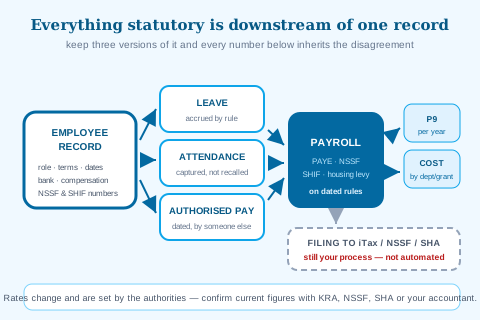
The roster is a plan; attendance is a fact
The single most useful distinction in shift management is between what was scheduled and what happened. They are different records with different purposes, and collapsing them is the root of most payroll disputes in a clinic. The roster is a forward-looking commitment — it tells staff when to be there and tells the matron whether Sunday night is covered. Attendance is a backward-looking fact. When the only record is the roster, you are paying people for what you intended them to do.
The gap between the two is where the interesting information lives. A nurse rostered to days who consistently clocks in on nights is a rostering failure. A ward that plans four and runs three every Sunday is understaffed in a way the roster politely conceals. Neither is visible unless the plan and the fact are separate records you can lay side by side.
The Friday-to-Monday handoff, and what crosses it
Before: the plan
Drawn once, ideally a week ahead, by someone with authority to commit people to dates.
- Who is on which shift, on which date
- Which shifts are uncovered and still need a locum
- Who is on approved leave and therefore unrosterable
- The standing pattern each person defaults to
After: the fact
Captured as it happens, by the person it happened to, not reconstructed on Monday.
- Who actually clocked in, and when
- Which planned shifts went uncovered
- Swaps that happened by phone and were never written down
- Overtime and night hours actually worked
What has to survive the weekend intact
- The identity of the person on each shift — because a swap changes who is owed
- The approval for any change, so Monday is not an argument about who authorised it
- The hours themselves, in a form payroll can read without retyping
- Any absence, so it lands in the leave record rather than as unexplained silence
Almost every clinic payroll dispute is a swap that crossed this seam verbally. The fix is not a better system so much as a rule: a swap is not a swap until it is on the roster. Everything else follows from enforcing that one sentence.
Locums are the part that breaks the payroll
Permanent staff are the easy case: a monthly salary, statutory deductions, a payslip that looks like last month's. Locums are the opposite — paid per session or per night, at rates that differ by person and sometimes by day of the week, often engaged at short notice by someone whose job is clinical cover rather than record-keeping. The result is the most common finance failure in Kenyan private healthcare: a real cost, correctly incurred, that reaches the accounts as a handwritten note.
One month of locum cover, reconstructed
Nobody in this scenario is dishonest. The facility loses the argument because it has no record, and pays because a locum you have offended does not answer the phone at 2am. The control is not suspicion — it is a signed session record at the time, which costs thirty seconds and settles every one of the three disputes before it starts.
-
Hold a rate per locum, in writing, before the first session
One agreed figure per person per session type, recorded where the person authorising cover can see it. Rate negotiation at 11pm on the night of the shift is how a facility ends up paying the top of its range for every gap.
-
Roster the locum like anyone else
A locum session that is not on the roster does not exist as far as anyone can later prove. Put it on the same document, on the date, with a name — this is also the only way "is Sunday night covered?" has a reliable answer.
-
Capture the session as it happens
A signature or a clock-in at the start of the shift, not a claim at the end of the month. The record needs to be created by the person who was there, at the time they were there.
-
Approve against the roster, not against the claim
The person approving payment should be comparing a claim to a rostered session, not deciding whether a claim feels plausible. If the two disagree, that is a conversation held on the 3rd rather than a concession made on the 28th.
-
Pay it through payroll, not out of the drawer
A locum paid from petty cash is invisible to your cost per bed-night and awkward with the taxman. Run it as an earning on a payroll record so it lands in the same cost figures as every other hour of clinical time.
The employee who is not a user
Most locums, and many support staff, will never log into anything. That is not a limitation to work around — it is the normal case, and any system that requires a login before a person can exist will quietly push half your workforce back onto paper. Check this specifically when evaluating software: can you hold a person, roster them, record their attendance and pay them without issuing them an account? If the answer is no, the roster you end up with will only cover the staff who happen to have email.
| Can the system tell you… | Permanent staff | Locum / casual | Contracted specialist |
|---|---|---|---|
| Who is rostered on a given date | Yes | Yes | Yes |
| Who actually attended | Yes | Partly — configurable by you | No |
| What the agreed rate is | Yes | No | No |
| What they were paid, on a payslip | Yes | Partly — configurable by you | No |
| Whether their licence is current | No | No | No |
| Cost of clinical cover per ward | Partly — configurable by you | Partly — configurable by you | No |
Built and maintained Configurable by you, not maintained by us Not built
The third question: who is legally allowed to be there
A roster answers who is on and payroll answers who is owed. The question neither answers is whether the person on duty holds a current practising licence for what they are doing — and in a licensing inspection that is the question actually asked. Professional registration numbers, renewal dates and indemnity cover are as much a rostering constraint as leave is: an expired licence should make somebody unrosterable in exactly the way approved leave does. Almost no facility treats it that way, and no general-purpose system will do it for you.
What AWRA OpsHub does today
- A genuine weekly roster. A seven-day grid of employees against dates, filterable by department, where each cell holds a shift for that person on that date. This is a real per-day schedule, not just a standing pattern — and it is more than the equivalent screens in most general business software.
- Shifts as records with a name, start and end time, a break allowance and a lateness grace period, so "night duty" is a defined thing rather than a convention.
- A standing shift assignment per employee with an effective-from date, which becomes the default the roster fills in — so you only record the exceptions.
- Attendance as a separate record from the roster, with regularisation for corrections, attendance sites, and verification — so the plan and the fact are genuinely two things you can compare.
- Leave requests, balances and types, and a combined availability board showing leave, shifts and holidays together, which is the screen that answers "can I roster this person".
- An employee who does not need a login. Employee and user are separate records and the link is optional, so locums, casuals and support staff can be held, rostered and paid without an account.
- Extra earnings on a payroll run — a described amount per employee per period, flagged taxable and pensionable independently, which is the correct home for a locum session fee. Payroll runs post through to the Payments Register with everything else.
- A maintained Kenyan statutory payroll engine, so PAYE, NSSF, SHIF and the housing levy are computed on the live records rather than in a parallel spreadsheet.
More we can add to your workspace
- A rate card per locum. An agreed-rate field on a person, so the control that stops rate drift at 11pm lives in the system rather than in a document beside it. Today the earning is an amount someone types.
- A session or shift-level pay rule. Pay derived from hours rostered or hours attended — a rate multiplied by a night. Today the connection between roster and payslip is a person reading one and typing into the other.
- An overtime or night-differential calculation. Hours worked beyond a shift are visible in attendance; converting them into an uplift is arithmetic you do and enter as an extra earning.
- A shift swap as a transaction: a request, a counterparty approval and a record that the swap happened. Today a swap is done by editing the roster, so the most dispute-prone event in rostering leaves no trail.
- Professional licence and registration tracking: a registration number, a renewal date and an indemnity expiry on an employee, with an unlicensed person made unrosterable. This is what makes the compliance question this post ends on answerable in the system.
- Cost of clinical cover per ward or unit. Payroll cost allocates to a project today; a ward or unit dimension, and a department on an expense, are what turn "what did night cover cost this ward" into a report rather than an assembly job.
- Two unrelated notions of a working week. A payroll run carries its own standard working days as a number set per run, and the workflow business calendar keeps a separate working-days array for due-date arithmetic. Neither reads the other and neither is derived from the roster, so a facility that genuinely works six days has to say so in more than one place.
The rostering half is genuinely good and better than our own build list suggested — a real per-day roster, shifts with grace periods, attendance separate from the plan, availability including leave, and employees who need no login. What sits between the roster and the money is the build: a rate per person, pay derived from hours, a swap trail. So the roster tells you who was on, and a person still turns that into what they are owed. For most Kenyan clinics that is a real improvement on a whiteboard and short of what "shift management" implies. Licence tracking is a build too, and if that is your compliance driver you should know it before a demo rather than during one.
Anything above that you need, we can build for you
Everything listed above as something we can add describes what ships in the standard product today — it is a starting point, not a limit on what AWRA OpsHub can do for your organisation. Kenya's eTIMS integration and its maintained payroll engine are both in the product because clients needed them and commissioned them; neither appeared by itself, and the same door is open for whatever you just read about. One qualification so this is worth what it claims: a small number of things on this blog we deliberately leave to a specialist rather than build — a statutory ledger we will not sign our name to, a rule that would decide a tax question for you, a clinical or member-funds record that belongs in a regulated system — and where that is true the post says so in those words. Everything else is a scope, a timeline and a price.
The operational work, which is what most commissions actually are
An extra approval stage in a chain that does not match the standard one, a custom field set on employees or assets that only your sector needs, an expiry that has to block an order rather than send an email, a report your board asks for in a shape nothing produces, or a scanner or weighbridge feeding the goods-in door. These are the commissions we are asked for most often and the smallest ones we quote — and unlike a revenue-authority pipeline, none of them waits on a regulator.
The module-shaped additions, which are the ones readers ask for most often
A price list with real discount authority, a customer-facing quotation that expires, a bill of materials or recipe costing, a staff advance that is issued, acquitted and chased, a member or unit ledger, a matching rule that holds a payment. Each of these is a build rather than a setting, and each has been quoted before — a bigger piece of work than a custom field, with a written spec and a date instead of a roadmap slide.
The report, document or pack nothing currently produces
The board pack in the shape your board actually asks for, a donor or funder layout, an invoice or receipt template carrying what your regulator or your customer expects, a dataset the report builder cannot reach yet. Usually the fastest thing on this list to deliver, because the data is already in the system.
Systems, rails and hardware you already run
The accounting package, CRM, online store, core banking or custom database you intend to keep — connected through our API so a fact is entered once and appears everywhere it is needed. Plus the physical edge: a scanner, a scale, a weighbridge or a till peripheral feeding the door it belongs to.
How it works: you describe the requirement, we return a written scope, timeline and cost, and once agreed it is built into your environment and maintained as part of the product. Nothing here waits on a regulator or a published specification, which is why operational builds are the ones we quote fastest. Tell us the requirement that would otherwise rule us out — that is a better first conversation than a demo.
Tell us what your operation needsThe short version
Separate the plan from the fact, and make one rule stick: a swap is not a swap until it is on the roster. That single sentence resolves more payroll disputes than any amount of software.
Clinical cover is usually the largest single line in a facility's costs, which makes it the largest input into cost per visit. The wider people record this sits on is covered in HR records that survive an audit, and the same attendance-to-payroll seam appears in payroll compliance in Kenya.
One roster everyone reads
A real weekly roster by date and department, shifts with breaks and grace periods, attendance recorded separately from the plan, leave and availability in one board, employees without logins, and Kenyan statutory payroll. Rates per locum and pay derived from hours are not built — the note above is specific.
See HR and payroll in AWRAFrequently asked questions
What is the difference between a shift assignment and a roster?
A shift assignment is the standing pattern — this nurse is normally on nights, from this date. A roster is the specific week: who is on which shift on which date, including every exception to the pattern. You need both, because the assignment is what lets the roster default sensibly so you only record the changes. A system with only the standing pattern cannot tell you who is on next Sunday.
Why keep attendance separate from the roster?
Because one is a plan and the other is a fact, and the difference between them is the information you actually want. A ward that plans four and runs three every Sunday is understaffed in a way the roster conceals. If the roster is also your attendance record, you are paying people for what you intended them to do rather than what they did.
How should locum sessions be recorded?
Rostered on the same document as everyone else, with a signature or clock-in at the start of the shift, then approved against that rostered session rather than against a claim submitted later. Agree the rate in writing before the first session. Most locum disputes are not dishonesty — they are a facility with no contemporaneous record losing an argument it cannot win.
Can we manage staff who never log into the system?
Yes, and you should insist on it. Employee and user are separate records with an optional link, so locums, casuals, cleaners and support staff can be held, rostered, have attendance recorded and be paid without ever being issued an account. Any system that requires a login before a person can exist will push a large part of a clinic workforce back onto paper.
Does the system calculate night or overtime rates?
No. Attendance shows the hours; converting them into an uplift is arithmetic you perform and enter as an extra earning on the payroll run, flagged taxable and pensionable as appropriate. Nothing multiplies a rate by hours worked, and there is no rate held per person — so plan for a human step between the roster and the payslip.
How do we track that clinical staff hold current licences?
Not in a general business system — there is no registration number, renewal date or indemnity field on an employee, and nothing prevents rostering someone whose licence has lapsed. Keep a licence register with renewal dates as a deliberate separate discipline and review it monthly. Treat an expired licence as making a person unrosterable, exactly as approved leave does.
What is the highest-value control in shift management?
A written rule that a swap is not a swap until it is on the roster, enforced by whoever owns the document. Verbal swaps that cross a weekend are the single largest source of clinic payroll disputes, and they are invisible to every downstream record. The rule costs nothing and no software substitutes for it, because a system can only be right about what somebody told it.
