Grading, Cold Chain & Post-Harvest Losses: Protecting Margin After the Gate
Between the farm gate and the buyer, a shocking share of Kenyan produce is lost — spoiled, downgraded, or simply unaccounted for. Most of it is invisible because nobody measures where it goes. Turning post-harvest loss from a vague shortfall into a number at each step is how you protect the margin.
A cooperative can weigh and grade perfectly at intake and still lose a large slice of its value before the crop reaches the buyer. Produce spoils in the heat, gets damaged in handling, is downgraded on arrival, or simply goes missing between the collection point and the sale. Post-harvest losses in Kenyan horticulture and grain are routinely estimated in the double digits, and for the co-op that loss falls straight on the margin — and ultimately on the price members can be paid. The tragedy is that most of it is invisible: it disappears into a single vague "shortfall" between what was received and what was sold, with no way to say where or why. What you cannot measure, you cannot fix.
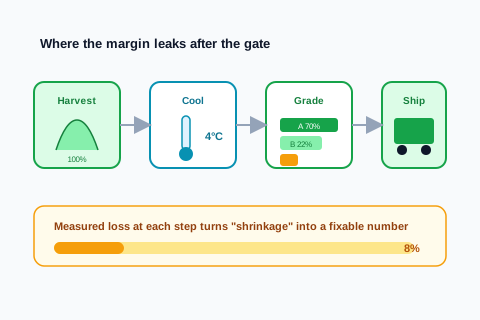
Measure loss at each step, not just the ends
The key shift is from measuring loss once — received minus sold — to measuring it at each stage, so you know which step is leaking.
-
At intake
Record what was received, by member and grade. This is the baseline every later loss is measured against — and where fair grading already matters.
-
Into cooling or storage
For perishables, record what went into the cold room or store and the conditions. Cooling that fails or is skipped is often the single largest loss, and it is invisible unless the before-and-after is captured.
-
At grading for market
Record the grade split going out — A, B, reject. A high reject rate points back to handling, cooling, or intake grading, and tells you exactly where to intervene.
-
At dispatch and delivery
Record what shipped and what the buyer accepted. Rejections and downgrades on arrival are loss too — and often a transport or timing problem you can only see if you measure it.
The cold chain is where perishable margin lives or dies
For dairy, horticulture, and other perishables, temperature is money. A break in the cold chain — a delayed collection, a cooler that failed overnight, produce left in the sun at a collection point — can turn grade-A produce into reject in hours. The co-ops that protect perishable margin treat the cold chain as a monitored process: recording temperatures, timing collections tightly, and tracing a spoiled consignment back to the step that failed. When a loss can be traced to a cause, it can be prevented next time; when it is just "we lost some," it repeats every season.
Loss recorded as one vague shortfall repeats forever; loss measured at each step becomes a problem you can actually solve.
The principle behind loss control
Traceability protects margin and opens markets
Measuring loss step by step produces a bonus the best-paying buyers now require: traceability. Recording which member supplied what, how it was graded, cooled, and handled, and where each consignment went, means a co-op can trace a quality problem back to its source — and prove provenance to certified and export buyers who will not deal without it. The same batch traceability that lets a processor recall one batch lets a co-op isolate one bad collection point or one failed cooling event, protecting both its reputation and its access to premium markets.
Post-harvest loss is the quiet tax on every agribusiness that does not measure it, and the recoverable margin for every one that does. As part of a connected co-op operation — intake, cooling, grading, dispatch all on one record — loss stops being an end-of-season mystery and becomes a set of specific, fixable numbers. That is margin handed back to the co-op and, through it, to the members who grew the crop.
What AWRA OpsHub does today
- Adjustments with a reason from a configured catalogue, which is how a loss is recorded and classified.
- Batch tracking with expiry, quality status and recall status, so a spoiled consignment is identifiable.
- Trace events per batch, giving a reconstructable chain of movements.
- Locations per stage — you can model intake, cold room, grading and dispatch as separate locations and see stock move between them.
- FEFO depletion, so the nearest-expiry batch is consumed first.
- Blind counting per location, which is how a stage loss is actually quantified.
More we can add to your workspace
- Temperature monitoring or sensor integration of any kind — a cold-chain breach is invisible to us.
- An automatic loss measurement. Loss at a stage is the difference between two counts; nothing computes it for you or attributes it to a step.
- A shrinkage or moisture-loss allowance per commodity.
- A certification or traceability-scheme management — batch trace is internal, not a GlobalGAP or organic certification record.
- Grading, so quality-driven downgrades are not captured as such.
The honest shape: we give you the structure to measure stage loss — locations per stage, batch trace, counted stock, reason-coded write-offs — and none of the automation. Someone has to count at each stage and read the difference. That is still a large improvement on an operation that discovers loss at the end, but it is a rhythm you run, not a report that arrives. And on temperature specifically: we hold nothing at all.
Anything above that you need, we can build for you
Everything listed above as something we can add describes what ships in the standard product today — it is a starting point, not a limit on what AWRA OpsHub can do for your organisation. Kenya's eTIMS integration and its maintained payroll engine are both in the product because clients needed them and commissioned them; neither appeared by itself, and the same door is open for whatever you just read about. One qualification so this is worth what it claims: a small number of things on this blog we deliberately leave to a specialist rather than build — a statutory ledger we will not sign our name to, a rule that would decide a tax question for you, a clinical or member-funds record that belongs in a regulated system — and where that is true the post says so in those words. Everything else is a scope, a timeline and a price.
The operational work, which is what most commissions actually are
An extra approval stage in a chain that does not match the standard one, a custom field set on employees or assets that only your sector needs, an expiry that has to block an order rather than send an email, a report your board asks for in a shape nothing produces, or a scanner or weighbridge feeding the goods-in door. These are the commissions we are asked for most often and the smallest ones we quote — and unlike a revenue-authority pipeline, none of them waits on a regulator.
The module-shaped additions, which are the ones readers ask for most often
A price list with real discount authority, a customer-facing quotation that expires, a bill of materials or recipe costing, a staff advance that is issued, acquitted and chased, a member or unit ledger, a matching rule that holds a payment. Each of these is a build rather than a setting, and each has been quoted before — a bigger piece of work than a custom field, with a written spec and a date instead of a roadmap slide.
The report, document or pack nothing currently produces
The board pack in the shape your board actually asks for, a donor or funder layout, an invoice or receipt template carrying what your regulator or your customer expects, a dataset the report builder cannot reach yet. Usually the fastest thing on this list to deliver, because the data is already in the system.
Systems, rails and hardware you already run
The accounting package, CRM, online store, core banking or custom database you intend to keep — connected through our API so a fact is entered once and appears everywhere it is needed. Plus the physical edge: a scanner, a scale, a weighbridge or a till peripheral feeding the door it belongs to.
How it works: you describe the requirement, we return a written scope, timeline and cost, and once agreed it is built into your environment and maintained as part of the product. Nothing here waits on a regulator or a published specification, which is why operational builds are the ones we quote fastest. Tell us the requirement that would otherwise rule us out — that is a better first conversation than a demo.
Tell us what your operation needsTurn post-harvest loss into a fixable number
Locations per stage, batch trace with expiry and quality status, reason-coded write-offs and counting per stage — the structure loss measurement needs.
Explore agribusiness & co-op operationsFrequently asked questions
Why measure post-harvest loss at each step instead of overall?
Because a single "received minus sold" figure tells you that produce was lost but not where or why, so it repeats every season. Measuring at intake, cooling, grading, and dispatch shows which step is leaking — letting you intervene precisely, whether the problem is a failed cold chain, rough handling, or downgrades on arrival.
How big is post-harvest loss in Kenya?
For horticulture and grain it is routinely estimated in the double digits as a share of production, with perishables especially vulnerable to cold-chain failures. For a cooperative that loss falls straight on margin and on the price members can be paid, which is why turning it from a vague shortfall into measured numbers is so valuable.
Why does the cold chain matter so much for margin?
Because for perishables like dairy and horticulture, temperature is money — a single break in the cold chain can turn grade-A produce into reject within hours. Treating cooling as a monitored process (recording temperatures, timing collections, tracing spoilage to the failed step) is how co-ops protect perishable value that would otherwise vanish invisibly.
How does loss tracking help with buyers and traceability?
Measuring loss step by step naturally produces traceability — a record of which member supplied what, how it was handled, and where it went. That lets a co-op trace quality problems to their source and prove provenance to certified and export buyers who require it, protecting both reputation and access to the premium markets that pay best.