Member Produce Intake & Payments: Weighing, Grading & Paying Fairly
The moment a farmer's produce hits the scale is the moment a cooperative earns or loses their trust. Weighing, grading, and paying fairly — and being able to prove it — is the single most important thing a co-op does. Here is how to make that flow honest and automatic.
Ask any smallholder what they distrust about their cooperative and the answer lands on the same spot: the scale and the grade. Was my delivery weighed honestly? Was it graded fairly, or marked down so someone else profits? Will I be paid the right amount, for the right weight, at the right price? These are not paranoid questions — where intake is recorded on loose tickets and grading is a subjective call by a clerk under pressure, quiet unfairness is entirely possible, and even honest co-ops struggle to prove they were fair. Getting intake and payment right is therefore not an operational detail; it is the core of the cooperative promise.
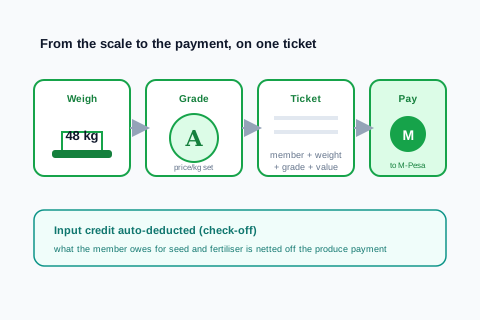
The intake-to-payment flow
A trustworthy intake process is a short, disciplined sequence where each step is recorded against the member and visible to them.
-
Weigh, against the member
Each delivery is weighed and the weight recorded immediately against the member's account — not scribbled on a shared sheet to be entered later, when transcription errors and disputes creep in.
-
Grade, on a clear standard
Grade is assigned against a defined, published standard (moisture, size, defects — whatever the crop demands), and the grade sets the price per kilo. A documented standard turns grading from an argument into a check.
-
Issue a ticket the member keeps
The member receives a record — printed or by SMS — showing weight, grade, price, and value. Transparency at the point of intake is what pre-empts the dispute weeks later at payment.
-
Pay for exactly what was delivered
When the payment cycle runs, each member is paid the sum of their tickets at grade prices, net of any input credit — with the calculation traceable to every delivery.
Why recording at the point of intake matters
The most common and most corrosive failure is the delay between weighing and recording. When deliveries are captured on paper and entered into a book or spreadsheet later, three things go wrong: transcription errors creep in, tickets get lost or duplicated, and the member has no immediate proof of what they delivered. Recording weight and grade against the member at the moment of intake — and handing them a matching ticket — closes all three gaps at once. The member leaves with certainty, and the co-op has a record that will still reconcile at payment time.
Every dispute at payment time is really a dispute about a number that was never properly recorded at intake.
Where co-op conflict actually starts
Paying correctly, net of credit
Payment is where the co-op's integrity is tested in public. Each member expects to be paid for the exact weight they delivered, at the grade price agreed, less only what they genuinely owe for inputs advanced on credit. When intake was recorded cleanly against the member, this is a calculation the system does automatically and can explain line by line. When it was not, payment becomes a fraught reconstruction, and every rounding or omission becomes a grievance. Accurate, explainable, on-time payment — increasingly straight to M-Pesa — is what keeps members loyal and delivering.
Fair, recorded intake and accurate payment are the foundation of the whole cooperative operation. Get them right and members deliver more, disputes fall away, and the co-op earns the clean records that unlock better buyers and financing. Get them wrong and no amount of good intention downstream can recover the trust lost at the scale.
What AWRA OpsHub does today
- Stock received into a store with batch, weight-as-quantity, expiry and quality status.
- Batch trace events, so a consignment can be reconstructed through the chain.
- Supplier records, if you model each farmer as a supplier — the closest available workaround.
- Purchase orders and payments to suppliers, with a consolidated payments register.
More we can add to your workspace
- A member entity, a member number, a membership record.
- An intake ticket: a delivery ticket the farmer keeps, weight-and-grade capture at a collection point, and a printed receipt.
- Grading or quality-based pricing. Batches carry a quality status, but nothing computes payment from grade.
- Deductions or check-off against a member balance.
- A bulk member payout. M-Pesa already pays out — B2C to a phone number, B2B to a till or paybill, with the transaction landing on the Payments Register — and today the payee is a vendor and each payment is raised individually. A member record and a payout run that settles a whole membership against its deliveries is the build, and the rail is already there.
- A per-kilo payment calculation of any kind.
Almost nothing this article describes exists here, and the workaround — modelling every farmer as a supplier and every intake as a purchase order — technically records the transaction but gives the farmer no ticket, no grade-based price and no statement. For a collection point running hundreds of deliveries a day that is not viable. Say so early rather than discovering it at pilot.
Anything above that you need, we can build for you
Everything listed above as something we can add describes what ships in the standard product today — it is a starting point, not a limit on what AWRA OpsHub can do for your organisation. Kenya's eTIMS integration and its maintained payroll engine are both in the product because clients needed them and commissioned them; neither appeared by itself, and the same door is open for whatever you just read about. One qualification so this is worth what it claims: a small number of things on this blog we deliberately leave to a specialist rather than build — a statutory ledger we will not sign our name to, a rule that would decide a tax question for you, a clinical or member-funds record that belongs in a regulated system — and where that is true the post says so in those words. Everything else is a scope, a timeline and a price.
The operational work, which is what most commissions actually are
An extra approval stage in a chain that does not match the standard one, a custom field set on employees or assets that only your sector needs, an expiry that has to block an order rather than send an email, a report your board asks for in a shape nothing produces, or a scanner or weighbridge feeding the goods-in door. These are the commissions we are asked for most often and the smallest ones we quote — and unlike a revenue-authority pipeline, none of them waits on a regulator.
The module-shaped additions, which are the ones readers ask for most often
A price list with real discount authority, a customer-facing quotation that expires, a bill of materials or recipe costing, a staff advance that is issued, acquitted and chased, a member or unit ledger, a matching rule that holds a payment. Each of these is a build rather than a setting, and each has been quoted before — a bigger piece of work than a custom field, with a written spec and a date instead of a roadmap slide.
The report, document or pack nothing currently produces
The board pack in the shape your board actually asks for, a donor or funder layout, an invoice or receipt template carrying what your regulator or your customer expects, a dataset the report builder cannot reach yet. Usually the fastest thing on this list to deliver, because the data is already in the system.
Systems, rails and hardware you already run
The accounting package, CRM, online store, core banking or custom database you intend to keep — connected through our API so a fact is entered once and appears everywhere it is needed. Plus the physical edge: a scanner, a scale, a weighbridge or a till peripheral feeding the door it belongs to.
How it works: you describe the requirement, we return a written scope, timeline and cost, and once agreed it is built into your environment and maintained as part of the product. Nothing here waits on a regulator or a published specification, which is why operational builds are the ones we quote fastest. Tell us the requirement that would otherwise rule us out — that is a better first conversation than a demo.
Tell us what your operation needsMake the scale and the payment provably fair
Produce received into a store with batch, quantity and quality status, and full trace events — the stock side, not the member side.
Explore agribusiness & co-op operationsFrequently asked questions
Why record produce intake against the member on the spot?
Because the delay between weighing and recording is where errors, lost or duplicated tickets, and disputes are born. Capturing weight and grade against the member at the moment of intake — and giving them a matching ticket — means the member leaves with proof and the co-op has a record that still reconciles weeks later at payment time.
How does grading stay fair?
By grading against a defined, published standard (moisture, size, defects, or whatever the crop requires) rather than a clerk's subjective call, and recording the grade with the delivery. Because grade sets the price per kilo, a documented standard turns grading from an argument into a verifiable check the member can understand.
How are member payments calculated?
Each member is paid the sum of their recorded deliveries at the applicable grade prices, less any input credit they owe (recovered by check-off). When intake was recorded cleanly against the member, the system calculates this automatically and can explain it delivery by delivery — increasingly paying straight to M-Pesa.
What causes most payment disputes in cooperatives?
Almost always a number that was never properly recorded at intake — a weight scribbled on a shared sheet, a ticket lost, a grade no one can substantiate. Fix the recording at the scale and the disputes at payment largely disappear, because every figure traces back to a delivery the member witnessed.