Farm-Input Credit & Stock Control: Lending Inputs Without the Leak
Advancing seed and fertiliser on credit is how co-ops and input dealers grow their farmers — and how many of them quietly lose money. The difference is whether the advance is tracked as a real debt against real stock, or trusted to memory. Here is how to run input credit without the leak.
Farm inputs on credit are one of the most valuable services a cooperative or input dealer offers: seed, fertiliser, and chemicals advanced at the start of a season when farmers have no cash, recovered from produce payments at the end. Done well, it lifts yields, deepens member loyalty, and grows the whole business. Done on loose records, it is the fastest way to bleed a co-op dry — because it combines the two things that leak most easily, stock and credit, into a single transaction that is often recorded as neither. Getting input credit right means treating it as exactly what it is: inventory leaving the store, and a debt landing on a member's account.
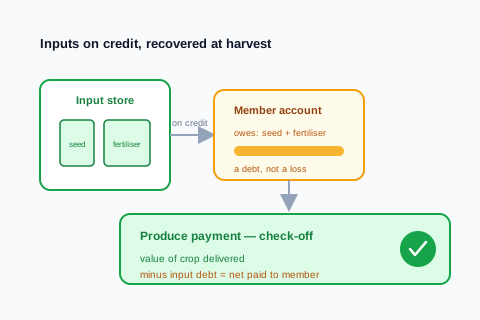
Two leaks in one transaction
When a member collects a bag of fertiliser on credit, two things must be recorded, and informal systems usually capture neither properly:
-
Stock leaves the store — record the movement
Fertiliser and seed are inventory with real cost. Issued without recording, the store's stock figure drifts from reality and the value simply disappears — the same stock leak any warehouse suffers, made worse by being given away on trust.
-
A debt lands on the member — record the credit
The advance is money the member owes, to be recovered at harvest. Recorded as a proper member debt, it is an asset waiting to be collected; unrecorded, it is a gift the co-op did not mean to give.
-
Recover at payment — check-off
When the member is paid for produce, the input debt is netted off automatically. The member sees crop value, less what they owed, equals net pay — traceable to both the input issue and the deliveries.
Why input stock needs the same discipline as any store
Input dealers and co-op stores hold serious value in seed, fertiliser, and agrochemicals — often bought on the co-op's own credit line or a supplier's terms. That stock deserves the same control as any inventory: recorded receipts against purchase orders, issues booked against members or cash sales, and periodic counts to catch the difference. Agrochemicals add a further reason for discipline — expiry and batch traceability matter for products with shelf lives and regulatory requirements, and selling expired or unrecorded chemicals is both a financial and a compliance risk.
An input advance is not a favour you hope comes back — it is stock that left the store and a debt that must be collected.
The mindset that stops the leak
Recovery rates you can actually see
The number that decides whether an input-credit scheme is sustainable is the recovery rate — how much of what was advanced is actually recovered at harvest. On paper systems, nobody knows it until the season's losses are totted up and it is too late to act. When input issues and produce payments live on one system, recovery is visible in real time: which members are behind, which advances exceed a member's likely crop value, and whether the scheme as a whole is covering its cost. That visibility is what lets a co-op lend inputs boldly to good members and cautiously where the risk is real — instead of lending blindly and hoping.
Input credit is one of the highest-leverage parts of a co-op or agribusiness operation — and one of the highest-risk when it is not tracked. Treat every advance as stock out and a debt on, recover it by check-off at produce payment, and watch the recovery rate: that is the whole difference between an input scheme that funds the season and one that quietly funds nobody.
What AWRA OpsHub does today
- Inputs as tracked stock across stores and locations, with governed issues and transfers.
- Batch and expiry tracking on agrochemicals and seed, with FEFO depletion.
- Blind counting with variance rules, so an input store reconciles honestly.
- Procurement with thresholds and supplier prequalification for input suppliers.
- Adjustments with catalogued reasons for damage and expiry write-offs.
More we can add to your workspace
- A member debt or credit account, recording that a member owes for inputs and giving you a balance to recover.
- A check-off. Automatic recovery from a member's produce payment does not exist, because neither the member nor the payment does.
- Recovery-rate reporting, since there is nothing to recover against.
- A credit limit or eligibility rules per member.
- A seasonal or crop-cycle concept to align issue and recovery.
The stock half is genuinely solid — an input store with batch, expiry and enforced blind counting is real control over goods that expire and walk. The credit half is the build, and it is the half this article is actually about. Input credit needs a member ledger, so until that is commissioned it lives in whatever system holds your member accounts.
Anything above that you need, we can build for you
Everything listed above as something we can add describes what ships in the standard product today — it is a starting point, not a limit on what AWRA OpsHub can do for your organisation. Kenya's eTIMS integration and its maintained payroll engine are both in the product because clients needed them and commissioned them; neither appeared by itself, and the same door is open for whatever you just read about. One qualification so this is worth what it claims: a small number of things on this blog we deliberately leave to a specialist rather than build — a statutory ledger we will not sign our name to, a rule that would decide a tax question for you, a clinical or member-funds record that belongs in a regulated system — and where that is true the post says so in those words. Everything else is a scope, a timeline and a price.
The operational work, which is what most commissions actually are
An extra approval stage in a chain that does not match the standard one, a custom field set on employees or assets that only your sector needs, an expiry that has to block an order rather than send an email, a report your board asks for in a shape nothing produces, or a scanner or weighbridge feeding the goods-in door. These are the commissions we are asked for most often and the smallest ones we quote — and unlike a revenue-authority pipeline, none of them waits on a regulator.
The module-shaped additions, which are the ones readers ask for most often
A price list with real discount authority, a customer-facing quotation that expires, a bill of materials or recipe costing, a staff advance that is issued, acquitted and chased, a member or unit ledger, a matching rule that holds a payment. Each of these is a build rather than a setting, and each has been quoted before — a bigger piece of work than a custom field, with a written spec and a date instead of a roadmap slide.
The report, document or pack nothing currently produces
The board pack in the shape your board actually asks for, a donor or funder layout, an invoice or receipt template carrying what your regulator or your customer expects, a dataset the report builder cannot reach yet. Usually the fastest thing on this list to deliver, because the data is already in the system.
Systems, rails and hardware you already run
The accounting package, CRM, online store, core banking or custom database you intend to keep — connected through our API so a fact is entered once and appears everywhere it is needed. Plus the physical edge: a scanner, a scale, a weighbridge or a till peripheral feeding the door it belongs to.
How it works: you describe the requirement, we return a written scope, timeline and cost, and once agreed it is built into your environment and maintained as part of the product. Nothing here waits on a regulator or a published specification, which is why operational builds are the ones we quote fastest. Tell us the requirement that would otherwise rule us out — that is a better first conversation than a demo.
Tell us what your operation needsLend inputs without losing the money
Inputs as tracked stock with batch, expiry and FEFO, governed issues and enforced blind counts — the goods side of input credit.
Explore agribusiness & co-op operationsFrequently asked questions
What is input credit / the check-off model?
It is advancing farm inputs — seed, fertiliser, chemicals — to members on credit at the start of a season and recovering the cost from their produce payments at harvest (check-off). It boosts yields and loyalty when tracked properly, but leaks money fast when the advance is recorded as neither stock nor debt.
Why is input credit so prone to losses?
Because it combines the two things that leak most easily — inventory and credit — in one transaction. If the stock leaving the store is not recorded, the store's value drifts and disappears; if the debt on the member is not recorded, the advance becomes an unintended gift. Both must be captured, and the debt recovered by check-off at payment.
What is a recovery rate and why track it?
The recovery rate is how much of the input credit advanced is actually recovered at harvest. Tracked in real time — rather than discovered in end-of-season losses — it shows which members are behind, which advances exceed likely crop value, and whether the scheme covers its cost, letting a co-op lend boldly to good members and cautiously where risk is real.
Do co-op input stores need inventory controls too?
Yes — seed, fertiliser, and agrochemicals are valuable stock deserving the same discipline as any warehouse: receipts against purchase orders, issues booked to members or cash sales, and periodic counts. Agrochemicals also need expiry and batch traceability, since selling expired or unrecorded chemicals is both a financial and a compliance risk.