
Free Zone or Mainland: One SKU, Two Landed Costs
Duty is suspended in a free zone, not waived. The same carton therefore carries two different true unit costs depending on where it eventually goes, and most stock systems can only hold one of them. The arithmetic, the failure mode it creates, and how to structure around it.
Ask a UAE distributor what a particular item costs them and you will usually get one number. Ask whether that number assumes the goods clear into the mainland or leave on a re-export, and the conversation changes — because those are two different numbers, both correct, and the business has been running reports on whichever one happened to be entered.
This is not an exotic edge case. It is the ordinary condition of trading through a free zone, and it is the single most consequential operational fact in this market. It is also almost entirely absent from vendor material, which is why it is worth its own post.
Nothing here is customs, tax or legal advice. Duty rates, exemptions, customs valuation basis and the treatment of any particular consignment are matters for the relevant customs authority, your clearing agent or your adviser, and they vary by commodity and by circumstance. The figures below are illustrative arithmetic, not a tariff schedule.
What suspension actually means
Goods held inside a free zone sit outside the customs territory. Import duty has not been forgiven; it has simply not been triggered yet. Two things can happen next, and they are financially different events.
The goods re-export
- They leave without ever entering the customs territory.
- Duty is never triggered. The liability that was hanging over the consignment simply expires.
- The costs that remain are real but modest: outbound documentation, handling, sometimes storage.
- This is the commercial reason the free zone location exists at all.
The goods clear into the mainland
- They cross into the customs territory and duty becomes payable.
- Duty is a cost of the goods, not an administrative fee. It belongs on the unit.
- Clearing agent charges, inland transport and any inspection cost arrive alongside it.
- From this moment the item is more expensive than the identical item on the next shelf.
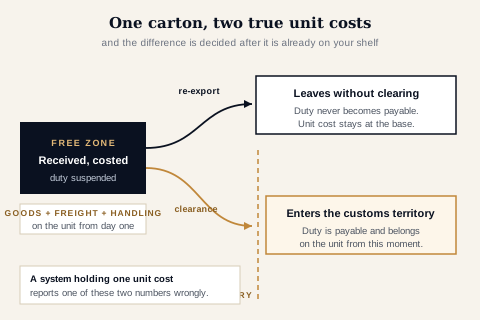
The arithmetic, on a real-shaped consignment
Take a container of five thousand units bought at a hundred thousand dollars. The dirham is pegged, so the conversion is stable and uninteresting — which is precisely why nobody looks at this leg for the risk.
Common to both routes — the base cost in the free zone
Every one of those three lines belongs on the unit already. A business that expenses freight and handling separately is understating cost of goods by AED 3.70 a unit before the interesting part even begins.
Route A — re-exported
Route B — cleared into the mainland
The 5% figure is the headline GCC common external tariff. Many commodities sit outside it, some at zero, and the customs valuation basis is not always what you assume. Use your own clearing agent's numbers, not this paragraph's.
Four dirhams and thirty-three fils. Five and a half per cent. On a distribution business running a twelve per cent gross margin, that difference is roughly forty-five per cent of the margin on every unit that took the second route — and it is invisible to any system holding a single average cost for the item.
The two numbers are both correct. The failure is having only one field to put them in.
How this actually goes wrong
The failure is rarely dramatic. Nothing crashes, no report is obviously wrong, and the year-end balances. Here is the sequence, which we have now watched enough times to describe it without needing an example.
-
The free zone and the mainland are set up as one stock location
Usually because they are one operation in everybody's head, and because setting up two locations felt like unnecessary complexity during implementation. It takes ten minutes to do and is expensive to undo.
-
Duty is posted as an expense
The clearing agent invoice arrives weeks after the goods, addressed to nobody in particular, and it lands in a customs and duty expense account because that is where invoices like that go.
-
Average cost quietly blends the two routes
The system now holds one weighted cost sitting somewhere between AED 77.79 and AED 82.12, matching neither. Every margin report from this point is confidently wrong in both directions.
-
Pricing is set off the blended number
Which means the re-export business is priced as though it carried duty and is losing deals it should win, and the mainland business is priced as though it did not and is winning deals it should lose.
-
Somebody investigates a year later
By which point the consignment records, the clearing invoices and the sales are three separate piles and the reconstruction is a project rather than a query. This is the point at which we usually get the call.
Note that step four is the expensive one and step one caused it. That gap — between the cheap configuration decision and the costly consequence — is the whole reason this deserves attention before go-live rather than after.
Structuring it properly
The fix is unglamorous, which is probably why it gets skipped. There is no clever feature here, only four structural decisions taken in the right order.
Four decisions, all cheap before go-live
- Free zone and mainland are separate stock locations. Not warehouses within a location, not a bin naming convention — separate locations with their own stock position, so a report can ask about one without the other.
- The move between them is a governed, costed transfer with the customs documentation attached to it, not a quantity adjustment. It is the moment your cost base changes and it should look like an event in the record.
- Duty and clearing land on the receipt as landed cost, allocated to the consignment they belong to, so they reach the unit rather than a monthly expense line that nobody can attribute afterwards.
- Decide your costing method deliberately. If your routes genuinely diverge, a single blended average across both is a decision to be wrong on purpose. Talk it through with your accountant rather than accepting whatever the system defaulted to.
Where AWRA OpsHub sits in this
All four of those are ordinary configuration in our product rather than customisation: locations, governed transfers with documents attached, and landed cost allocated per consignment and carried into unit cost. What we do not do is any part of the customs transaction itself — no declaration, no connection to Dubai Trade, Mirsal or any port community system, and no view on how a particular commodity should be classified. We hold the cost consequence; your clearing agent owns the customs event.
Our scope, plainly
What AWRA OpsHub does today
- Separate stock locations for free zone and mainland, each with its own live position, counts and valued variance.
- Governed transfers between them, with in-transit visibility and the customs paperwork attached to the transfer record.
- Landed cost allocated per consignment — freight, insurance, handling, duty and clearing folded into true unit cost rather than absorbed into overhead.
- Foreign-currency purchases at the rate actually applied, held on the transaction, which is what makes the buy-leg exposure visible at all.
- Documents on the record — bill of lading, packing list, certificate of origin, clearing invoice — retrievable from the consignment rather than from a shared drive.
- The African leg of the same lane in genuine depth, which is the reason most of our UAE conversations start.
More we can add to your workspace
- A customs system integration: a connection to Dubai Trade, Mirsal or a port community system. Declarations are made by your agent and recorded here as evidence today, rather than exchanged as data.
- A duty calculation and tariff classification. Holding a tariff schedule is a build; determining an HS code stays your declarant's, and we will not guess at a rate. Today you enter the duty your agent actually charged.
- An FTA e-invoicing integration, structuring, submitting and clearing against the Federal Tax Authority or an accredited service provider. Our fiscal e-invoicing integration today is Kenya's eTIMS, and it is Kenya-only.
- A view on free zone VAT treatment, designated zone rules or reverse charge. Those are questions for the FTA or your adviser and we would be wrong to answer them.
- A bonded warehouse module in the specialised sense — an automated duty-suspension liability register and per-consignment bond tracking. Locations and landed cost do the operational work today; the liability position lives with your agent.
- An intercompany elimination, so if your free zone and mainland entities are separate legal persons, a statutory consolidation stays with your auditor.
If you take one thing from this post, take the location decision. It costs nothing at configuration, it cannot be applied retroactively to eighteen months of movement history, and it is what makes every question below it answerable. That is true whoever you buy from.
What we can build for the UAE on top of the standard product
Everything listed above as something we can add describes what ships in the standard product today — it is a starting point for the UAE, not a limit on what AWRA OpsHub can do there. Kenya's eTIMS integration and its maintained payroll engine are in the product because Kenyan clients needed them and commissioned them; neither appeared by itself. The same door is open here. If FTA e-invoicing, a WPS salary file, a bank or mobile money feed, a statutory return format, a rule specific to how your operation runs, or a link to a system you already have is what stands between you and a decision, tell us and we will scope it as a build — written spec, timeline and price — before you commit to anything.
FTA e-invoicing and VAT output
Document structuring and submission through an accredited service provider under the Ministry of Finance programme, with the parts vendors gloss over — rejection handling, resubmission, and a daily report of sales carrying no registration identifier. Corporate tax computation stays with your adviser by design; what we would build is the record it is computed from.
Banks, acquirers and customs paperwork
Bank statement feeds, card acquirer settlements and instant-payment files pulled into the Payments Register, plus a data link to your clearing agent or port community system so a customs event updates the consignment instead of arriving as an email.
The operational work, which is what most commissions actually are
An extra approval stage in a chain that does not match the standard one, a custom field set on employees or assets that only your sector needs, an expiry that has to block an order rather than send an email, a report your board asks for in a shape nothing produces, or a scanner or weighbridge feeding the goods-in door. These are the commissions we are asked for most often and the smallest ones we quote — and unlike a revenue-authority pipeline, none of them waits on a regulator.
Payroll and statutory returns
WPS salary files in the layout MoHRE or your free zone authority expects, with end-of-service gratuity accrued on live employee records rather than estimated in a spreadsheet each year.
Systems you already run
The accounting package, CRM, online store or custom database you intend to keep — connected through our API so a fact is entered once and appears everywhere it is needed.
How it works: you describe the requirement, we return a written scope, timeline and cost, and once agreed it is built into your environment and maintained as part of the product. No roadmap slide, and no pretending in a demo that something exists when it does not.
Tell us what you need integratedWhen this does not apply to you
- If everything you import clears into the mainland, there is only one route and one cost. Set up landed cost properly and stop reading — the rest of this is complexity you do not have.
- If everything re-exports, likewise. The discipline that matters for you is that freight and handling still reach the unit, which most businesses in this position already get right.
- If your volumes are small and your SKU count is tiny, a spreadsheet per consignment genuinely works. Do not buy a system to solve a problem four columns can hold.
- If you are mixed, and most trading businesses through Dubai are, then the two-cost problem is yours whether or not your system acknowledges it. The only question is when you find out.
Where to go next
The wider buying frame — including the three quite separate products the word "ERP" is doing duty for in this market — is in the UAE buyer's guide. If the container in question is heading to an operating company further south, the Dubai–Africa trade lane picks up where this post stops, at the point the goods leave. And the general discipline of measuring cost at the rate actually paid, worked through in a market where the currency does move, is in multi-currency operations.
Our take
Two locations, one costed transfer between them, duty on the receipt, and a costing method chosen on purpose. Four decisions, none of them clever, all of them nearly free before go-live and genuinely painful afterwards. The businesses that get this right are not running better software than their competitors — they are running the same software configured by someone who asked the question in week one.
Cost one real container, both ways
Bring a consignment that actually arrived. We will cost it as a re-export and as a mainland clearance, show you the two unit costs and the reason they differ, and you can decide whether that changes anything for you.
Explore AWRA for the UAEFrequently asked questions
Can the same item really have two different costs in one system?
Yes, and the cleanest way to get there is by structure rather than by cleverness: the free zone and the mainland are separate stock locations, and the costed transfer between them is where duty and clearing attach. The item is one item; the cost is a property of the stock in a location, not of the item in the abstract. If instead you hold both routes in one location under a single weighted average, you get a blended figure that matches neither route, and no report afterwards can unblend it.
Do you connect to Dubai Trade or Mirsal?
No. There is no integration with Dubai Trade, Mirsal or any port community or customs system, and we do not lodge, retrieve or track declarations. Your clearing agent performs the customs transaction and we record its consequences — the duty, the charges, the documents and the resulting unit cost. If a data link to your agent or to a port system is what stands between you and a decision, that is a build we would scope in writing rather than a feature we would claim.
Does AWRA calculate the duty for us?
No, deliberately. We hold no tariff schedule, we do not classify goods to an HS code and we will not estimate a rate, because a wrong duty figure produced confidently by software is worse than no figure at all. You enter what your agent actually charged, and the system allocates it across the consignment so it reaches the unit. Classification and rate are questions for customs or your agent.
What about VAT on the free zone side?
Not something we determine. Designated zone rules, the treatment of supplies within and out of a free zone, and reverse charge positions are genuinely technical and depend on facts about your business that a software vendor should not be interpreting. We ship a 5% VAT preset and separate net, tax and gross on every line at the point of capture, which gives your adviser a clean record to work from. The treatment itself is theirs, and you should confirm it with the Federal Tax Authority or your tax adviser.
Is this worth restructuring for if we have been running blended for years?
Usually yes, but not retroactively — and that distinction matters. You cannot recover the true route-level cost of movements already recorded without the underlying detail, so treat the history as lost and structure correctly from a chosen date forward. Most businesses do this at a stock count boundary, which gives a clean opening position. The value arrives from the first month, not from the reconstruction.
Does any of this transfer to other free zones in the region?
The principle does — duty suspension, a boundary crossing that changes the cost base, and the need to model the boundary in the system — and it applies well beyond the Gulf, including to bonded arrangements in East and Southern Africa. What does not transfer is any specific rate, valuation basis or procedure, and the wider regime around it differs country by country. Take the structural lesson and get the numbers locally.
