
Multi-Currency Operations in Egypt & Morocco: Two Very Different Problems
The Egyptian pound and the Moroccan dirham are both "the local currency" and almost nothing else about them is alike. One punishes businesses that record a rate carelessly; the other punishes businesses that believe they have no exposure at all.
Group finance teams tend to treat multi-currency as one capability. You either have it or you do not, and if you have it you are covered everywhere. Egypt and Morocco are a useful pair precisely because they break that assumption: the same feature set protects you in one country and leaves you completely exposed in the other, for reasons that have nothing to do with software.
The difference is not that one currency is riskier. It is that the risk sits somewhere different, and the discipline that catches it is therefore different too.
Currency arrangements change. Confirm the current position for both countries with your bank or adviser rather than relying on any description here; nothing in this post is financial or tax advice.
Two problems wearing one name
Egypt — the rate you recorded is the whole story
- The pound has repriced substantially more than once in recent years, and the gap between the rate assumed at order and the rate applied at settlement can be wide.
- Foreign currency availability adds a second variable: the delay between committing to pay and actually paying is itself an exposure.
- The failure is arithmetic. A cost recorded at a standing rate is not slightly wrong — it can be wrong by more than the entire margin on the item.
- The discipline: record the rate that actually applied, per transaction, and fold the true landed cost onto the goods before anything is priced.
Morocco — the exposure you did not think you had
- The dirham is managed within a band against a currency basket weighted toward the euro, and has historically been far steadier than most currencies in this series.
- Steadiness breeds a specific complacency: businesses stop applying rate discipline entirely, because for years nothing punished them for it.
- The real exposure is rarely the dirham at all. An exporter sells in euros, buys inputs in euros or dollars, and pays costs in dirhams — the margin is a spread across three currencies.
- The discipline: know which currency each side of a contract is in, and measure margin in the currency you actually get paid in.
A volatile currency teaches discipline by inflicting pain. A stable one removes the lesson and leaves the exposure.
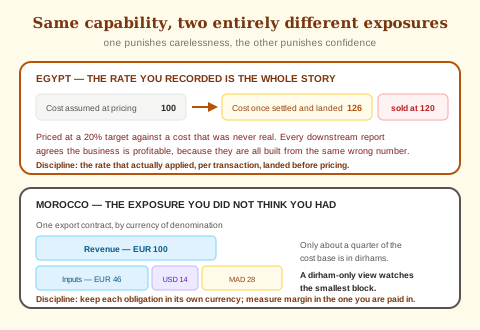
The Egyptian arithmetic
Take an ordinary import, priced when the order is placed and paid weeks later. Nothing unusual happens; everybody behaves reasonably.
An import priced at the order rate, settled at the payment rate
Illustrative figures indexed to 100, not tied to any actual rate or period. Price this at a 20% target off the assumed cost and you sell at 120 against a real cost of 126. The business believes it is profitable and is not — and every downstream report agrees with it, because they are all built from the same wrong cost.
What makes this hard to catch by hand is that no single component looks alarming. The rate difference arrives weeks after the pricing decision, from the bank rather than the supplier; the clearing charge arrives from a third party; and by the time the last one lands, most of the consignment has been sold.
The Moroccan arithmetic
Now the same exercise for an exporter in Casablanca or Tangier selling into Europe. The dirham barely moves, so nobody thinks about currency. The exposure is still there — it has simply moved to a place nobody is looking.
An export contract with revenue and costs in different currencies
Illustrative figures indexed to 100. The dirham-denominated costs are the smallest block, and the euro-dollar cross is doing more to this margin than the local currency ever will. A business measuring everything in dirhams sees a stable-looking picture and cannot tell whether a bad month was operational or a currency cross it never tracked. The fix is not hedging — that is a treasury decision above software — it is recording each contract and each input in the currency it was actually denominated in.
This is the point most systems get wrong in a subtle way. Converting everything to a single reporting currency at capture is convenient and destroys the information you need. The original currency of each obligation is a fact worth keeping.
The discipline, in both countries
-
Record the transaction currency, always
Not the converted amount alone. If a purchase was denominated in euros, the euro figure is the fact and the local amount is a derivation. Systems that keep only the derivation cannot answer the question later.
-
Use the rate that applied, not a standing rate
A monthly average or a rate set at the start of the quarter is an accounting convenience, not a costing input. For pricing decisions it needs to be the rate on the transaction.
-
Fold everything into landed cost before pricing
Duty, freight, insurance, clearing, handling and inland transport belong on the goods. A margin measured against an invoice price rather than a landed cost is a margin measured against a number that was never real.
-
Separate settlement difference from operating margin
When the paid rate differs from the recorded rate, that difference is a currency outcome, not a purchasing outcome. Mixing them makes both unreadable and hides whichever one is actually deteriorating.
-
Report margin in the currency you get paid in
For an exporter that is the contract currency. Converting to local currency for management reporting is fine as a second view and dangerous as the only one.
-
Re-derive, do not re-key
Any figure a person retypes into a spreadsheet to answer a currency question will be wrong within a week. The system should be able to produce it directly or the discipline will not survive contact with a busy month.
The general treatment of the costing side is in what is landed cost, and the cross-border group version of the reporting problem is in multi-currency accounting for cross-border trade — a different region, identical arithmetic.
What we do here
What AWRA OpsHub does today
- The Egyptian pound and the Moroccan dirham ship as built-in currency presets, alongside a VAT rate preset for each country.
- Transactions recorded in their original currency, with the exchange rate actually applied to that transaction rather than a standing rate.
- Landed cost per consignment — duty, freight, insurance, clearing, handling and inland transport folded into true unit cost before the item is priced.
- Margin visible against real cost, so a sale is measured against what the goods actually cost rather than against an invoice value.
- Multi-currency purchasing and sales across locations, with reporting that can distinguish the currency an obligation was denominated in.
- Additional tax lines configurable with their own rates, effective dates and treatment.
More we can add to your workspace
- Customs or clearing functionality — we record what an import cost, not what it required.
- Fiscal e-invoicing in either country. Our only such integration is Kenya's eTIMS.
- Statutory payroll for Egypt or Morocco, and no Arabic or French interface.
Where we point you to a specialist
- We are not a treasury system. No hedging instruments, no forward contracts, no exposure management, no position monitoring.
- We do not source or forecast exchange rates for you as a market data service, and we do not advise on which rate is correct for a given accounting purpose.
- We do not perform statutory currency translation for consolidated financial statements — that is your auditor's domain.
The treasury boundary is worth being clear about. Recording exposure accurately and managing it are different disciplines, and a vendor who blurs them is offering you a false sense of control. What good records buy you is the ability to have an informed conversation with a bank or a treasury adviser — which is considerably more than most businesses in either country can currently do.
What we can build for Egypt on top of the standard product
Everything listed above as something we can add describes what ships in the standard product today — it is a starting point for Egypt, not a limit on what AWRA OpsHub can do there. Kenya's eTIMS integration and its maintained payroll engine are in the product because Kenyan clients needed them and commissioned them; neither appeared by itself. The same door is open here. If ETA e-invoicing, an Arabic right-to-left interface, a bank or mobile money feed, a statutory return format, a rule specific to how your operation runs, or a link to a system you already have is what stands between you and a decision, tell us and we will scope it as a build — written spec, timeline and price — before you commit to anything.
ETA e-invoicing and e-receipts
Document structuring to the prescribed format and submission against the Authority's interface, including the part vendors skip — rejection handling, resubmission, and a daily report of sales with no registration identifier.
Arabic interface, banks and payments
Arabic text with right-to-left layout and bilingual document templates, plus bank feeds and local payment gateways wired into the Payments Register.
The operational work, which is what most commissions actually are
An extra approval stage in a chain that does not match the standard one, a custom field set on employees or assets that only your sector needs, an expiry that has to block an order rather than send an email, a report your board asks for in a shape nothing produces, or a scanner or weighbridge feeding the goods-in door. These are the commissions we are asked for most often and the smallest ones we quote — and unlike a revenue-authority pipeline, none of them waits on a regulator.
Payroll and statutory returns
An Egyptian payroll engine with income tax bands and social insurance contributions, producing schedules in the layout your filing body expects rather than a spreadsheet rebuilt each month.
Systems you already run
The accounting package, CRM, online store or custom database you intend to keep — connected through our API so a fact is entered once and appears everywhere it is needed.
How it works: you describe the requirement, we return a written scope, timeline and cost, and once agreed it is built into your environment and maintained as part of the product. No roadmap slide, and no pretending in a demo that something exists when it does not.
Tell us what you need integratedQuestions worth asking yourself
- In which currency is each of my revenue contracts actually denominated? If the answer requires opening contracts, your system is not holding a fact it should be.
- In which currency are my three largest input costs denominated? Exporters frequently discover the answer is not the one they assumed.
- When I price, what cost am I pricing off? Invoice value, landed cost, or a standard set last year and never revisited.
- Can I separate a bad month caused by operations from one caused by a currency cross? If not, both will be attributed to whichever is more comfortable.
- What rate does my system use, and who set it? "The system rate" is not an answer; somebody chose it and somebody should be maintaining it.
- Would I know if the exposure changed? In a stable-currency country the honest answer is usually no, which is exactly the Moroccan risk.
Where to go next
The country buying frames are in the Egypt buyer's guide and the Morocco buyer's guide. For exporters specifically, the operational half of the Moroccan story is in manufacturing and export operations in Morocco, and the layered view of what "localized" means in this region is in Arabic, French and the localization nobody tests.
Our take
Keep the original currency of every obligation and the rate that actually applied, then measure margin in the currency you are paid in. In Egypt that discipline protects you from an arithmetic that can consume an entire margin between the order and the payment. In Morocco it protects you from something more insidious — a currency that has been calm for so long that nobody noticed the exposure moved to the euro.
See costing that survives a moving rate
Purchases recorded in their original currency at the rate actually applied, landed cost folded onto the goods, and margin measured against what things really cost.
Explore AWRA for EgyptFrequently asked questions
Does AWRA support the Egyptian pound and Moroccan dirham?
Yes — both ship as built-in currency presets, each alongside a VAT rate preset for the country. Transactions can be recorded in their original currency with the exchange rate actually applied to that transaction, rather than everything being converted at a standing rate at the point of capture. That distinction is what makes the rest of the costing discipline possible.
Can it show margin in the currency we are paid in?
Yes, and for exporters it should. Keeping the original currency of each contract and each input cost means margin can be measured in the contract currency rather than only in a converted local figure. A business that converts everything to one reporting currency at capture loses the ability to tell whether a bad month came from operations or from a currency cross it was never tracking.
Do you provide exchange rates?
We do not operate as a market data service and we do not advise on which rate is appropriate for a given accounting purpose — that is a question for your accountant. What the system does is record the rate you apply to a transaction and keep it with that transaction, so costing and margin are computed against what actually happened rather than against a standing assumption somebody set months ago.
Is this a treasury or hedging system?
No. There are no hedging instruments, no forward contracts, no exposure management and no position monitoring. Recording exposure accurately and managing it are different disciplines and we only do the first. What accurate records buy you is the ability to have a specific, evidenced conversation with your bank or treasury adviser, which for most businesses in this position is the missing piece rather than the instruments themselves.
How does landed cost work for imports?
Duty, freight, insurance, clearing, handling and inland transport are folded into the true unit cost of the goods received, per consignment, so margin on a subsequent sale is measured against what the consignment genuinely cost. For an Egyptian importer this is the single most valuable discipline in the system, because the gap between an assumed rate and a settlement rate can exceed the entire intended margin on the item.
Our currency is stable — do we need any of this?
That is the Moroccan question, and the honest answer is that stability moves the exposure rather than removing it. If you sell in euros and buy inputs in euros and dollars, your margin is a cross between two foreign currencies and the dirham is almost incidental to it. A business that has never needed rate discipline typically has no records with which to analyse the exposure when someone finally asks — which is a worse position than a volatile-currency business that learned the habit under pressure.
