
ERP Software in Morocco: A Practical Buyer's Guide (2026)
Moroccan buyers are usually choosing between a French-language local incumbent and an English-language international platform, and the deciding factor is almost never the feature list. Who reads the screen, who keeps the statutory books, and who answers the phone in March.
The Moroccan software market has a shape that most of this series does not. There is a competent local industry, an established relationship between businesses and external accounting firms, and a working language — French, alongside Arabic — that international vendors overwhelmingly do not support. A buyer here is not choosing between software and spreadsheets. They are choosing between two different theories of who does what.
That makes the useful question less "which product is better" and more "which parts of my operation do I want served locally, and which parts genuinely do not care what language they are in".
Nothing here is tax, accounting or legal advice. Confirm all statutory obligations with the Direction Générale des Impôts, your fiduciaire or your own adviser.
Which buyer are you?
Three shapes recur in Moroccan conversations and they should lead to genuinely different purchases. Identify yours before you look at a single demo.
Shape one
A domestic business, working in French and Arabic
Your staff, your suppliers, your customers and your fiduciaire all work in French or Arabic, and your statutory accounting follows Moroccan conventions. Buy locally. A Moroccan vendor with French documentation, local accounting alignment and a support line in your language will serve you better than any international product, and we will tell you so on the first call.
Shape two
An exporter serving European customers
Your revenue is in euros, your customers audit you, and part of your team already works in English or is comfortable doing so. Here the operations layer — traceability, stock, procurement, cost — is genuinely language-agnostic in a way statutory accounting is not, and an international platform becomes reasonable.
Shape three
A branch, subsidiary or NGO of a larger group
Head office is elsewhere, reporting is consolidated, and the group already has an operations standard. The Moroccan entity needs to fit the group's system while its statutory accounting stays local. The split is natural and this is the shape we fit best.
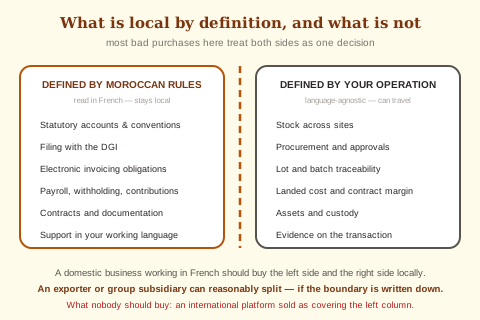
Statutory accounting is local by definition. Stock control is not. Most bad purchases here come from treating both as the same decision.
The deciding axis
Rather than a feature comparison, here is the axis Moroccan buyers are really moving along — and what you gain and give up at each position on it.
Local incumbent to international platform
Full local suite
Statutory accounting aligned to Moroccan conventions, French interface and documentation, support in your timezone and language, and someone who has met your fiduciaire. For a domestic business this is usually simply correct.
Local accounting, local operations, one vendor
The same, extended into stock and procurement. Coherent, and the right answer if the local product's operations depth genuinely matches your operation rather than merely existing on the price list.
Local statutory accounting plus an international operations layer
Your fiduciaire or local package keeps the books to Moroccan conventions; an international system runs stock, procurement, traceability, assets and cost. Where we fit. Requires a written boundary and a team comfortable in English.
One international platform for everything
Attractive to groups wanting a single standard, and the position most likely to end in a bad surprise — statutory accounting conventions and local filing rarely travel, whatever the sales deck implies.
Notice that both extremes are coherent and the trouble lives in the middle-right, where a buyer chooses an international platform and only later discovers which statutory layer it never covered. Decide deliberately where you want to sit and make every vendor tell you where they think they sit.
Our status, layer by layer
The same seven-layer frame we apply across North Africa, scored for Morocco. Use it on every vendor you shortlist, local or international.
Morocco: which localization do you mean?
The Moroccan dirham
MAD ships as a built-in currency preset, and transactions in euros or dollars record the rate actually applied — which for an exporter matters far more than the dirham itself.
A VAT rate and VAT-aware records
A Moroccan taxe sur la valeur ajoutée rate ships as a preset, and net, tax and gross are separated line by line on purchases as well as sales at the point of capture.
Additional tax components
Further tax lines can be configured with their own rates, effective dates and inclusive or exclusive treatment. Configurable means you own the upkeep — we ship one maintained preset, not a maintained rate history.
Moroccan statutory accounting conventions
We are not a Moroccan-plan accounting package. We do not produce statutory financial statements to local conventions and we do not replace your fiduciaire or your local accounting software.
Electronic invoicing and filing
No integration with the DGI, no submission, no filing. Our only fiscal e-invoicing integration is Kenya's eTIMS. Morocco has been moving toward electronic invoicing requirements — confirm the current position and your own obligation with the DGI or your adviser.
Moroccan statutory payroll
Income tax withholding and social contributions are not calculated, produced or submitted for you. Our maintained statutory payroll engine covers Kenya only.
Interface and documents in French or Arabic
The interface is English only, with no right-to-left layout, and documents are produced in English. For a domestic Moroccan business this is usually the deciding limitation, and it should be.
Four marks against us, and one of them — the interface language — is the one most likely to matter on day one rather than in month six. If your team works in French, that is a sufficient reason to buy locally and we would rather you acted on it now. What remains for us is a specific and real segment: exporters and group subsidiaries whose operations layer is genuinely language-agnostic and whose statutory layer is already handled by people who do it properly.
What the operations layer is actually for
If you have concluded that a split makes sense, it is worth being precise about what the international half is buying you, because "an ERP" is too vague to justify the boundary.
-
A stock position that is true continuously
Every sale and every issue moves inventory in the same second, across every site. This is the foundation everything else is measured against, and it is where most operations fail long before accounting does.
-
Procurement that refuses
Requisition, threshold approval that blocks rather than warns, RFQ, quotation comparison and three-way matching against the delivery. Governance that can be clicked past is documentation of the moment somebody was overruled.
-
Traceability your customer can audit
For exporters this is frequently the whole reason for the purchase — lot and batch history that survives a European client visit. It is taken up properly in the manufacturing and export post.
-
True cost, in the currency that matters
Landed cost on imported inputs at the rate actually applied, and margin measured in the currency you are paid in rather than only in dirhams.
-
Assets with named custody
Location, condition, custodian and verification history — which for grant-funded or group-funded equipment is an obligation rather than a nicety.
-
Evidence attached to the transaction
Quotes, approvals, delivery notes and invoices held on the record, so your fiduciaire receives clean, substantiated data rather than a folder and a phone call.
That last point is the one that makes a split arrangement genuinely attractive rather than merely tolerable. An external accountant working from governed operational records is doing a different and much cheaper job than one reconstructing a year from receipts.
The buyer's scorecard
Morocco operations software scorecard
Weighted for a buyer keeping statutory accounting local and choosing what runs the operation.
The language your staff actually work in
Make them prove it: Put the storekeeper, not the finance director, in front of it for ten minutes. If they hesitate, the answer is decided regardless of anything else on this list.
A clear statement of what statutory work is not covered
Make them prove it: Ask directly whether they produce Moroccan statutory accounts and file anything. Prefer the vendor who says no cleanly to the one who talks about exports and formats.
Every sale moves inventory in the same second
Make them prove it: Record a sale, watch stock drop live, then run a variance report against a physical count.
Approvals that refuse rather than warn
Make them prove it: Attempt a purchase order above the threshold with no approval and watch whether the system blocks or merely complains.
Transactions kept in their original currency
Make them prove it: Enter a euro purchase and a dirham purchase and show both on one cost report with the original currency and applied rate visible.
Lot and batch traceability, both directions
Make them prove it: Pick a finished item and trace back to inputs; pick an input lot and trace forward to every customer who received it. Time both.
Evidence retrievable from the transaction
Make them prove it: Open a purchase from a year ago and produce the quote, approval, delivery note and invoice from the record — not from a shared drive.
A workable handover to your fiduciaire
Make them prove it: Ask what your accountant receives, in what form, and how often. Then ask your accountant whether that is useful to them before you sign.
Support hours that overlap your working day
Make them prove it: Ask for median first-response time in writing, in which language, and who answers on a Saturday.
Honesty about electronic invoicing
Make them prove it: Ask what is transmitted to the DGI and by whom. Vagueness here is the single most reliable warning sign in this category.
What to budget
| Cost | What it really is | How to size it |
|---|---|---|
| The subscription | Cloud platforms start in the tens of dollars a month and scale with users, sites and modules | Price the operation you will run in year two, not this month |
| Language friction | Time lost by staff working in a second language, and the risk of quiet non-adoption | Be honest about it. If it is material, it is not a budget line — it is a reason to buy locally |
| Data cleanup | Reconciling opening stock, items, suppliers and assets before go-live | One serious physical count per site, plus master data with a named owner and a deadline |
| The boundary with your accountant | Agreeing what the fiduciaire receives and in what form | Have that conversation with them before you sign, not after. It is short, and skipping it is expensive |
| Training the people who key transactions | Storekeepers, receivers, production and field staff | Count their hours, not the managers'. Adoption is decided at the keyboard |
Compare three-year totals including support rather than first-month prices — the method is in our ERP pricing guide, where the currency changes but the arithmetic does not.
Red flags
- An international vendor claiming Moroccan statutory accounting. Ask which conventions, produced how, signed off by whom. This claim rarely survives three questions.
- French offered as "we can translate the interface". Ask when, by whom, at whose cost, and to see it. Translation as a future intention is not a feature.
- Silence on the DGI. A vendor who neither integrates nor says so plainly has decided not to raise the subject with you.
- No view on your fiduciaire. Any vendor who has sold here before knows exactly where that boundary sits and will describe it unprompted.
- Traceability described rather than demonstrated. For exporters this is the core requirement. Make them trace, both directions, on the clock.
- A single-vendor pitch for a two-vendor problem. The right answer here is frequently a split, and a vendor who cannot say that has one product to sell.
Where to go next
For exporters, the operational core is in manufacturing and export operations in Morocco. The currency question — which in Morocco is not really about the dirham — is in multi-currency operations in Egypt and Morocco. The full localization frame is in Arabic, French and the localization nobody tests, and the regional neighbour's very different fiscal situation in the Egypt buyer's guide.
Our take
Decide first whether your operation is domestic or export-facing, because that single answer settles most of the rest. Domestic businesses working in French should buy locally and we will say so plainly. Exporters and group subsidiaries can reasonably split — statutory accounting local, operations international — provided the boundary is written down and the team is genuinely comfortable in English. What nobody should buy is an international platform sold as covering a statutory layer that no international platform actually covers.
What we can build for Morocco on top of the standard product
Everything listed above as something we can add describes what ships in the standard product today — it is a starting point for Morocco, not a limit on what AWRA OpsHub can do there. Kenya's eTIMS integration and its maintained payroll engine are in the product because Kenyan clients needed them and commissioned them; neither appeared by itself. The same door is open here. If DGI e-invoicing, a French or Arabic interface, a bank or mobile money feed, a statutory return format, a rule specific to how your operation runs, or a link to a system you already have is what stands between you and a decision, tell us and we will scope it as a build — written spec, timeline and price — before you commit to anything.
DGI declarations and e-invoicing
Declaration output in the format the administration expects and electronic invoicing against any prescribed interface — with retries, a failure queue and a reconciliation report rather than a black box.
French and Arabic interface, banks and payments
Interface language and document templates in French or Arabic with right-to-left layout, plus bank feeds and local payment gateways wired into the Payments Register.
The operational work, which is what most commissions actually are
An extra approval stage in a chain that does not match the standard one, a custom field set on employees or assets that only your sector needs, an expiry that has to block an order rather than send an email, a report your board asks for in a shape nothing produces, or a scanner or weighbridge feeding the goods-in door. These are the commissions we are asked for most often and the smallest ones we quote — and unlike a revenue-authority pipeline, none of them waits on a regulator.
Payroll and statutory returns
IR and CNSS declarations produced in the layout your filing body expects, generated from live payroll records rather than rebuilt in a spreadsheet each month.
Systems you already run
The accounting package, CRM, online store or custom database you intend to keep — connected through our API so a fact is entered once and appears everywhere it is needed.
How it works: you describe the requirement, we return a written scope, timeline and cost, and once agreed it is built into your environment and maintained as part of the product. No roadmap slide, and no pretending in a demo that something exists when it does not.
Tell us what you need integratedFind out in one call whether we fit
Tell us your working language and who keeps your statutory books. We can usually tell you within twenty minutes whether to talk further or buy locally.
Explore AWRA for MoroccoFrequently asked questions
Is the interface available in French or Arabic?
No. The interface is English only, there is no right-to-left layout, and documents such as invoices and purchase orders are produced in English. We do not ship translation files and this is not a setting waiting to be enabled. For a domestic Moroccan business whose staff work in French or Arabic this is usually a sufficient reason to buy from a local vendor, and we would rather you reached that conclusion in the first call than in month three.
Does AWRA produce Moroccan statutory accounts?
No. We are not a Moroccan-plan accounting package, we do not produce statutory financial statements to local conventions, and we do not file anything with the DGI. We are an operations layer — stock, procurement, traceability, assets, project attribution and costing — designed to sit alongside whatever keeps your statutory books, whether that is a local package or your fiduciaire. Confirm your statutory obligations with them or with the DGI.
Does it handle the dirham and Moroccan VAT?
The dirham and a Moroccan value added tax rate ship as built-in presets, and every sales and purchase line separates net, tax and gross at the point of capture. Transactions can be held in their original currency — which for an exporter with euro revenue and euro or dollar inputs matters considerably more than the dirham does. We ship one maintained VAT preset rather than a maintained rate history; additional lines are configurable but yours to keep current.
What about electronic invoicing and the DGI?
We have no integration with the DGI and we submit nothing. Our only fiscal e-invoicing integration is Kenya's eTIMS and it is Kenya-only. Morocco has been moving toward electronic invoicing requirements and you should confirm the current position, scope and timing with the DGI or your adviser rather than assuming any particular state of affairs. Where an obligation applies, you will need a compliant solution for it from someone else.
How does this work alongside our fiduciaire?
The arrangement most Moroccan clients settle into is that AWRA holds governed operational records — stock movements, purchases with approvals and three-way matching, sales, assets, project costs, with documents attached to each transaction — and the fiduciaire works from those records rather than from receipts and recollection. Agree with them before go-live what they need to receive and in what form; that conversation is short, and skipping it is the most common source of friction in a split arrangement.
When is an international platform the right choice in Morocco?
Most often for exporters serving European customers and for subsidiaries of international groups. In both cases the operations layer — traceability, stock, procurement, cost — is genuinely language-agnostic and often has to satisfy an audience outside Morocco, while the statutory layer stays local where it belongs. For a purely domestic business working in French, the local vendor is usually the better purchase and we say so routinely.
