
ERP Software in South Africa: A Practical Buyer's Guide (2026)
A vendor-honest guide to choosing operations software in South Africa in 2026 — why replacing is usually the wrong first instinct, how to read a polished vendor answer, what to ask about POPIA and data residency, and the straight position on SARS, B-BBEE and South African payroll.
South Africa is the hardest market in this series to write honestly about, and the reason is flattering to the country rather than to us. Most South African businesses that come to this decision are not automating for the first time. They already own something — a well-regarded accounting package, a warehouse system, a payroll bureau, often all three — and the question in front of them is not "should we get software" but "why does the software we have not answer the question I just asked it".
That changes the buying problem completely. A first-time buyer in a less developed software market can be helped by almost anything. A South African buyer with a working finance system can easily spend a great deal of money replacing a component that was never the problem, and end up with the same bad afternoon in a nicer interface.
So this guide starts one step earlier than the others. Before comparing vendors, work out which layer actually failed. Then read the rest of this with that answer in hand — including the parts where we tell you not to buy from us.
First, diagnose the layer
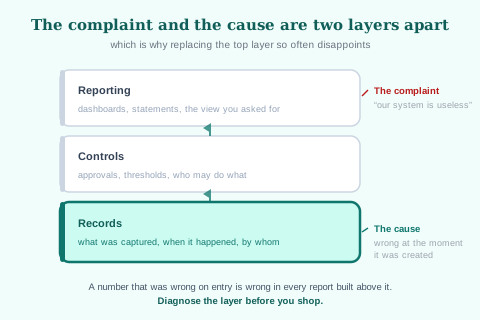
Almost every complaint that arrives as "our system is useless" resolves into one of three quite different failures. They look identical from the boardroom and they need entirely different money spent on them.
Layer one
A records problem
The number is wrong at the moment it is created. Stock was not moved when the sale happened, the receipt was keyed three days later, the count was estimated. No reporting tool can repair this, because the error is upstream of every report. This is the layer we build for.
Layer two
A control problem
The records are fine but nothing was enforced. Approvals were verbal, thresholds were advisory, the purchase order was raised after the goods arrived. You do not need better books — you need a system that refuses.
Layer three
A reporting problem
Records and controls are sound and you simply cannot get the view you want out of the tool you have. This is the cheapest of the three to fix and the one most often misdiagnosed as the other two. Sometimes the honest answer is a report writer, not a new platform.
The diagnosis matters because the South African market will happily sell you a solution to any of them. Get it wrong and you will migrate a whole business onto a new platform to solve something that was, in the end, a spreadsheet somebody could have replaced in a fortnight.
Replace, or underpin?
The second decision is the one that saves the most money, and most vendors have a commercial reason not to raise it. If your finance package is genuinely working, you may not need to replace it at all.
Replace the whole stack
- Makes sense when the finance system itself is failing — unsupported, unhosted, or so old that nobody left in the building knows how it was configured.
- One vendor, one contract, one place to phone. Genuinely simpler once you are through it.
- The cost that is never in the quote: a full migration, a parallel run, and every person in the business learning a new way to do a task they already knew how to do.
- The risk concentrates. If the migration goes badly, it goes badly across accounting, stock and payroll at once.
Keep finance, underpin the operations
- Makes sense when the ledger is fine and the mess is in stock, procurement, assets or evidence — which, in our experience here, is most of the time.
- Smaller blast radius. If the operations layer disappoints, your books were never at risk.
- The cost that is never in the quote: the interface between the two, and the discipline to keep one of them the system of record for each fact.
- Requires you to be strict about boundaries. Two systems that both think they own stock is worse than either alone.
We would rather sell you the second one and have it work than the first one and have you regret it in month eight. If a vendor never offers you the underpinning option, notice that — it tells you something about whose problem the proposal was designed around.
In a mature software market the expensive mistake is not buying the wrong product. It is replacing the layer that was working.
Reading a polished vendor
South African vendors are good. That is the difficulty. In a thin market you can spot the weak claim because it is delivered badly; here every answer arrives fluent, confident and technically true. The skill you need is not scepticism about people — it is knowing which sentence has quietly answered a different question.
Five questions and how to read the answers
Is your system SARS compliant?
What you will hear
Yes — a clear, confident yes, sometimes with a reference to VAT handling or an accountant-friendly export.
How to read it
Almost meaningless as asked, because compliance is a property of your filing, not of a product. Re-ask it as: does this system submit anything to SARS on my behalf, or does it hold the records my practitioner files from? Any honest vendor in this category will say the second.
Is it POPIA compliant?
What you will hear
Yes, with mention of encryption, access controls, and possibly a certificate or an audit report.
How to read it
Encryption and access control are real and worth having, but POPIA obligations sit with you as the responsible party. The useful version of the question is where is my data, who can reach it, how long are backups kept, and what do I get back if I leave — in writing.
Do the approvals stop a transaction?
What you will hear
Yes, we have a full approval workflow with configurable thresholds and notifications.
How to read it
Notifications are not enforcement. Ask them to attempt the transaction above the threshold, in front of you, with no approval in place. Watch whether the system refuses or merely disapproves.
Does it handle B-BBEE?
What you will hear
Some form of yes — supplier classification, scorecard fields, or reporting.
How to read it
Ask precisely what is calculated, against which element, and who verifies it. Holding supplier certificates and their expiry dates is a records feature and a genuinely useful one. Producing a score is a different claim entirely, and one we do not make.
How does it cope with load-shedding?
What you will hear
A reference to cloud hosting, so the system is always available.
How to read it
Their data centre staying up is not your problem — your branch losing power is. The real question is whether a person with a charged phone can keep capturing work while the building is dark, and whether that work syncs cleanly afterwards rather than arriving as duplicates.
Data residency and POPIA, without the hand-waving
This is the question South African buyers ask that no other market in this series raises with the same seriousness, and it deserves a straight answer rather than a reassuring one. "Where does our data live" is not a binary, so here is the spectrum you are actually choosing on.
Where operational data physically sits
On-premise, self-hosted
Maximum control, and every consequence of it: your power, your backups, your patching, your break-in risk, your person who left.
Hosted in a South African region
What most POPIA-anxious buyers assume they are getting. Ask for it explicitly and get the region named in the contract — assumption is not a control.
Hosted elsewhere, with contractual safeguards
Legitimate under POPIA subject to the conditions for cross-border transfer, which your own advisers should assess against your specific data. Where AWRA OpsHub sits today — ask us for the current region in writing before you sign.
None of these positions is automatically right or wrong, and none of them makes a vendor "POPIA compliant" — compliance attaches to you as the responsible party, informed by what your operator can demonstrate. Get the region, the access model, the backup retention and the exit terms in writing from every vendor you shortlist, including us, and have your own advisers assess them. Nothing here is legal advice.
The buyer's scorecard
Everything below should be demonstrated live, on your data, in your demo. Not described, not screenshotted, not on a roadmap.
South Africa operations software scorecard
Weighted for a buyer who already owns a finance system and is fixing the layer underneath it.
Every sale moves inventory in the same second
Make them prove it: Record a sale, watch the stock level drop live, then run a variance report against a physical count.
Approvals that refuse rather than warn
Make them prove it: Attempt a purchase order above the threshold with no approval. The correct outcome is a refusal you cannot click past.
Source documents held against the transaction
Make them prove it: Open a purchase from six months ago and produce the quote, the approval, the delivery note and the invoice from the record itself — not from a shared drive.
Governed transfers between provinces
Make them prove it: Move stock from Johannesburg to Cape Town and show it in transit, belonging to neither location until it is confirmed received.
Net, tax and gross separated on purchases as well as sales
Make them prove it: Enter a purchase and show the input side of the VAT position as a report rather than a reconstruction.
Offline capture that survives an outage
Make them prove it: Airplane-mode the device, record a receipt and a count, reconnect, and watch it sync without duplicating anything.
Asset custody by named person and location
Make them prove it: Pick an asset at random and have the system say who holds it, where it is, and what it was bought with.
Data residency and exit answered in writing
Make them prove it: Ask for the hosting region, the access model, backup retention and what you receive on termination — as a document, not a verbal assurance.
Honest about SARS submission
Make them prove it: Ask whether anything is submitted to SARS on your behalf. Prefer the vendor who says "no, here is what we hold instead" to the one who reframes the question.
A clean answer on what it does not do
Make them prove it: Ask what they would not recommend themselves for. A vendor with no answer has either not thought about it or is not telling you.
The straight answer on South Africa
Here is our position, stated the way we would state it across a table rather than the way it would appear in a brochure.
What AWRA OpsHub does today
- The rand and a South African VAT rate ship as built-in presets in our tax and currency configuration.
- VAT-aware records on purchases as well as sales — net, tax and gross separated line by line at the point of entry, with source documents attached to the transaction.
- Additional tax lines you can configure with their own rates, effective dates and inclusive or exclusive treatment.
- Foreign-currency purchases at the rate actually paid, with duty, freight and clearing folded into landed cost.
- The full operations layer — inventory across provinces, procurement with enforced approvals, three-way matching, asset registers with custody, project and funder tracking, offline capture.
- Supplier records with documents and expiry dates, which is where your B-BBEE certificates, tax clearance and insurance evidence belong.
More we can add to your workspace
- A SARS eFiling integration. Our fiscal e-invoicing integration today is Kenya's eTIMS, and it is Kenya-only — which is exactly the pattern a second authority follows, with your practitioner still approving what goes.
- Turnkey South African statutory payroll — PAYE, UIF and SDL calculated, with EMP and IRP5 output. Submission stays your practitioner's.
- B-BBEE scorecard reporting. Element weighting, sector code logic and verification-ready output, assembled from procurement and payroll records the system already holds.
Where we point you to a specialist
- We do not file returns and we do not interpret South African tax rules.
- We are not a customs, clearing or freight system, and we are not a manufacturing execution system.
- We do not certify your POPIA position. We can tell you where your data sits and who can reach it; the assessment is yours.
The B-BBEE line is the one most worth pausing on, because it is where claims in this market get loosest. Holding a supplier's certificate with its expiry date is a records feature. Calculating a score against a sector code is professional work with a verification process attached. A vendor who blurs those two has told you something useful about the rest of their claims. Confirm all tax treatment with SARS or your tax practitioner; nothing here is tax or legal advice.
What we can build for South Africa on top of the standard product
Everything listed above as something we can add describes what ships in the standard product today — it is a starting point for South Africa, not a limit on what AWRA OpsHub can do there. Kenya's eTIMS integration and its maintained payroll engine are in the product because Kenyan clients needed them and commissioned them; neither appeared by itself. The same door is open here. If SARS-shaped return output, a bank or mobile money feed, a statutory return format, a rule specific to how your operation runs, or a link to a system you already have is what stands between you and a decision, tell us and we will scope it as a build — written spec, timeline and price — before you commit to anything.
SARS output and e-invoicing
VAT201-shaped return output from live records, a maintained rate history rather than a single preset, and e-invoicing against any prescribed interface — with retries, a failure queue and a reconciliation report.
Banks, EFT and card acquirers
Bank statement feeds, EFT and debit-order files, and card acquirer settlement reports pulled into the Payments Register so receipts match invoices without anyone re-keying a statement.
The operational work, which is what most commissions actually are
An extra approval stage in a chain that does not match the standard one, a custom field set on employees or assets that only your sector needs, an expiry that has to block an order rather than send an email, a report your board asks for in a shape nothing produces, or a scanner or weighbridge feeding the goods-in door. These are the commissions we are asked for most often and the smallest ones we quote — and unlike a revenue-authority pipeline, none of them waits on a regulator.
Payroll and statutory returns
EMP201 and EMP501 schedules, UIF declarations and COIDA returns produced in the layout your filing body expects, generated from live payroll records instead of rebuilt each month.
Systems you already run
The accounting package, CRM, online store or custom database you intend to keep — connected through our API so a fact is entered once and appears everywhere it is needed.
How it works: you describe the requirement, we return a written scope, timeline and cost, and once agreed it is built into your environment and maintained as part of the product. No roadmap slide, and no pretending in a demo that something exists when it does not.
Tell us what you need integratedThe VAT and SARS side of that is worked through properly in SARS, VAT and rand operations, and the payroll boundary — where we argue hardest against ourselves — in payroll, PAYE, UIF and SDL.
The buying sequence
The order matters more than the vendor. Every one of these steps is cheap to do first and expensive to do fourth.
-
Count everything once, properly
A real physical count per location, reconciled and signed off. Every number for the next year is measured from this line, so a soft baseline quietly undermines everything built on it.
-
Make every sale and issue move stock
No batch updates at close of business, no reconciliation on Fridays. This single rule is what turns inventory from an opinion into a record.
-
Put teeth in the approvals
Requisition, approval, order, receipt, match — with thresholds that refuse. Governance you can click past is documentation of the moment you were overruled.
-
Attach the evidence at the point of entry
Quotes, delivery notes and invoices held against the transaction. This is the step that turns an audit or a funder query from a fortnight of archaeology into an afternoon.
-
Then decide what your finance system keeps
With governed operations underneath it, you are in a far better position to judge whether the ledger above needs replacing at all — and you will make that call with evidence rather than frustration.
The sector-neutral version is in our ERP implementation checklist, and if you are still weighing whether to move at all, the true cost of running on spreadsheets is the honest baseline to measure any quote against.
What to budget
Locally-priced cloud platforms start in the tens of dollars a month for small teams and scale with users, locations and modules. In South Africa specifically, the subscription is rarely the number that decides whether this succeeds.
| Cost | What it really is | How to size it |
|---|---|---|
| Training time | Experienced people being asked to change a routine that already works for them | Count the hours of the staff who key transactions — storekeepers, receivers and clerks, not managers. Expect more resistance here than in a first-time market, because the old way genuinely functioned |
| Data cleanup | Somebody reconciling opening stock, suppliers and asset records before go-live | One serious physical count per location, plus a master data list with a named owner and a deadline |
| The interface | Keeping your finance system and your operations system agreeing with each other | Decide which system owns each fact before go-live, and write it down. This is the line item that gets skipped and then costs the most |
| Year two, not month one | The branches, users and modules you will add as you grow | Price the business you are becoming; per-module pricing that looks cheap now can balloon |
Compare three-year totals including support rather than first-month prices — the method is set out in our ERP pricing guide, where the currency changes but the arithmetic does not.
Red flags
- "Fully SARS compliant." Compliance is a property of your filing, not of a product. Ask what is submitted and by whom.
- A B-BBEE claim without a named element. Ask which element, calculated how, verified by whom. Vagueness here is the tell.
- "POPIA compliant" as a closing line. The useful vendor answers the residency, access, retention and exit questions in writing instead.
- Approvals that only warn. A control you can dismiss is a log, not a control.
- No opinion on whether you should replace your finance system. A vendor who thinks the answer is always "yes, all of it" has one product and no diagnosis.
- Migration treated as an afterthought. Master data and verified opening balances migrate; history stays archived. A vendor with no view here has not done it before.
Where to go next
The rest of this series splits by what you actually run: inventory for distributors and retail for the national footprint problem, multi-branch retail where pricing consistency is the pressure, manufacturing for BOM, yield and planning around a published interruption schedule, and procurement and asset management for NPOs where governance is judged on what you can reconstruct.
If you operate elsewhere on the continent too, the same discipline in different dialects is in our Nigeria buyer's guide and Ghana buyer's guide, and the group-level version is in one ERP across the EAC.
Our take
Diagnose the layer before you shop, and be genuinely open to the answer that your finance system is fine and the operations underneath it are not. Buy for records that cannot drift, approvals that refuse, and evidence attached at the point of entry — then make every compliance claim, ours included, be demonstrated rather than asserted. In this market the vendor who volunteers what they do not do is giving you the most valuable thing on offer.
See what an honest operations system looks like for South Africa
One stock position across provinces, approvals that actually block, evidence attached where it belongs — and straight answers on SARS, POPIA, B-BBEE and payroll before you sign anything.
Explore AWRA for South AfricaFrequently asked questions
Do we need to replace our existing accounting system?
Often not, and we will say so. South Africa has a mature accounting software market, and in most cases the ledger is not where the problem is — the operational layer beneath it is, where stock, procurement and asset records are informal or after-the-fact. Running governed operations underneath your existing finance package is a legitimate end state, usually cheaper and always lower-risk than a full replacement. Replace the finance system when the finance system is what is failing.
Is AWRA OpsHub SARS compliant?
That question cannot honestly be answered yes by any product, because compliance attaches to your filing rather than to software. What we can say precisely is this: we do not connect to SARS eFiling, we do not submit anything on your behalf, and we do not file returns. We hold the operational and sales records your VAT position is built from, with net, tax and gross separated on every line and source documents attached to the transaction. Your accountant or tax practitioner files, and the two reconcile on a regular rhythm. Confirm all treatment with SARS or your practitioner.
Where is our data hosted, and does that satisfy POPIA?
Ask us for the current hosting region, the access model, backup retention and exit terms in writing before you sign — we will provide them, and you should require the same of every vendor you shortlist. What we will not do is tell you that our product makes you POPIA compliant. Your obligations as responsible party depend on your data, your purposes and your own assessment, and cross-border hosting is permissible subject to conditions your advisers should evaluate. Any vendor who closes that conversation with a single word has answered a different question.
Does it do B-BBEE scorecard reporting?
No. We do not calculate B-BBEE scores, classify suppliers against sector codes, or produce verification-ready reporting, and buying an operations system on that basis would be a mistake. What we do is hold supplier records with their documents attached and expiry dates tracked, so the underlying procurement evidence exists and is current when your verification process needs it. The scoring and verification stay with the professionals who do that work.
What about South African payroll?
Our turnkey statutory payroll engine is maintained for Kenya only. South African PAYE, UIF and SDL are not calculated for you, no EMP201, EMP501 or IRP5 output is produced, and nothing is submitted or remitted on your behalf. We recommend a South African payroll specialist or bureau for that layer, with AWRA holding employee records, attendance, leave and payroll cost allocation to projects and cost centres. The full reasoning is in our South African payroll post, which mostly argues against us.
Will the system keep working during load-shedding?
The capture layer will, on a charged phone or tablet — receiving, counts, issues and field work continue offline and sync when power and signal return, without duplicating what was already recorded. That protects the record rather than the operation; no software runs your equipment. It matters most in branches and warehouses, which is exactly where records are usually lost during an outage and never recovered afterwards.
How much should a South African business budget?
Locally-priced cloud platforms start in the tens of dollars a month for small teams and scale with users, locations and modules. The subscription is rarely decisive here. Budget seriously for training time — experienced staff changing a routine that already works is harder than teaching a first-time user — for data cleanup, and for the interface between your operations system and whatever finance system you keep. Compare three-year totals including support.
