
Procurement & Asset Management for South African NPOs
South African non-profit governance runs on documents that expire and assets that outlive the grant that bought them. What a procurement and asset system has to hold, why certificate currency is the quiet failure, and the honest line on B-BBEE reporting and section 18A receipts.
South African non-profits are held to a documentary standard that most commercial businesses of the same size never encounter. A funder, an auditor or a board can ask, at any point, to see not only what you bought but who approved it, which suppliers you considered, whether their paperwork was current on the day you paid them, and where the laptop that grant funded is sitting today.
None of that is unreasonable. All of it is answerable. What makes it painful is that the evidence is almost always produced backwards — assembled under deadline from email, a shared drive and one person's memory, weeks or years after the decision it is meant to justify.
The organizations that find this easy are not more honest than the ones that find it hard. They simply capture the evidence at the moment of the decision rather than at the moment of the question.
Documents that expire are the quiet failure
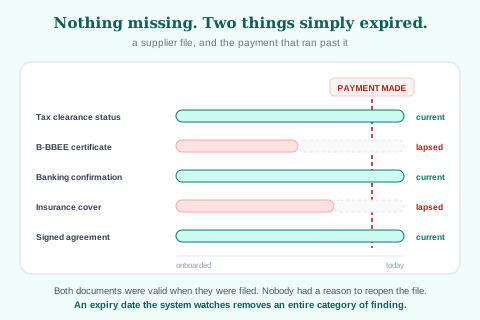
Most procurement document trouble in South African NPOs is not a missing document. It is a document that was perfectly valid when it was filed and had lapsed by the time the payment went out — and nobody had a reason to look.
| What you hold on a supplier | Why it goes stale | What breaks when it lapses |
|---|---|---|
| Tax clearance status | Time-bound by nature and outside your control | A payment made against a supplier whose status has changed, which a funder query will find faster than you will |
| B-BBEE certificate or affidavit | Issued for a period, then requires renewal or a fresh affidavit | Your own reporting inherits a gap you did not know about, and the supplier file no longer supports the procurement decision |
| Banking details confirmation | Changes, and change is exactly what fraud imitates | Payment diverted, or a legitimate change treated with the same casualness as an illegitimate one |
| Insurance and statutory registrations | Annual, and renewal notices go to whoever onboarded them | Contractor on site with cover that expired in March, discovered after the incident rather than before |
| Signed contract or service agreement | Terms end; extensions get agreed verbally | Work continuing outside an agreement, which is both a governance finding and a genuine legal exposure |
The system requirement here is small and specific: every supplier document should carry an expiry date, and the expiry date should be something the system watches rather than something a person remembers. That single feature removes an entire category of audit finding, and it is worth more to most NPOs than any reporting dashboard.
The chain a funder actually tests
When procurement is examined, the examiner is following a chain rather than checking a box. Every link needs a date, a person and a document, and the links need to be in the right order — an approval dated after the purchase order is a finding regardless of how sound the decision was.
-
The need, with a budget line attached
A requisition that names the project, grant or cost centre it will be charged to. Attribution decided at the point of request is accurate; attribution decided at month-end is a reconstruction, and reconstructions are what get questioned.
-
The approval, before the commitment
Threshold-based and enforced, so an approval cannot be recorded after the order it authorises. The date order is half of what an auditor is looking at.
-
The market test, proportionate to the value
Quotes or an RFQ, with the ones you did not choose kept alongside the one you did. A single-source award is defensible when it is documented as a deliberate exception; it is indefensible when it is simply the only quote in the file.
-
The order, then the delivery, then the invoice
Three-way matching, in that sequence. The most common real finding in small organizations is not fraud but sequence — goods received before anyone raised the order, invoice paid before anyone confirmed delivery.
-
The payment, against a supplier whose file was current
This is where the expiry dates from the previous section earn their keep, because the check happens automatically rather than depending on whoever prepared the batch.
Governance is not judged on whether you were honest. It is judged on whether an outsider can establish that you were, without your help, three years later.
Assets outlive the grant that bought them
The asset side is where South African NPOs carry an obligation most commercial buyers never think about. A vehicle, a laptop or a set of equipment bought with restricted funding does not simply become yours. There is usually a condition attached about what happens to it when the project ends — retained, transferred to a beneficiary organization, handed to a government partner, or disposed of with the proceeds treated in a specified way.
That obligation lives in a grant agreement signed by someone who may well have moved on. Three years later, the questions are: which assets did that grant buy, where are they now, who holds them, and what does the agreement say we must do with them?
What a funded-asset register has to answer without a search
- Which grant, project or funder paid for this asset, recorded when it was acquired rather than inferred later from an invoice date.
- Where it physically is — site, room or vehicle — and when that was last confirmed by somebody who saw it.
- Which named person holds it, with the handover recorded. "The programmes team" is not custody; a person is custody.
- What condition it is in, with the last verification date and ideally a photograph attached to the record.
- What the end-of-grant obligation is, held against the asset itself rather than only in the agreement document.
- What happened at disposal or transfer — to whom, on whose authority, on what date, with what evidence.
- A verification history, so a count is a repeatable exercise rather than an annual crisis.
None of that is exotic. It is an asset register with attribution and custody, which is a modest thing to build and an enormous thing to lack. The organizations that struggle at project close are almost never the ones that lost assets — they are the ones that cannot prove where the assets went.
The straight answer on B-BBEE and section 18A
Two questions come up in every South African NPO conversation, and both of them are places where software vendors overclaim. Here is our position on each.
What AWRA OpsHub does today
- Supplier records with documents attached and expiry dates tracked — tax clearance, B-BBEE certificates and affidavits, banking confirmations, insurance, signed agreements.
- Procurement with approvals that refuse rather than warn, RFQs, quotation comparison with unsuccessful quotes retained, and three-way matching.
- Grant, project and funder attribution captured at the point of request, with live budget burn against restricted funds.
- Asset registers with named custody, location, condition, verification history and funder attribution, including disposal and transfer records.
- Documents held against the transaction or the asset, retrievable from the record rather than from a shared drive.
- Offline capture for field sites, so evidence is created where the work happens.
More we can add to your workspace
- B-BBEE scorecard calculation. Element weighting, sector code logic and verification-ready output, assembled from the procurement records the system already holds.
- A SARS eFiling integration. The transmission layer built and maintained the way Kenya's eTIMS clearance was, with your practitioner still approving what goes.
- Detecting collusion or price-fixing — verifying that a quote is genuine, or that a supplier is related to a member of your staff — is a judgement about intent, and we decline to sell software as a substitute for auditing it.
- Turnkey South African statutory payroll — see the payroll post for the full position.
Where we point you to a specialist
- We do not issue section 18A receipts or maintain the donation records a tax-deductible receipting process requires.
- We do not produce statutory NPO or PBO returns, and we do not interpret the obligations attached to your registration.
The B-BBEE distinction is worth stating twice. Holding a supplier's certificate with its expiry date is a records feature and a genuinely useful one — it is where the underlying evidence for your own reporting comes from. Calculating a score is professional work with a verification process attached, and any operations vendor claiming it should be asked which element, computed how, and verified by whom. Confirm all compliance obligations with your auditors, your verification agency and SARS as applicable; nothing here is legal, tax or accounting advice.
What we can build for South Africa on top of the standard product
Everything listed above as something we can add describes what ships in the standard product today — it is a starting point for South Africa, not a limit on what AWRA OpsHub can do there. Kenya's eTIMS integration and its maintained payroll engine are in the product because Kenyan clients needed them and commissioned them; neither appeared by itself. The same door is open here. If SARS-shaped return output, a bank or mobile money feed, a statutory return format, a rule specific to how your operation runs, or a link to a system you already have is what stands between you and a decision, tell us and we will scope it as a build — written spec, timeline and price — before you commit to anything.
SARS output and e-invoicing
VAT201-shaped return output from live records, a maintained rate history rather than a single preset, and e-invoicing against any prescribed interface — with retries, a failure queue and a reconciliation report.
Banks, EFT and card acquirers
Bank statement feeds, EFT and debit-order files, and card acquirer settlement reports pulled into the Payments Register so receipts match invoices without anyone re-keying a statement.
The operational work, which is what most commissions actually are
An extra approval stage in a chain that does not match the standard one, a custom field set on employees or assets that only your sector needs, an expiry that has to block an order rather than send an email, a report your board asks for in a shape nothing produces, or a scanner or weighbridge feeding the goods-in door. These are the commissions we are asked for most often and the smallest ones we quote — and unlike a revenue-authority pipeline, none of them waits on a regulator.
Payroll and statutory returns
EMP201 and EMP501 schedules, UIF declarations and COIDA returns produced in the layout your filing body expects, generated from live payroll records instead of rebuilt each month.
Systems you already run
The accounting package, CRM, online store or custom database you intend to keep — connected through our API so a fact is entered once and appears everywhere it is needed.
How it works: you describe the requirement, we return a written scope, timeline and cost, and once agreed it is built into your environment and maintained as part of the product. No roadmap slide, and no pretending in a demo that something exists when it does not.
Tell us what you need integratedSegregation of duties when there are four of you
Every governance framework assumes the requester, the approver, the receiver and the payer are four different people. In a small NPO they are frequently two, and pretending otherwise produces a control environment that exists on paper and nowhere else.
- Write down the overlap rather than hiding it. An auditor who finds a documented compensating control is in a completely different conversation than one who finds an undisclosed one.
- Move an approval to the board or a trustee above a threshold you can actually live with. A threshold set unrealistically low gets bypassed within a month and then never enforced again.
- Separate the two that matter most: whoever approves the purchase should not be the one confirming the goods arrived. If you can only afford one separation, buy that one.
- Use the trail as the compensating control. When roles must overlap, an immutable record of who did what and when is what makes the overlap survivable.
- Have someone outside the chain review a sample monthly. Ten transactions, chosen at random, looked at by a trustee. It is cheap, it is unglamorous, and it is the control most likely to actually catch something.
Where to go next
The overall purchase decision is in the South Africa buyer's guide, the VAT evidence chain in SARS, VAT and rand operations, and the payroll boundary in payroll, PAYE, UIF and SDL. If you run programmes in more than one country, the multi-jurisdiction version of this discipline is in multi-country NGO operations.
Our take
Capture evidence at the moment of the decision, put an expiry date on every supplier document, and attach a funder and a named custodian to every asset the day it arrives. Do those three things and most of what an audit or a funder visit costs you simply evaporates — not because you are better governed than you were, but because you can finally prove it without three weeks of archaeology.
See procurement and assets built for evidence
Approvals that refuse, supplier documents with expiry dates the system watches, and funded assets with named custody from acquisition to disposal.
Explore AWRA for South AfricaFrequently asked questions
Does AWRA do B-BBEE scorecard reporting?
No. We do not calculate B-BBEE scores, apply element weightings or sector codes, or produce verification-ready output, and you should not select an operations system on that basis. What we do is hold supplier records with their certificates and affidavits attached and expiry dates tracked, so the underlying procurement evidence exists and is current when your own reporting or verification process needs it. The scoring and the verification stay with the professionals who do that work.
Can it issue section 18A receipts?
No. We do not issue section 18A receipts and we do not maintain the donation records that a tax-deductible receipting process requires — that is donor-management and receipting territory, and if it is central to your organization you need a tool built for it. AWRA covers the operational side: procurement, assets, budgets, project attribution and the evidence behind spending, which is a different problem from receipting income.
How do we track assets bought with restricted funding?
Attribution is captured when the asset is acquired — which grant, project or funder paid for it — and stays on the asset record alongside its location, condition, verification history and the named person who holds it. The end-of-grant obligation can be held against the asset itself rather than only in the agreement, so that at project close the question "what must we do with these" is answerable from the register. Disposals and transfers are recorded with date, authority and evidence.
Will it stop a payment to a supplier whose tax clearance has lapsed?
Supplier documents carry expiry dates that the system tracks and surfaces, so a lapsed document becomes visible rather than remaining quietly in a file. How hard that should block depends on your own policy, and we would encourage you to set it deliberately rather than accept a default. What no system can do is tell you a document is genuine — verification of the document itself remains a human control.
We are a team of four. Can we really segregate duties?
Not fully, and any vendor who says otherwise is selling you a paper control. What works is documenting the overlap honestly, separating the two roles that matter most — approving a purchase and confirming the goods arrived — moving high-value approvals to a trustee or board member, and relying on an immutable audit trail plus a small monthly sample review as the compensating control. Auditors respond far better to a disclosed and mitigated overlap than to a framework everybody knows is fictional.
Does it produce our NPO or PBO statutory returns?
No. We do not produce statutory returns of any kind, we do not submit anything to SARS or the relevant registrar, and we do not interpret the obligations attached to your registration. What we hold is the operational evidence your auditors and your funders work from — spending with approvals, attribution to funders and projects, assets with custody, and documents attached at the point of the decision. Confirm your reporting obligations with your auditors.
