
Procurement Software for Ghanaian NGOs and Development Programmes
Ghana hosts a dense concentration of donor programmes, development partners and grant-funded institutions — and every one of them is judged on whether spending was competitive, coded, authorized and received. The controls that make that provable, and where software genuinely stops.
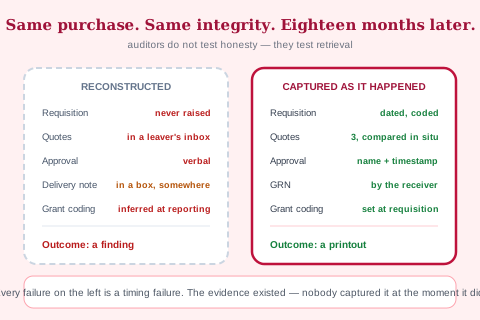
An audit finding is rarely about a bad purchase. It is almost always about a purchase nobody can reconstruct. The goods were needed, the price was fair, the supplier delivered — and eighteen months later the quotes are in a former colleague's email, the approval was verbal, and the delivery note is in a box somewhere. The spend was fine. The evidence was not, and in a donor relationship those two things are not meaningfully different.
This is the gap worth understanding before evaluating any procurement system. You are not buying honesty — you already have that. You are buying reconstructability: the property that any transaction, chosen at random, months later, can be shown end to end by somebody who was not there when it happened.
The question an auditor is really asking is not "was this proper?" It is "can you show me?" — and an organization that can show everything is rarely asked much else.
What reconstructability actually requires
Break the requirement into its parts and it becomes a checklist rather than an anxiety.
| The question asked | What must exist | Where it usually fails |
|---|---|---|
| Was it needed and budgeted? | A requisition raised before the spend, against a grant and budget line | The purchase happened first; the paperwork was assembled to match |
| Was it competitive? | Quotes requested, received and compared inside one system | Quotes exist in three inboxes and one of them belongs to a leaver |
| Who authorized it? | An approval at the value threshold, by someone entitled, recorded with a timestamp | Verbal approval, or a signature on a document nobody can now locate |
| Did the goods arrive? | A goods received note raised by the receiver, not the buyer | Receiving done against the invoice rather than against the physical delivery |
| Did we pay correctly? | Order, delivery and invoice matched before payment | Invoice paid because it looked right and the supplier was chasing |
| Which grant funded it? | Grant and budget line tagged at requisition, not allocated later | Cost allocated at reporting time, from memory, under deadline |
Notice how many of those failures are timing failures rather than integrity failures. The evidence was available at the moment the thing happened and was not captured; everything afterwards is reconstruction, and reconstruction is what auditors are trained to detect.
Tag the grant at the start, not at the end
If there is one discipline that separates organizations that find donor reporting routine from those that dread it, this is it. Every commitment carries its funding source from the moment it is raised — grant, budget line, project, cost centre — rather than being attributed during the reporting scramble.
The difference compounds. Tagging at requisition means eligibility is a decision made once, at the point where someone still knows the context, by someone who can be asked. Allocating at reporting time means a person under deadline pressure is inferring intent from a description written months ago by somebody else. One of those produces a defensible allocation; the other produces a plausible one.
It also makes burn rate real-time rather than retrospective, which is the difference between managing a grant and reporting on one. The structural separation of restricted and unrestricted funds follows from the same discipline — restricted funds are protected by the system refusing an ineligible commitment, not by everyone remembering the rule.
The gates, and the one that gets skipped
-
Requisition against a budget line
The need stated in writing, coded to its funding source, before money moves. Most uncontrolled spending begins with a purchase nobody requested — it was simply made.
-
Approval at the threshold
Authority checked against value, and the system refuses rather than warns. See segregation of duties — the requester must never be the approver, and in small teams this is the hardest rule to hold.
-
Sourcing with evidence
Quotes requested, received and compared inside the system so "we obtained three quotes" is a retrievable document. RFQ vs RFP vs RFI covers which instrument suits which purchase.
-
Receipt by the receiver
A goods received note recording actual quantity and condition, raised by someone other than the buyer. This is the gate most often skipped and the one auditors probe first.
-
Three-way matching before payment
Order, delivery and invoice reconciled before money leaves — how it works. It catches over-invoicing, short delivery and duplicate payment, and almost nobody on spreadsheets does it consistently.
The gate that gets skipped
Receiving. It feels like administration rather than control, especially when the buyer is standing right there and can confirm the delivery themselves. That convenience is exactly the problem: when the person who ordered is also the person who confirms arrival, you have no independent evidence that anything arrived at all. It costs two minutes and it is the finding auditors reach for first.
Small teams and the segregation problem
Most Ghanaian NGOs and grant-funded institutions are not large. A five-person country office cannot have five separate roles in the procurement chain, and pretending otherwise produces a policy that is formally satisfied and practically theatre — the same person clicking through three stages under three hats.
The workable answer is honesty about the constraint plus compensating controls: the approver may be remote rather than local, thresholds may be set low enough that most purchases escalate to someone genuinely independent, and the audit trail becomes the compensating control precisely because full separation is impossible. Auditors respond well to an organization that documents this reasoning and badly to one that pretends to a separation it plainly cannot staff.
What we do and do not do
What AWRA OpsHub does today
- Enforced approval thresholds that refuse rather than warn.
- Grant, budget line and cost centre tagged at requisition, with live budget and burn visibility.
- Sourcing evidence in one place — RFQs, quotations received, and the comparison behind the award.
- Three-way matching before payment is released.
- A complete, non-rewritable audit trail retrievable per transaction.
- Donor-funded assets flowing from purchase into a register with a named custodian and funding source.
More we can add to your workspace
- Detecting collusion between a buyer and a supplier who both follow the process correctly is a judgement about intent. Systems enforce process; people audit intent.
- Telling you a quoted price is above market needs a market reference we decline to assert. What the system shows you is the quotes you collected.
- Verifying that a supplier exists or is eligible stays your due diligence, and we would rather say so plainly than imply a check nobody runs.
- GRA e-invoicing — our fiscal integration is Kenya's eTIMS and it is Kenya-only.
- A maintained Ghanaian levy stack; one VAT preset ships today and further components are configurable by you, with us maintaining them as a build.
The honest claim is narrower than the marketing one and more useful: every shortcut becomes visible and attributable. That does not make wrongdoing impossible; it makes it very hard to do quietly, which is what actually changes behaviour in a small office.
What we can build for Ghana on top of the standard product
Everything listed above as something we can add describes what ships in the standard product today — it is a starting point for Ghana, not a limit on what AWRA OpsHub can do there. Kenya's eTIMS integration and its maintained payroll engine are in the product because Kenyan clients needed them and commissioned them; neither appeared by itself. The same door is open here. If GRA e-invoicing, a bank or mobile money feed, a statutory return format, a rule specific to how your operation runs, or a link to a system you already have is what stands between you and a decision, tell us and we will scope it as a build — written spec, timeline and price — before you commit to anything.
GRA e-invoicing and the levy stack
Electronic invoicing against GRA's published interface, and a maintained multi-component levy stack we keep current for you instead of leaving the effective-from dates in your hands.
MoMo, cards and bank feeds
Mobile money settlement files, card acquirer reports and bank statement feeds pulled into the Payments Register, so collections reconcile against invoices without anyone re-keying a statement.
The operational work, which is what most commissions actually are
An extra approval stage in a chain that does not match the standard one, a custom field set on employees or assets that only your sector needs, an expiry that has to block an order rather than send an email, a report your board asks for in a shape nothing produces, or a scanner or weighbridge feeding the goods-in door. These are the commissions we are asked for most often and the smallest ones we quote — and unlike a revenue-authority pipeline, none of them waits on a regulator.
Payroll and statutory returns
PAYE and SSNIT contribution schedules produced in the layout your filing body expects, generated from live payroll records rather than rebuilt in a spreadsheet each month.
Systems you already run
The accounting package, CRM, online store or custom database you intend to keep — connected through our API so a fact is entered once and appears everywhere it is needed.
How it works: you describe the requirement, we return a written scope, timeline and cost, and once agreed it is built into your environment and maintained as part of the product. No roadmap slide, and no pretending in a demo that something exists when it does not.
Tell us what you need integratedThe broader pattern — and how the same five questions arrive in commercial language from a board or a lender — is set out in procurement for Nigerian NGOs and enterprises. Audit preparation itself is covered in audit readiness, and the recurring failure modes across markets in procurement challenges NGOs face.
Our take
Judge a procurement system on one thing: pick a transaction at random from a year ago and try to reconstruct it end to end without asking anybody. If you can — requisition, approval, quotes, receipt, match, funding source — your next audit is administrative. If you cannot, no policy document will save you, because the policy was never the thing being examined.
See a transaction you can reconstruct in a year
Requisitions coded to grants, thresholds that block, quotations compared on the record, receiving by the receiver, and three-way matching before payment.
Explore AWRA for GhanaFrequently asked questions
We are a small country office. Can we really separate duties?
Not fully, and you should not pretend to. The workable approach is compensating controls: an approver who is remote rather than local, thresholds set low enough that most purchases escalate to someone genuinely independent, and an audit trail that serves as the compensating control precisely because full separation cannot be staffed. Document that reasoning explicitly — auditors respond well to an organization that has thought about its constraint and badly to one performing a separation it obviously cannot achieve.
Can costs be split across more than one grant?
Yes, and the tagging happens at requisition rather than at reporting time, which is the important part. Allocating during the reporting scramble means somebody under deadline is inferring intent from a description written months earlier by someone else; tagging at the start means the decision was made once, in context, by someone who can still be asked about it. Burn rates against each grant then stay live rather than retrospective.
Will this prevent procurement fraud?
No system will, and any vendor implying otherwise is overselling. What it does is make every shortcut visible and attributable, which changes the calculation for anyone considering one and gives you a concrete trail to follow when a pattern emerges. Collusion between a buyer and a supplier who both follow the process correctly remains an audit problem — the system's contribution is that it is no longer hidden among a hundred other undocumented transactions.
Do donor-funded assets get tracked automatically?
Assets purchased through the procurement chain flow into an asset register carrying their funding source and a named custodian, with movement history and verification rhythms. That matters because donors frequently ask what was bought with their money, where it is now and who holds it — a question that is trivial with a register linked to procurement and genuinely difficult without one.
Does it handle Ghanaian VAT on supplier invoices?
It keeps VAT-aware records with net, tax and gross separated on purchases as well as sales, and the cedi and a Ghana VAT rate ship as presets. Ghana's position is layered, and further tax components are configured by you rather than shipped as a maintained stack. It does not integrate with GRA electronic invoicing. Confirm applicable rates and treatments with GRA or your adviser — nothing here is tax advice.
