
Procurement Software for Nigerian NGOs and Enterprises
Procurement is where an organization's money leaves and its reputation is decided. For Nigerian NGOs answering to donors and enterprises answering to boards and lenders, the disciplines that make spending defensible — and the honest limits of what software can enforce.
Almost nobody sets out to run bad procurement. What happens instead is that a policy exists, everyone broadly agrees with it, and then a series of individually reasonable exceptions accumulate until the policy describes a process nobody follows. The order was urgent. The supplier was a known quantity. The approver was travelling. Each decision defensible; the pattern indefensible.
That drift is the actual problem software solves — not paperwork, not efficiency. A written policy is an intention. A system that will not create the purchase order without the approval is a control. The distance between those two things is where donor findings, board queries and quiet losses live.
Two audiences, one discipline
Nigerian NGOs and Nigerian enterprises describe their procurement pressure in completely different vocabulary and are, underneath, asking for exactly the same thing.
What the NGO is answering
- "Was this spend competitive, and can you show the quotes you compared?"
- "Which grant and budget line paid for this, and was it eligible?"
- "Who approved it, and were they authorized to at that value?"
- "Show us the goods actually arrived — not just that they were invoiced."
- "Reproduce this for an audit, eighteen months from now."
What the enterprise is answering
- "Did we pay a market price, or the price of the supplier we always call?"
- "Which cost centre or project absorbed this, and was there budget?"
- "Who committed the company's money, and under what authority?"
- "Did we pay for quantities we actually received?"
- "Explain this spend to a lender or an incoming investor."
Same five questions in two dialects: competition, coding, authority, receipt, reproducibility. Any system that answers all five for one audience answers them for the other, which is why we have never built separate procurement for NGOs and businesses. The governance bar the donors set turns out to be the bar a serious enterprise wants anyway.
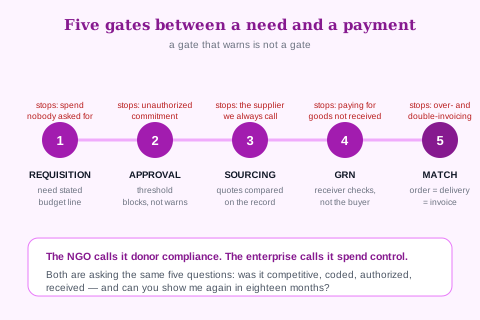
The five gates, and what each one is actually for
-
Requisition — the need is stated before the money moves
Someone asks, in writing, for a defined thing against a defined budget line. This sounds bureaucratic until you notice that most uncontrolled spending begins with a purchase that was never requested by anybody — it was simply made.
-
Approval — authority is checked against value
Thresholds decide who can commit what. The critical property is that the system refuses rather than warns: a control you can click past is not a control, it is a record of the moment you were overruled. See segregation of duties for why the requester must never be the approver.
-
Sourcing — competition is evidenced, not asserted
Quotes requested, received and compared inside the system, so "we got three quotes" is a document rather than a claim. RFQ vs RFP vs RFI covers which instrument fits which purchase.
-
Receipt — somebody physically checked what arrived
A goods received note recording actual quantities and condition, raised by someone who is not the buyer. What a GRN is — and why receiving against the invoice instead of the delivery is the most common expensive shortcut in procurement.
-
Matching — you pay for what you ordered and received
Order, delivery and invoice compared before payment: three-way matching. This single control catches over-invoicing, short deliveries and duplicate payments, and almost no organization running on spreadsheets does it consistently.
A policy tells people what they should do. A system decides what they can do. Only one of those survives a busy Friday afternoon and an urgent order.
What NGOs need on top
Donor-funded procurement adds a dimension rather than a different process: every commitment has to carry its funding source from the moment it is raised, not attributed afterwards.
Donor-grade additions to the same chain
- Grant and budget line tagged at requisition, so eligibility is a decision at the start rather than a reconciliation at the end
- Restricted funds walled off structurally, so a commitment against the wrong grant is prevented rather than corrected — see restricted vs unrestricted funds
- Burn rate visible while there is still time to act on it: grant burn rate
- Thresholds that reflect donor rules, which are often stricter than your internal ones
- A complete document trail per transaction, retrievable in one place when the audit comes — audit readiness
- Assets bought with donor funds entering a register with a custodian and a funding source attached: donor-funded asset registers
None of that is unique to Nigeria — the procurement challenges NGOs face are remarkably consistent across markets. What Nigeria adds is scale and pace: larger programmes, more field locations, more suppliers, and a tempo that makes informal shortcuts more tempting and more costly.
The honest limits of what any system can do
Vendors sell procurement software as though it eliminates fraud. It does not, and you should be suspicious of anyone who implies otherwise. What it does is far more specific: it makes the shortcuts visible and attributable, which changes the arithmetic for anyone considering one.
What AWRA OpsHub does today
- Enforced approval thresholds — the system refuses to proceed, rather than warning and logging.
- Sourcing evidence in one place — RFQs, quotations received and the comparison that led to the award.
- Three-way matching across order, delivery and invoice before payment is released.
- Grant, budget line and cost centre tagged at requisition, with live budget and burn visibility.
- A complete, non-rewritable audit trail — who did what, when, and what changed.
- Assets flowing from purchase into a register with a named custodian.
More we can add to your workspace
- Detecting collusion between a buyer and a supplier who both follow the process perfectly is a judgement about intent. Systems enforce process; people audit intent.
- Telling you a quoted price is above market needs a market reference we decline to assert. What the system shows you is the quotes you actually collected.
- Verifying that a supplier is real stays your due diligence, and we would rather say so plainly than imply a check nobody runs.
- FIRS e-invoicing integration — our fiscal integration today is Kenya's eTIMS, and it is Kenya-only.
- Customs, clearing and trade finance go to a specialist system, and we would point you at one rather than approximate it.
The honest claim is narrower and more useful than the marketing one: the system makes every shortcut visible and attributable. That does not make wrongdoing impossible — it makes it hard to do quietly, which is what actually changes behaviour.
What we can build for Nigeria on top of the standard product
Everything listed above as something we can add describes what ships in the standard product today — it is a starting point for Nigeria, not a limit on what AWRA OpsHub can do there. Kenya's eTIMS integration and its maintained payroll engine are in the product because Kenyan clients needed them and commissioned them; neither appeared by itself. The same door is open here. If FIRS e-invoicing, a bank or mobile money feed, a statutory return format, a rule specific to how your operation runs, or a link to a system you already have is what stands between you and a decision, tell us and we will scope it as a build — written spec, timeline and price — before you commit to anything.
FIRS e-invoicing and tax pipelines
Invoice transmission against the authority's published interface, plus WHT credit handling and sector levies — with the parts vendors gloss over: retries, a failure queue and a daily report of sales carrying no fiscal reference.
Banks, cards and transfers
Bank statement feeds, card acquirer settlements and bulk-payment files pulled into the Payments Register, so money in and out reconciles without anyone re-keying a statement.
The operational work, which is what most commissions actually are
An extra approval stage in a chain that does not match the standard one, a custom field set on employees or assets that only your sector needs, an expiry that has to block an order rather than send an email, a report your board asks for in a shape nothing produces, or a scanner or weighbridge feeding the goods-in door. These are the commissions we are asked for most often and the smallest ones we quote — and unlike a revenue-authority pipeline, none of them waits on a regulator.
Payroll and statutory returns
PAYE, pension and NHF schedules produced in the layout your filing body expects, generated from live payroll records rather than rebuilt in a spreadsheet each month.
Systems you already run
The accounting package, CRM, online store or custom database you intend to keep — connected through our API so a fact is entered once and appears everywhere it is needed.
How it works: you describe the requirement, we return a written scope, timeline and cost, and once agreed it is built into your environment and maintained as part of the product. No roadmap slide, and no pretending in a demo that something exists when it does not.
Tell us what you need integratedWhere to start if procurement is currently informal
Do not attempt to implement your entire policy in week one. Organizations that try either abandon it or, worse, keep it nominally alive while everyone routes around it. Sequence it:
| Stage | What you turn on | What changes immediately |
|---|---|---|
| 1 | Requisitions with a budget line, for everything above a low threshold | Spending starts being requested rather than simply happening |
| 2 | Approval thresholds that genuinely block | Authority becomes a property of the system, not of who is in the room |
| 3 | Goods received notes raised by the receiver, not the buyer | You stop paying for quantities nobody confirmed arrived |
| 4 | Three-way matching before payment | Over-invoicing and duplicate payments surface before the money leaves |
| 5 | Sourcing and quotation comparison inside the system | "We compared three quotes" becomes a document instead of a memory |
The full sector-neutral sequence is in the procure-to-pay process, and the difference between the first two documents in that chain trips up more teams than anything else — purchase requisition vs purchase order is worth ten minutes before you configure a single threshold.
And if procurement is one part of a wider system decision, the full evaluation rubric for Nigeria — plus the straight answer on FIRS, VAT and payroll — is in our Nigeria ERP buyer's guide.
Our take
Judge procurement software on one question: can somebody complete a purchase without the approval, the quotes, or the receipt? If the answer is yes with a warning, you are buying documentation, not control. If the answer is no, you are buying the thing that makes a donor audit or a board query uneventful — and uneventful is the entire goal.
See procurement that refuses to be talked around
Requisitions against budget lines, thresholds that block rather than warn, quotations compared on the record, and three-way matching before a naira leaves.
Explore AWRA for NigeriaFrequently asked questions
Can approvals be overridden by a senior person?
Thresholds are configured to your policy, and where your policy allows an escalation path that path exists — but every step is recorded with a name and a timestamp, and nothing proceeds silently. What the system does not permit is the informal override: a purchase order that simply appears without the approval that should have preceded it. That distinction is the whole value, because organizations rarely lose money to authorized escalation and routinely lose it to purchases nobody approved.
Does it work for both donor-funded programmes and commercial purchasing?
Yes, on the same chain. Donor-funded procurement adds grant and budget-line tagging at requisition, restricted-fund separation and burn visibility, but the underlying gates — request, approve, source, receive, match — are identical. Organizations that run both a grant-funded programme and commercial operations use one procurement process with different coding, which is considerably easier to govern than two parallel systems.
Will this stop procurement fraud?
No system will, and we would not claim otherwise. What it does is make every shortcut visible and attributable, which changes the calculation for anyone considering one and gives you something concrete to investigate when a pattern emerges. Collusion between a buyer and a supplier who both follow the process correctly is an audit problem, not a software problem — the software's contribution is that everything else is no longer hidden in the noise.
How does it handle imported purchases?
Foreign-currency purchase orders record the exchange rate actually applied, and landed cost folds duty, freight, clearing and handling into the true unit cost of the goods received. For Nigerian buyers this matters as much for governance as for margin: it means the cost recorded against a grant or a cost centre is the cost you actually incurred, not the invoice value converted at a rate somebody assumed.
Does it handle FIRS e-invoicing for supplier invoices?
No. Our fiscal e-invoicing integration is Kenya's eTIMS and it is Kenya-only. In Nigeria the system records and matches supplier invoices as part of the procurement chain, and you continue to meet FIRS requirements through your existing process. If direct integration is essential, raise it as a written requirement before committing and confirm current rules with FIRS or your tax adviser.
