ERP Software in Nigeria: A Practical Buyer's Guide (2026)
A practical, vendor-honest guide to choosing operations software in Nigeria in 2026 — what an ERP must actually do when the naira moves under you, how to make a vendor prove every claim, what to budget, and the straight answer on FIRS e-invoicing, VAT and Nigerian payroll.
Nigeria is the largest and most competitive commercial market on the continent, and the hardest one in which to know your own numbers. Volume is not the problem — Nigerian businesses move enormous volume. The problem is that the naira, the branch network and the supply chain all move faster than the records that are supposed to describe them, so a business can be busy, growing, and quietly unprofitable at the same time, and only find out at reconciliation.
That is what makes the Nigerian buying decision different from the one a business elsewhere in Africa makes. The question is not "should we get off spreadsheets?" — most operators already know the answer. It is "which system will still tell me the truth when the exchange rate moved between the order and the delivery, when four branches each hold their own version of the stock position, and when someone finally asks for an audit trail?"
This guide is deliberately vendor-honest. Where AWRA OpsHub does something, we say so and tell you how to test it. Where it does not — most importantly around FIRS electronic invoicing and Nigerian statutory payroll — we say that too, plainly, because the fastest way to waste money on operations software in Nigeria is to believe an "it's fully integrated" claim you were never made to watch working.
When a Nigerian business has genuinely outgrown spreadsheets
Spreadsheets are the right tool for longer than software vendors like to admit. The threshold is not turnover — it is the moment the same fact lives in three places and nobody trusts any of them. In Nigeria the signals are consistent:
- Your sales, your bank and your stock tell three different stories. Payments digitized early here — transfers, POS terminals, mobile wallets. Operations often did not. That gap is the clearest signal of all.
- A second and third location made visibility a daily argument. Lagos plus Abuja plus a depot means head office needs today's position today, not a WhatsApp photo of a stock sheet on Friday.
- You import, and your margin is a guess. If nobody can tell you the landed cost of the consignment that arrived last week at the rate you actually paid, you are pricing on a rate that has already expired.
- Shrinkage has become a number you absorb rather than investigate. Without per-branch, per-person records there is nothing to investigate — only a loss to accept.
- Someone external now wants real records — a bank, a donor, an investor, a board, FIRS — and "give me two days to put it together" has stopped being an acceptable answer.
The naira is the variable everything else bends around
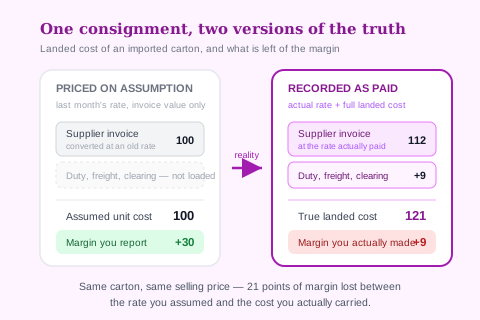
In most markets, foreign exchange is a finance-department concern. In Nigeria it is an operations concern, because it changes what a unit of stock costs between the day you order it and the day you sell it. A distributor who buys in dollars, clears in naira and prices off last month's assumption is not running a pricing strategy — they are running an unhedged position they cannot see.
The discipline that fixes this is not exotic. It is recording foreign-currency purchases at the rate actually paid on that transaction, and folding duty, freight, clearing and handling into the unit cost of the goods that arrived — what the rest of the world calls landed cost. Do that, and margin becomes a fact about a consignment instead of an opinion about the market.
A system that cannot tell you the true landed cost of the consignment sitting in your warehouse is not an ERP. It is an expensive way to keep believing an exchange rate that expired weeks ago.
This is also the honest reason a Nigerian buyer should push harder on inventory and procurement than on dashboards. Reporting is downstream of records. If the records are wrong at the point of receipt, every report built on them is confidently wrong, and the prettier the dashboard the longer it takes anyone to notice.
The buyer's scorecard: what to make every vendor prove
Every demo looks good. Demos are built to look good. The value is entirely in what you make the vendor do in front of you, on your data, with the network behaving the way it behaves in your actual business. Score each vendor on this rubric and the field narrows fast.
Nigeria operations software scorecard
Ask for each of these to be demonstrated live — not described, not screenshotted, not "on the roadmap for Q3".
Records naira and foreign currency at the rate you actually paid
Make them prove it: Enter one NGN purchase and one USD purchase at a rate you choose, then show both on a single cost report with the FX explicitly visible.
Loads landed cost onto imported stock
Make them prove it: Add duty, freight and clearing to a consignment and watch the unit cost of the item change — then show the margin on a sale of that item.
Every sale moves inventory in the same second
Make them prove it: Record a sale and watch the stock level drop live, then run a variance report against a physical count.
Approvals that cannot be talked around
Make them prove it: Try to raise a purchase order above the threshold without approval. The system should refuse — not warn, not log, refuse.
Multi-branch stock with governed transfers
Make them prove it: Move stock between two branches and show it in transit — belonging to neither branch's sellable position until received.
Works when the network does not
Make them prove it: Put the device in airplane mode, record a receipt and a count, reconnect, and watch it sync without duplicating.
One connected system, not four apps with an API story
Make them prove it: Trace a single purchase from request → approval → receipt → payment without leaving the system or re-keying anything.
Named custody on assets
Make them prove it: Show a generator or vehicle with a current custodian, its movement history, and who signed for it last.
Support in a timezone that is awake when you are
Make them prove it: Ask for median first-response time in writing, and the name of who answers on a Saturday.
Honest about FIRS e-invoicing
Make them prove it: Ask them to show fiscalization working inside their product. Prefer the vendor who says "not built, here is what we do instead" over the one who waves it off.
The one claim never to take on trust
If a vendor tells you they are "fully integrated with FIRS", ask to watch an invoice fiscalize inside their system, live, on a real connection. Integration is the single most over-claimed word in this category. A confident wave-off is the most expensive sentence in the room.
FIRS, VAT and the naira — what to honestly expect
Here is our own position, stated as plainly as we would state it in a sales meeting. You should demand the same clarity from every vendor you shortlist, and treat vagueness as an answer in itself.
What AWRA OpsHub does today
- The naira (NGN) and Nigeria's VAT rate ship as built-in presets in our tax and currency configuration — transactions, pricing and reporting run in NGN with VAT-aware records.
- Multi-currency purchasing with explicit exchange-rate tracking — the rate you actually paid, recorded against the transaction rather than assumed globally.
- Landed cost — duty, freight, clearing and handling loaded onto the true unit cost of imported stock.
- The full operations layer — multi-branch inventory, procurement with enforced approvals, three-way matching, asset registers with custody, donor and budget tracking, offline mobile capture.
- Consolidated reporting across branches and across countries for groups operating beyond Nigeria.
More we can add to your workspace
- FIRS electronic invoicing. Our fiscal e-invoicing integration is Kenya's eTIMS today, and it is Kenya-only. In Nigeria, AWRA runs alongside your fiscalization process and your records reconcile against it.
- Turnkey Nigerian statutory payroll. PAYE, pension and NHF automated the way Kenyan PAYE, NSSF and SHIF already are. Today earnings and deductions are configured by hand, or you keep your existing payroll and use AWRA for operations.
Where we point you to a specialist
- We are not a customs, clearing or trade-finance system. We record what an import cost you; we do not file or clear it.
- We do not set or interpret Nigerian tax rules. Rates, thresholds and filing obligations are the authorities' domain and they change.
Confirm all rates, thresholds and filing obligations with FIRS or your own tax adviser before relying on them. This is not tax advice — and any vendor stating Nigerian tax rules as settled fact without pointing you back to FIRS is overreaching.
What we can build for Nigeria on top of the standard product
Everything listed above as something we can add describes what ships in the standard product today — it is a starting point for Nigeria, not a limit on what AWRA OpsHub can do there. Kenya's eTIMS integration and its maintained payroll engine are in the product because Kenyan clients needed them and commissioned them; neither appeared by itself. The same door is open here. If FIRS e-invoicing, a bank or mobile money feed, a statutory return format, a rule specific to how your operation runs, or a link to a system you already have is what stands between you and a decision, tell us and we will scope it as a build — written spec, timeline and price — before you commit to anything.
FIRS e-invoicing and tax pipelines
Invoice transmission against the authority's published interface, plus WHT credit handling and sector levies — with the parts vendors gloss over: retries, a failure queue and a daily report of sales carrying no fiscal reference.
Banks, cards and transfers
Bank statement feeds, card acquirer settlements and bulk-payment files pulled into the Payments Register, so money in and out reconciles without anyone re-keying a statement.
The operational work, which is what most commissions actually are
An extra approval stage in a chain that does not match the standard one, a custom field set on employees or assets that only your sector needs, an expiry that has to block an order rather than send an email, a report your board asks for in a shape nothing produces, or a scanner or weighbridge feeding the goods-in door. These are the commissions we are asked for most often and the smallest ones we quote — and unlike a revenue-authority pipeline, none of them waits on a regulator.
Payroll and statutory returns
PAYE, pension and NHF schedules produced in the layout your filing body expects, generated from live payroll records rather than rebuilt in a spreadsheet each month.
Systems you already run
The accounting package, CRM, online store or custom database you intend to keep — connected through our API so a fact is entered once and appears everywhere it is needed.
How it works: you describe the requirement, we return a written scope, timeline and cost, and once agreed it is built into your environment and maintained as part of the product. No roadmap slide, and no pretending in a demo that something exists when it does not.
Tell us what you need integratedWe have written up the Nigerian position in full in FIRS, VAT and naira operations, including the four questions that reliably expose a vendor who has blurred a records claim into an integration claim.
The wider principle holds across the continent: Kenyan businesses ran this race earlier under eTIMS, and the ones who came out ahead treated compliance as a by-product of clean records rather than a bolt-on module. Get operations genuinely clean and fiscalization becomes a reconciliation. Leave them messy and no integration will save you — it will just transmit your mess faster.
The buying sequence: stock-first, not software-first
Businesses that fail at digitization usually buy the right tool in the wrong order — reporting before records, payroll before stock, a five-module rollout before anyone has counted a warehouse. Start where money leaks fastest, stabilize, then extend.
-
Stock control first
Receiving, issues, transfers and counts. Shrinkage loses its deniability, and the biggest silent loss in most Nigerian businesses stops first. This alone often pays for the project.
-
Tie sales to stock
Every sale moves inventory. Bank transfers, POS settlements and cash reconcile against system sales daily instead of monthly — and the daily close becomes a five-minute job rather than an argument.
-
Purchasing with approvals and landed cost
Requisition → approval → PO → receipt → match. Supplier prices verified, deliveries matched to orders, and imports costed at the rate you actually paid. Margin is defended at the door, not explained afterwards.
-
Branch and field visibility
Transfers governed, in-transit stock owned by nobody until received, branch variances attributable to a person and a date, and head office seeing today — today.
-
Assets, then reporting for decisions and lenders
Generators, vehicles and ICT with named custodians; then statements generated from live data rather than typed up for the occasion. Banks and investors can tell the difference.
The sector-neutral version of this sequence is in our ERP implementation checklist — it applies unchanged in Lagos. If procurement is where your governance pressure is coming from, the procure-to-pay process and three-way matching are the two ideas worth understanding before you sit through a single demo.
From here the guidance splits by what you actually run. Distributors should read inventory and distribution in Lagos; retailers with more than one shop, multi-branch retail; processors, manufacturing operations and the real cost of power; NGOs and anyone facing a governance audit, procurement for Nigerian NGOs and enterprises; aggregators and commodity traders, from buying point to export. On payroll we argue against ourselves — read payroll, PAYE and pension in Nigeria before assuming any vendor covers it.
What to budget — including the costs vendors do not print
Locally-priced cloud platforms start in the tens of dollars a month for small teams and scale with users, branches and modules. That sticker price is the smallest line in your real budget. Budget honestly for three things vendors rarely quote:
| Cost | What it actually is | How to size it |
|---|---|---|
| Training time | Your people learning a new way of working, during working hours | Count the hours of the staff who will actually key transactions — storekeepers and branch clerks, not managers |
| Data cleanup | Somebody reconciling opening stock and master data before go-live | One serious physical count per location, plus a supplier and item list somebody owns |
| The business you are becoming | The branches, users and modules you will add in year two | Price year two, not month one — per-module pricing that looks cheap now can balloon |
Compare three-year totals including support, not first-month prices. The method is laid out in full in our ERP pricing guide — the currency changes, the arithmetic does not. And if you are still weighing whether to move at all, the true cost of running on spreadsheets is the honest baseline to measure any quote against.
Red flags when evaluating a vendor in Nigeria
- "Fully integrated with everything." Integration is the most over-claimed word in the category. Make them show it working, on a live connection, today.
- No offline story. If your depots, field teams or upcountry branches lose connectivity — and they will — treat offline capture as a requirement, not a bonus.
- Tax claims stated as settled fact. A trustworthy vendor hedges to FIRS and your accountant. Confidence about someone else's tax rules is not expertise; it is exposure they are handing you.
- No answer on exchange rates. If they cannot show you a purchase recorded at a specific rate with landed cost loaded, they have not built for this market.
- Approvals that only warn. A control that can be clicked past is not a control. It is a log of the moment you were overruled.
- Per-module pricing that balloons. Add up everything you will be running in year two before you sign anything in year one.
- No migration plan for your spreadsheets. Master data and verified opening balances should migrate; history stays archived. A vendor with no opinion on this has not done it before.
If you operate beyond Nigeria
Groups running Nigeria alongside other African markets face a second-order problem: one operating model, several currencies, and several sets of statutory rules that refuse to be one set. The workable answer is one system of record with country dimensions — local currencies at branch level, consolidated reporting at group level, and no pretence that fiscal integration or statutory payroll travels across borders, because it does not.
The discipline is the same one we documented for one ERP across the EAC, and for NGOs specifically in multi-country operations across several tax regimes. If your exposure is to a volatile local currency more than to a particular tax authority, multi-currency operations in frontier economies covers the same ground from the FX side.
Our take
In Nigeria, buy for stock accuracy, enforced approvals and true landed cost — in that order — and treat every compliance claim as something to watch working rather than something to believe. A system that gets those three right will still be telling you the truth when the rate moves. A system that got them wrong will simply be wrong faster.
See what an honest operations system looks like for Nigeria
Multi-branch stock, procurement with real approvals, landed cost at the rate you actually paid, and assets with named custody — NGN-ready, offline-capable, and straight with you about FIRS.
Explore AWRA for NigeriaFrequently asked questions
Does AWRA OpsHub integrate directly with FIRS e-invoicing?
No — not as a built-in integration today. Our fiscal e-invoicing integration is Kenya's eTIMS and it is Kenya-only. In Nigeria, AWRA runs your operations — stock, procurement, sales records, assets, donor funds — alongside your existing fiscalization process, and your records reconcile against it. If direct FIRS integration is essential to your workflow, make it a written requirement before you commit, with us or with any vendor, and confirm the current rules with FIRS or your tax adviser.
Does it support the naira and Nigerian VAT?
Yes. The Nigerian naira and Nigeria's VAT rate are built-in presets in our tax and currency configuration, so transactions and reporting run in NGN with VAT-aware records, alongside multi-currency handling for imports and foreign-currency grants. Rates and thresholds are set by the authorities and do change, so confirm current figures with FIRS or your accountant — this is not tax advice.
How does the system handle a moving exchange rate?
Foreign-currency purchases are recorded with explicit exchange-rate tracking against the transaction, and landed cost folds duty, freight, clearing and handling into the true unit cost of the goods received. Your margin is then measured against what that specific consignment actually cost you rather than against a rate that has since expired. For a Nigerian importer or distributor this is the single most valuable discipline in the system.
What about Nigerian payroll — PAYE, pension and NHF?
Our turnkey statutory payroll engine is maintained for Kenya only. For Nigeria we recommend either keeping your existing payroll process and using AWRA for operations, or configuring earnings and deductions manually. We would rather tell you that now than localize on a promise — tell us what you need and we will scope it against real demand. Confirm current PAYE, pension and NHF obligations with the relevant authorities or your accountant.
How much should a Nigerian SME budget for operations software?
Locally-priced cloud platforms start in the tens of dollars a month for small teams and scale with users, branches and modules. The larger budget items are training time and data cleanup, which every business faces regardless of which vendor they choose. Compare three-year totals including support and the branches you plan to open, not the first month.
Can one system run our Nigerian and other African operations together?
Yes. Multi-location organizations run branches per country with local currencies and consolidated group reporting. What does not travel across borders is country-specific fiscal integration and statutory payroll automation — those are Kenya-only today. Everything else runs on the general operations, multi-currency and VAT-aware layer, which is the same in Lagos as it is in Nairobi.
Do we need offline capability if our branches are in Lagos and Abuja?
In a well-connected city office you may rarely need it, but the moment you run a depot, a field team, a delivery route or an upcountry branch you will. Offline-first capture on ordinary Android devices costs nothing extra to have and stops work halting when a connection drops, so treat it as insurance you test in the demo rather than a feature you skip.