
Payroll, PAYE & Pension in Nigeria: Getting the Basics Right
Nigerian payroll carries obligations to a state tax authority, a pension administrator and more besides — and it is the one area where we will tell you plainly that our system is not the answer today. What payroll actually demands, what an operations platform genuinely contributes, and where the boundary sits.
This is the shortest sales pitch in our entire Nigeria series, because for most of it we are arguing against ourselves. Nigerian statutory payroll is not something AWRA OpsHub automates the way it automates Kenyan payroll, and a buyer who chooses us expecting otherwise will be unhappy in month two. So this guide is mostly about what good payroll practice looks like, and only briefly about where we fit.
Nothing here is tax or legal advice. Rates, bands, thresholds, remittance deadlines and the obligations that apply to your particular organization change and vary — confirm every one of them with the relevant authority, your accountant or a payroll specialist. Where this guide names an obligation, it names it as a category to plan for, never as a figure to rely on.
Why Nigerian payroll is structurally harder than one number
The difficulty is not arithmetic. It is that a single monthly payroll produces several different obligations, owed to several different bodies, on several different timetables — and the person managing it is usually also managing three other things.
| Obligation category | Owed to | What makes it awkward in practice |
|---|---|---|
| Employee income tax (PAYE) | The relevant state internal revenue service | Administered at state level, so a workforce spread across states is not one filing relationship but several |
| Pension contributions | Licensed pension fund administrators | Employee and employer portions, remitted per employee to the administrator each has chosen |
| Other statutory deductions and levies | Various bodies, depending on your sector, size and location | Applicability genuinely differs by organization — this is the part most worth professional advice |
| Net pay itself | Your employees | The only part everybody notices immediately, and the reason the rest gets rushed |
That state-level dimension is the detail that catches out organizations expanding beyond one location. Payroll that was a single relationship in Lagos becomes several the moment you open in Abuja and Port Harcourt, and a system that models tax as one national rule will quietly mislead you. Confirm your specific obligations per state with each relevant authority or your adviser.
Payroll is the one process where being roughly right is worse than being slow. Everything else in an operation can be reconciled later; a deduction remitted to the wrong body is a problem that grows while you are not looking.
What we do and do not do — plainly
We maintain a turnkey statutory payroll engine for exactly one country. Extending that properly to another means tracking that country's bands, thresholds, contribution rules and filing formats, and keeping them current as they change — a commitment we will make on real demand and not on a slide.
What AWRA OpsHub genuinely contributes
- An employee record that is not a spreadsheet — people, roles, departments, start dates, documents, and history that survives staff turnover in HR itself.
- Configurable earnings and deductions, which you set up to match what your adviser tells you applies — the calculation runs, but the rules are yours to define.
- Leave and attendance feeding the inputs payroll depends on, so variable pay is based on records rather than recollection.
- Payroll cost visible where it belongs — allocated to departments, projects, cost centres or grants alongside every other cost.
- Payments recorded in the same ledger as the rest of your money-out, so payroll is not a separate universe at reporting time.
- An audit trail over changes to pay, roles and deductions.
What we can add for Nigeria
- A turnkey Nigerian statutory engine. PAYE bands, pension contribution rules and other statutory deductions are not maintained and updated for you the way Kenyan PAYE, NSSF and SHIF are.
- A state-by-state PAYE administration modelling.
- Statutory filing and remittance, submitting to the authority or pension administrator. Signing what goes stays yours.
- Pension administrator integrations.
- Advice on what applies to you. Which obligations bind your organization is a question for your accountant or a payroll specialist.
The honest recommendation: if statutory payroll is your primary requirement, buy a Nigerian payroll specialist for that and use AWRA for operations. If operations are your primary requirement and payroll is a secondary need, configure earnings and deductions to your adviser's specification and keep filing where it is today. Tell us what you need — regional payroll localization gets built on real demand, not on promises.
What we can build for Nigeria on top of the standard product
Everything listed above as something we can add describes what ships in the standard product today — it is a starting point for Nigeria, not a limit on what AWRA OpsHub can do there. Kenya's eTIMS integration and its maintained payroll engine are in the product because Kenyan clients needed them and commissioned them; neither appeared by itself. The same door is open here. If FIRS e-invoicing, a bank or mobile money feed, a statutory return format, a rule specific to how your operation runs, or a link to a system you already have is what stands between you and a decision, tell us and we will scope it as a build — written spec, timeline and price — before you commit to anything.
FIRS e-invoicing and tax pipelines
Invoice transmission against the authority's published interface, plus WHT credit handling and sector levies — with the parts vendors gloss over: retries, a failure queue and a daily report of sales carrying no fiscal reference.
Banks, cards and transfers
Bank statement feeds, card acquirer settlements and bulk-payment files pulled into the Payments Register, so money in and out reconciles without anyone re-keying a statement.
The operational work, which is what most commissions actually are
An extra approval stage in a chain that does not match the standard one, a custom field set on employees or assets that only your sector needs, an expiry that has to block an order rather than send an email, a report your board asks for in a shape nothing produces, or a scanner or weighbridge feeding the goods-in door. These are the commissions we are asked for most often and the smallest ones we quote — and unlike a revenue-authority pipeline, none of them waits on a regulator.
Payroll and statutory returns
PAYE, pension and NHF schedules produced in the layout your filing body expects, generated from live payroll records rather than rebuilt in a spreadsheet each month.
Systems you already run
The accounting package, CRM, online store or custom database you intend to keep — connected through our API so a fact is entered once and appears everywhere it is needed.
How it works: you describe the requirement, we return a written scope, timeline and cost, and once agreed it is built into your environment and maintained as part of the product. No roadmap slide, and no pretending in a demo that something exists when it does not.
Tell us what you need integrated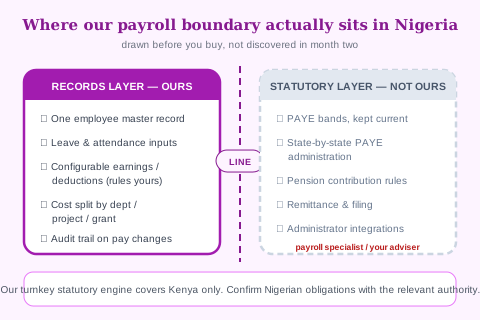
What good payroll practice looks like regardless of your software
Most payroll failures are not calculation errors. They are record failures that surface as calculation errors, and they are fixable without buying anything.
The disciplines worth fixing first
- One authoritative employee record. Not an HR list, a payroll sheet and a bank mandate file that disagree about who works here and at what rate.
- Changes to pay authorised and dated, by someone other than the person who processes payroll — the segregation of duties principle applies to payroll more than to anything else.
- Variable inputs captured as records, not messages. Overtime, allowances and absence should arrive from attendance data, not from a supervisor's WhatsApp on payroll day.
- A reconciliation before payment, not after. Headcount, total gross, total deductions and total net compared against last period, with every movement explained.
- Deductions remitted on their own timetable and reconciled to the payroll that generated them, so a gap is caught in one period rather than accumulating quietly.
- Payroll cost allocated where the work happened — by department, project, or grant. Without this, payroll is a single monthly lump nobody can attribute.
For NGOs the allocation point is not optional. Donor-funded programmes typically require staff cost to be attributed to the grant and budget line that funded it, sometimes split across several — the discipline is set out in NGO payroll practice, and while the statutory layer there is Kenyan, the allocation and audit-trail requirements travel unchanged.
For the wider decision — what an operations system should do in Nigeria and how to test every claim in a demo — see our Nigeria ERP buyer's guide, which applies the same "make them prove it" standard to inventory, procurement and compliance.
How the two systems should meet
-
Keep one employee master
Decide which system is authoritative for who works here, at what rate, in what role — and let the other read from it. Two masters is the root cause of most payroll disputes.
-
Feed variable inputs from records
Attendance, leave and overtime flow from captured data rather than being re-keyed from messages. This is where AWRA earns its place even when payroll runs elsewhere.
-
Calculate statutory obligations where they are maintained
Your specialist payroll system or your adviser handles bands, contributions and filing formats — the part that must be current, every month, without you thinking about it.
-
Bring the result back as cost
Post payroll cost into the same ledger as every other outflow, allocated to department, project or grant, so management reporting is complete rather than payroll-shaped-hole complete.
-
Reconcile remittances against the payroll that created them
Each period, tie what was deducted to what was remitted. Discrepancies caught in one period are administrative; discrepancies caught in twelve are a liability.
The question to ask any payroll vendor
Ask who updates the statutory rules when they change, how quickly, and what happened the last time they did. A vendor maintaining a genuine Nigerian payroll engine will answer with a process and a date. A vendor who has configured a calculator and called it localization will answer with reassurance. That single question separates them reliably.
Our take
For Nigeria, our recommendation is not to move statutory payroll to us on the strength of what ships today. Buy a specialist who maintains the statutory layer and answers for it, keep your employee, attendance and cost records in one operational system, and make sure payroll cost lands in the same ledger as everything else. Said with one qualification, because it is a real one: a Nigerian engine with PAYE, pension and NHF schedules is a build we will scope and price if you want it in one place, and clients have commissioned exactly that elsewhere. Our advice above is what we think is the better buy, not the limit of what we will do. We would rather be honestly useful for four-fifths of your operation than dishonestly complete across all of it.
Get the operations side right first
One employee record, attendance and leave feeding real inputs, and payroll cost allocated to the department, project or grant that incurred it — with a straight answer about the statutory layer.
Explore AWRA for NigeriaFrequently asked questions
Can AWRA OpsHub run our Nigerian payroll end to end?
Not the statutory part, no. Our turnkey statutory payroll engine is maintained for Kenya only, so Nigerian PAYE bands, pension contribution rules and other statutory deductions are not kept current for you. You can configure earnings and deductions manually to whatever specification your adviser gives you, and the calculation will run — but you own the rules, and nothing is filed or remitted on your behalf. If statutory payroll is your main requirement, use a Nigerian payroll specialist alongside us.
Why not just build Nigerian payroll?
Because doing it properly means tracking bands, thresholds, contribution rules and filing formats across state-level administration and keeping them current every time they change — and a payroll engine that is six months stale is worse than no payroll engine, since people trust it. We will build it on real, expressed demand from customers who need it, and we would rather tell you it does not exist yet than sell you a calculator with a Nigerian flag on it.
What does the system actually contribute to payroll then?
The records payroll depends on and the cost reporting that comes after it: one authoritative employee record, leave and attendance producing real variable inputs rather than messages on payroll day, an audit trail over changes to pay and roles, and payroll cost allocated to the department, project or grant that incurred it and posted into the same ledger as every other outflow. In most organizations those are the parts that are genuinely broken, while the calculation itself is the part someone already handles.
We have staff in several states. Does that change anything?
It can change your obligations significantly, because PAYE in Nigeria is administered at state level, which means a workforce spread across states may involve more than one filing relationship rather than a single national one. Any system that models income tax as one national rule will mislead you here. Confirm your specific position with each relevant state authority or with your adviser — this is exactly the kind of question worth paying a specialist for once rather than guessing at monthly.
Can payroll cost be split across donor grants?
Yes — cost allocation to departments, projects, cost centres and grants is part of the operations layer and works regardless of where the payroll calculation itself runs. For donor-funded programmes this is usually the requirement that matters most, since staff cost typically has to be attributed to the grant and budget line that funded it, sometimes split across several, with a trail an auditor can follow.
