
Payroll, PAYE, UIF & SDL in South Africa: Getting the Split of Tools Right
South African payroll is a submission regime as much as a calculation one, and this is the clearest case in the whole series for hiring a specialist rather than us. What we hold, what we will not pretend to do, and how to divide the work so nothing falls in the gap.
We will make the argument against ourselves first, because it is the most useful thing in this post. If South African statutory payroll is what you are shopping for, we are not the answer, and a vendor in our category who tells you otherwise is either misunderstanding the question or hoping you will not check.
That is not modesty. Our maintained statutory payroll engine covers Kenya only. Everywhere else — Nigeria, Ghana, and South Africa most of all — we hold employee records, attendance, leave and cost allocation, and we recommend a local specialist for the statutory layer.
South Africa is the strongest version of that recommendation in this series, and the reason is worth understanding even if you never buy anything from us. Nothing here is tax, legal or payroll advice; confirm every obligation, deadline and rate with SARS, the relevant authorities and your own payroll practitioner.
Why this one is different
In most markets, "payroll software" means a calculation engine. You configure the rules, it applies them to hours and salaries, and it produces a payslip. Getting that wrong is embarrassing and correctable.
South African payroll is not primarily a calculation product. It is a submission product. Around the monthly pay run sits a rhythm of employer declarations, periodic reconciliations, employee tax certificates and separate returns for other statutory schemes — each with its own format, its own deadline and its own consequences for being late or inconsistent. The calculation is the easy half. The half that generates real exposure is the reporting that follows it, and that reporting has to reconcile with itself across a whole tax year.
On top of that sits an employment framework with genuine complexity in it: sectoral determinations, bargaining council agreements where they apply, leave entitlements with statutory minimums, and termination arithmetic that is not a matter of preference. A generic international payroll module configured by a well-meaning finance manager will produce numbers. Whether those numbers are right is a question nobody in the building is qualified to answer, and the first time you find out is when a reconciliation does not balance.
A payroll that is wrong pays people. That is what makes it dangerous — the error is invisible for a year and then arrives all at once, with a reconciliation attached.
Dividing the work
The practical question is not who does payroll. It is where the line sits, because payroll touches operational data that a payroll bureau has no business owning and operational systems touch statutory rules they have no business maintaining.
How much of payroll you take on yourself
Full bureau service
You send changes, they run the payroll and handle submissions. Lowest exposure, least flexibility, and you must still get your own inputs right — a bureau cannot fix hours you recorded wrongly.
Bureau or practitioner plus your own operational system
You own employee records, attendance, leave and cost allocation; they own calculation, statutory rules and submissions. Where we fit, and what we recommend for most South African organizations.
Specialist South African payroll software, run in-house
A maintained local product with the statutory layer built and updated for you, operated by your own trained person. Sensible at scale, provided that person genuinely exists and stays.
Generic software configured by you
Rules entered by hand into a system that does not maintain them. Cheapest on paper and the position we would most strongly advise against — you have taken on specialist accountability without specialist support.
Note where the risk sits at the right-hand end. Configuring statutory rules yourself in generic software does not make the obligation yours to interpret — it already was. It simply removes the professional who would have caught the mistake.
What we do and do not do
What AWRA OpsHub does today
- Employee records — personal details, employment history, position, department, cost centre, documents attached with expiry dates.
- Attendance and time capture, including offline capture at sites and on the floor where connectivity is unreliable.
- Leave management — requests, approvals, balances and history, configured to the entitlements your practitioner specifies.
- Payroll cost allocation to projects, funders, cost centres and production jobs, which is usually what an operations system is genuinely needed for.
- Manually configurable earnings and deductions, to a specification you or your practitioner provide.
- A maintained statutory payroll engine — for Kenya. Stated so the boundary is unmistakable rather than implied.
More we can add to your workspace
- PAYE, UIF and SDL calculated for you: maintained South African statutory rules, tax tables, rebates and thresholds, on the pattern the Kenyan engine already follows.
- Employer declarations or reconciliation output. We produce no EMP201, no EMP501, and no employee tax certificates.
- Submissions: a SARS eFiling or e@syFile integration, a UIF declaration, and a return of earnings for workplace injury cover.
- A remittance. Paying anything to anybody on your behalf is a position we hold rather than work outstanding — the money leaves through your bank, on your authority.
- Bargaining council and sectoral determination logic, encoded and maintained as rules. Which determination applies to you stays your adviser's call.
- A termination or retrenchment calculation, which is precisely the moment when getting it wrong is most expensive.
Read that right-hand column as a recommendation rather than an apology. It describes work that a South African payroll specialist does properly, keeps current as rules change, and carries professional accountability for. We would rather you buy that from someone qualified and buy the operations layer from us than buy a single system that is confident about both.
What we can build for South Africa on top of the standard product
Everything listed above as something we can add describes what ships in the standard product today — it is a starting point for South Africa, not a limit on what AWRA OpsHub can do there. Kenya's eTIMS integration and its maintained payroll engine are in the product because Kenyan clients needed them and commissioned them; neither appeared by itself. The same door is open here. If SARS-shaped return output, a bank or mobile money feed, a statutory return format, a rule specific to how your operation runs, or a link to a system you already have is what stands between you and a decision, tell us and we will scope it as a build — written spec, timeline and price — before you commit to anything.
SARS output and e-invoicing
VAT201-shaped return output from live records, a maintained rate history rather than a single preset, and e-invoicing against any prescribed interface — with retries, a failure queue and a reconciliation report.
Banks, EFT and card acquirers
Bank statement feeds, EFT and debit-order files, and card acquirer settlement reports pulled into the Payments Register so receipts match invoices without anyone re-keying a statement.
The operational work, which is what most commissions actually are
An extra approval stage in a chain that does not match the standard one, a custom field set on employees or assets that only your sector needs, an expiry that has to block an order rather than send an email, a report your board asks for in a shape nothing produces, or a scanner or weighbridge feeding the goods-in door. These are the commissions we are asked for most often and the smallest ones we quote — and unlike a revenue-authority pipeline, none of them waits on a regulator.
Payroll and statutory returns
EMP201 and EMP501 schedules, UIF declarations and COIDA returns produced in the layout your filing body expects, generated from live payroll records instead of rebuilt each month.
Systems you already run
The accounting package, CRM, online store or custom database you intend to keep — connected through our API so a fact is entered once and appears everywhere it is needed.
How it works: you describe the requirement, we return a written scope, timeline and cost, and once agreed it is built into your environment and maintained as part of the product. No roadmap slide, and no pretending in a demo that something exists when it does not.
Tell us what you need integrated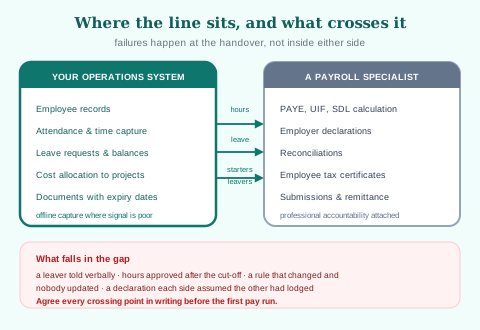
The crossing points, and who owns each
Almost every payroll failure in a split arrangement happens at a handover rather than inside either system. Agree these explicitly, in writing, before the first pay run.
| What crosses the boundary | Who owns it | Where it goes wrong |
|---|---|---|
| New starters and leavers | You — from the operations and HR side | A leaver who was told verbally and paid for another month; a starter whose date differs between the two systems |
| Hours, overtime and shift data | You — captured at the site | Hours approved after the payroll cut-off, then paid a month late and reconciled never |
| Leave taken and balances | You, to entitlements your practitioner specifies | Unpaid leave that never reached the payroll, and accrued balances that differ between the two records |
| Statutory calculation and rates | Your practitioner or bureau — never you, and never us | A rule that changed and a configuration nobody updated, discovered at reconciliation |
| Declarations, certificates and submissions | Your practitioner or bureau | Late or inconsistent filing, usually because an input arrived late from your side |
| Payroll cost by project or cost centre | You — allocation belongs with operations | Funder reports built from a payroll total split by estimate rather than by recorded allocation |
That last row is the one that most often justifies an operations system in the first place. A funder or a board asking what a programme cost wants staff cost attributed to the programme, not a payroll total apportioned afterwards by somebody's estimate of who spent time where.
Questions for whoever you do buy payroll from
Ask these of a payroll vendor or bureau — not of us
Who updates the statutory rules when they change, and how fast?
What you will hear
We keep the software updated in line with legislation.
How to read it
Ask for the last three changes, when they were released, and how customers were told. A vendor who maintains this properly will have the answer immediately; one who does not will describe a process rather than an instance.
What exactly do you submit, and what remains ours?
What you will hear
A list of outputs, possibly with an integration mentioned.
How to read it
Get it as a written list of every declaration, reconciliation and certificate, with who lodges each. This single document prevents the most common failure in a split arrangement, which is both parties assuming the other filed something.
Who is professionally accountable if a calculation is wrong?
What you will hear
A reference to terms and conditions, or to the software being correctly configured.
How to read it
Software vendors generally carry no accountability for your filings; practitioners and bureaux often carry some. That difference is worth more than any feature comparison, and it is the strongest argument for a specialist over a configured module.
How do hours and leave get in?
What you will hear
Import, integration, or manual capture.
How to read it
Whatever the answer, pin down the cut-off date and what happens to a late approval. Most month-to-month payroll pain lives here rather than in the calculation.
Good payroll practice, whatever you buy
- One employee master, and everybody knows which system it is. Two lists of employees will diverge, and they will diverge quietly, and you will discover it during a reconciliation.
- A hard cut-off with a documented late path. Not "get it in by Friday" but a stated date and an agreed procedure for what happens when something misses it.
- Approvals on the inputs, not just on the payroll. Overtime approved by a supervisor before it reaches payroll is a control; overtime approved by the payroll run is arithmetic.
- Reconcile monthly rather than at year end. The annual reconciliation should confirm what you already know. If it is the first time anyone has compared the numbers, it will not balance and the trail will be twelve months cold.
- Keep termination arithmetic with a professional, always. It is infrequent, high-value, emotionally charged and legally consequential — the exact profile of work not to do yourself to save a fee.
- Document the boundary and review it annually. Split arrangements decay as people leave. The written division of work is what survives the handover.
Where to go next
The overall purchase decision is in the South Africa buyer's guide, and the same boundary in different dialects is set out for Nigeria and Ghana. If cost allocation to funders and projects is what brought you here, procurement and asset management for South African NPOs covers the attribution discipline properly.
Our take
Hire a South African payroll specialist or bureau, and hold your employee records, attendance, leave and cost allocation in your operations system. Then write down every crossing point between the two and who owns it, because that document — not either piece of software — is what actually prevents the failures. We would rather be one honest half of that arrangement than the confident whole of a worse one.
The operations half, done properly
Employee records, attendance with stock and asset movement captured offline, leave with real approvals, and payroll cost allocated to the projects and funders that need to see it — alongside whichever specialist runs your statutory payroll.
Explore AWRA for South AfricaFrequently asked questions
Does AWRA OpsHub calculate South African PAYE, UIF and SDL?
No. Our maintained statutory payroll engine covers Kenya only. For South Africa there are no maintained tax tables, thresholds, rebates or contribution rules, nothing is calculated for you, and nothing is submitted or remitted on your behalf. Earnings and deductions can be configured manually to a specification you or your practitioner provide, but you own those rules entirely. We recommend a South African payroll specialist or bureau for the statutory layer.
Can it produce EMP201, EMP501 or IRP5 certificates?
No. We produce no employer declarations, no reconciliations and no employee tax certificates, and there is no SARS eFiling or e@syFile integration of any kind. This is the specific reason South African payroll is not a fit for us — the statutory obligation here is as much about the submission and reconciliation rhythm as about the calculation, and that is specialist work with professional accountability attached.
Then what is AWRA actually useful for on the HR side?
Employee records with documents and expiry dates, attendance and time capture including offline at sites with poor connectivity, leave requests with approvals and balances, and payroll cost allocated to projects, funders, cost centres and production jobs. That last one is usually the real reason organizations need an operations system alongside a payroll bureau: a funder or board asking what a programme cost wants staff cost attributed at the point of work, not a payroll total split afterwards by estimate.
What about bargaining councils and sectoral determinations?
We do not encode or maintain those rules and we would be wary of any generic operations vendor who claims to. Where they apply to your sector, they affect entitlements, rates and procedures in ways that need a practitioner who follows them. Configure your leave entitlements and earning types in AWRA to the specification that practitioner gives you, and keep the interpretation with them.
Can we just configure the South African rules ourselves in a generic system?
You can, and it is the arrangement we would most strongly advise against. Configuring the rules yourself does not shift the obligation — it was always yours — it simply removes the professional who would have caught the mistake. The errors are invisible for months because a wrong payroll still pays people, and they surface all at once at reconciliation. The fee for a specialist is almost always smaller than the cost of finding out that way.
Is this the same position in your other African markets?
Yes, with South Africa the strongest case. Turnkey statutory payroll is maintained for Kenya only; Nigeria, Ghana and South Africa all get the same division of work — operations, records, attendance, leave and cost allocation from us, statutory calculation and submissions from a local specialist. South Africa is where we push hardest for the specialist, because the submission and reconciliation regime around the pay run is the heaviest of the three.
