
Payroll, PAYE & Pensions in Ghana: Getting the Basics Right
Ghanaian payroll answers to a revenue authority and a multi-tier pension arrangement, and it is the one area of this series where we recommend somebody else. What good payroll practice looks like regardless of your software, and exactly where our boundary sits.
We will make the same argument here that we made for Nigeria, because it is equally true and equally unprofitable to say: our turnkey statutory payroll engine is maintained for Kenya only. If Ghanaian statutory payroll is your primary requirement, buy a Ghanaian payroll specialist and use us for operations. That is the honest recommendation and the rest of this guide assumes you have taken it.
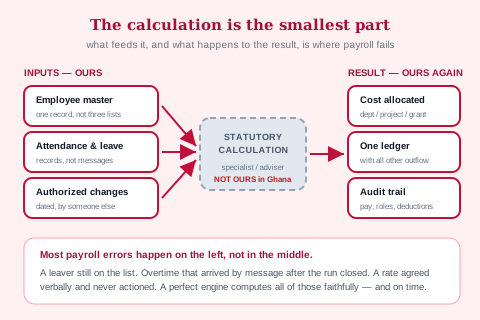
Which leaves a more useful question. If the calculation runs somewhere else, what should the rest of your system be doing about payroll? The answer is more than most organizations realise, because the majority of payroll failures are not calculation errors at all — they are record failures that surface as calculation errors.
Nothing here is tax or legal advice, and this guide deliberately states no rates, bands or contribution percentages. What applies to your organization, at what rate, on what timetable, is a matter for the relevant authorities and your adviser, and it changes.
Why the calculation is the easy part
Ask a payroll administrator what went wrong last time something went wrong. You will very rarely hear "we applied the wrong rate." You will hear that somebody left and stayed on the payroll, that an overtime claim arrived by message after the run had closed, that a salary change was agreed verbally and never actioned, or that the bank list and the payroll list disagreed about a name.
Every one of those is a record problem occurring before the calculation. A statutory engine, however well maintained, computes faithfully on whatever it is given — which means a perfect engine fed poor inputs produces confidently wrong payslips, and does so on time.
A payroll engine cannot know that the person it just paid resigned three weeks ago. That is not a calculation failure — it is a record failure that arrives wearing a calculation's clothes.
The disciplines worth fixing first
None of these require buying a payroll system
- One authoritative employee record — not an HR list, a payroll sheet and a bank mandate file that quietly disagree about who works here and at what rate
- Pay changes authorized and dated by someone other than the person who processes payroll. This is segregation of duties, and payroll is where it matters most
- Variable inputs arriving as records, not messages. Overtime, allowances and absence should come from attendance data rather than from a supervisor's message on payroll day
- A pre-payment reconciliation — headcount, total gross, total deductions and total net compared against last period, with every movement explained before anyone approves the run
- Leavers processed at the point of leaving, not at the point of noticing. This is the single most common source of overpayment in every market
- Deductions reconciled to the payroll that generated them, each period, so a gap surfaces in one cycle rather than accumulating quietly across twelve
That fourth item deserves emphasis because it takes ten minutes and catches almost everything. If gross moved by an amount you cannot explain from a list of joiners, leavers and agreed changes, something is wrong — and you have found it before the money left rather than afterwards.
Where our boundary sits
What AWRA OpsHub genuinely contributes
- An authoritative employee record — people, roles, departments, start and end dates, documents and history that survives turnover in HR itself.
- Leave and attendance producing the variable inputs payroll depends on, so overtime and absence are records rather than recollection.
- Configurable earnings and deductions, set up to whatever specification your adviser provides — the calculation runs, but the rules are yours.
- Payroll cost allocated where the work happened — department, project, cost centre or grant.
- Payments recorded in the same ledger as every other outflow, so payroll is not a separate universe at reporting time.
- An audit trail over changes to pay, roles and deductions.
What we can add for Ghana
- A turnkey Ghanaian statutory engine. PAYE and the pension tiers are not maintained and updated for you the way Kenyan PAYE, NSSF and SHIF are.
- Statutory filing and remittance, submitting to the authority or pension trustee. Signing what goes stays yours.
- Integrations with pension schemes or trustees.
- Advice on what applies to you — which obligations bind your organization, and at what rates, is a question for your adviser.
- GRA e-invoicing anywhere in the product; our fiscal integration is Kenya's eTIMS and it is Kenya-only.
The recommendation, plainly: use a Ghanaian payroll specialist for the statutory layer and AWRA for the records that feed it and the cost that comes out of it. Tell us what you need — regional payroll localization gets built on real demand, never on a promise made during a sale.
What we can build for Ghana on top of the standard product
Everything listed above as something we can add describes what ships in the standard product today — it is a starting point for Ghana, not a limit on what AWRA OpsHub can do there. Kenya's eTIMS integration and its maintained payroll engine are in the product because Kenyan clients needed them and commissioned them; neither appeared by itself. The same door is open here. If GRA e-invoicing, a bank or mobile money feed, a statutory return format, a rule specific to how your operation runs, or a link to a system you already have is what stands between you and a decision, tell us and we will scope it as a build — written spec, timeline and price — before you commit to anything.
GRA e-invoicing and the levy stack
Electronic invoicing against GRA's published interface, and a maintained multi-component levy stack we keep current for you instead of leaving the effective-from dates in your hands.
MoMo, cards and bank feeds
Mobile money settlement files, card acquirer reports and bank statement feeds pulled into the Payments Register, so collections reconcile against invoices without anyone re-keying a statement.
The operational work, which is what most commissions actually are
An extra approval stage in a chain that does not match the standard one, a custom field set on employees or assets that only your sector needs, an expiry that has to block an order rather than send an email, a report your board asks for in a shape nothing produces, or a scanner or weighbridge feeding the goods-in door. These are the commissions we are asked for most often and the smallest ones we quote — and unlike a revenue-authority pipeline, none of them waits on a regulator.
Payroll and statutory returns
PAYE and SSNIT contribution schedules produced in the layout your filing body expects, generated from live payroll records rather than rebuilt in a spreadsheet each month.
Systems you already run
The accounting package, CRM, online store or custom database you intend to keep — connected through our API so a fact is entered once and appears everywhere it is needed.
How it works: you describe the requirement, we return a written scope, timeline and cost, and once agreed it is built into your environment and maintained as part of the product. No roadmap slide, and no pretending in a demo that something exists when it does not.
Tell us what you need integratedHow the two systems should meet
-
Decide which system owns the employee master
One of them is authoritative for who works here, in what role, at what rate; the other reads from it. Two masters is the root cause of most payroll disputes and every reconciliation headache.
-
Feed variable inputs from captured records
Attendance, leave and overtime flow from data rather than being re-keyed from messages. This is where an operations system earns its place even when payroll runs entirely elsewhere.
-
Calculate where the rules are maintained
Your specialist handles bands, contributions and filing formats — the part that must be current every single month without you thinking about it.
-
Bring the result back as allocated cost
Post payroll into the same ledger as every other outflow, split by department, project or grant, so management reporting is complete rather than payroll-shaped-hole complete.
-
Reconcile remittances against the payroll that created them
Each period, tie what was deducted to what was remitted. A discrepancy caught in one period is administrative; the same discrepancy caught in twelve is a liability.
The question to ask any payroll vendor in Ghana
Ask who updates the statutory rules when they change, how quickly, and what specifically happened the last time one did. A vendor maintaining a genuine Ghanaian engine answers with a process, a person and a date. A vendor who configured a calculator and called it localization answers with reassurance. That one question separates them reliably, and it works on us too.
For grant-funded organizations
If donor funding pays any part of your salary bill, cost allocation stops being a management nicety and becomes a reporting obligation. Staff cost typically has to be attributed to the grant and budget line that funded it — sometimes split across several — with a trail an auditor can follow back to an authorization.
This is squarely on our side of the boundary and works regardless of where the calculation runs. The practice is set out in NGO payroll discipline; the statutory layer there is Kenyan, but the allocation and audit-trail requirements travel unchanged, and they are usually the part a donor actually examines.
Our take
For Ghana, our recommendation is not to move statutory payroll to us on the strength of what ships today. Buy a specialist who maintains the statutory layer and answers for it when it changes, keep your employee, attendance and cost records in one operational system, and make sure payroll cost lands in the same ledger as everything else. With the same qualification we would give in person: a Ghanaian engine with PAYE and SSNIT schedules is a build we will scope and price if having it in one system matters more to you than having a local specialist answer for it. That is a trade-off for you to make with real numbers, not a door we are closing. We would rather be honestly useful across four-fifths of your operation than dishonestly complete across all of it.
Get the records side right first
One employee record, attendance and leave producing real inputs, and payroll cost allocated to the department, project or grant that incurred it — with a straight answer about the statutory layer.
Explore AWRA for GhanaFrequently asked questions
Can AWRA OpsHub run Ghanaian payroll end to end?
Not the statutory part. Our turnkey statutory payroll engine is maintained for Kenya only, so Ghanaian PAYE and pension rules are not kept current for you and nothing is filed or remitted on your behalf. Earnings and deductions can be configured manually to your adviser's specification and the calculation will run, but you own those rules. If statutory payroll is your main requirement, use a Ghanaian specialist alongside us rather than expecting us to cover it.
Why not build it?
Because doing it properly means tracking bands, thresholds, contribution rules and filing formats and keeping them current every time they change — and a payroll engine six months out of date is worse than none at all, because people trust it. We will build it on real expressed demand from customers who need it, and until then we would rather say so than ship a calculator with a Ghanaian label on it.
So what does the system actually contribute?
The records payroll depends on and the cost reporting that follows it: one authoritative employee record, leave and attendance producing genuine variable inputs rather than messages on payroll day, an audit trail over changes to pay and roles, and payroll cost allocated to the department, project or grant that incurred it and posted into the same ledger as every other outflow. In most organizations those are the parts that are actually broken, while the calculation is the part somebody already handles competently.
What is the most common payroll error you see?
Leavers who stay on the payroll — processed at the point of noticing rather than the point of leaving. It is universal across markets, it is expensive, and it is caught reliably by one habit: a pre-payment reconciliation comparing headcount, gross, deductions and net against the previous period, with every movement explained before anyone approves the run. It takes about ten minutes and catches almost everything.
Can payroll cost be split across donor grants?
Yes — cost allocation to departments, projects, cost centres and grants sits on the operations side and works regardless of where the calculation itself runs. For grant-funded organizations this is usually the requirement that matters most, since staff cost typically has to be attributed to the grant and budget line that funded it, sometimes across several, with a trail an auditor can follow back to an authorization.
