
Multi-Branch Retail in Nigeria: One Stock Position, Many Locations
A second shop doubles your revenue and quadruples your blind spots. What changes when a Nigerian retailer goes from one location to several — and the handful of controls that decide whether the third branch makes money or quietly consumes it.
One shop is manageable by presence. You are there, you see the shelves, you know the staff, and when something is wrong you feel it before you can prove it. That instinct is a genuine management system and it works remarkably well — right up to the moment there is a second location, at which point it silently stops scaling and nobody notices for about a year.
What replaces presence is not more visits. It is a small set of records that behave the same way in every branch, produced daily by people who are not you. Retailers who understand this expand profitably. Retailers who try to scale presence end up spending their week in traffic between locations, arriving everywhere too late to change anything.
What actually breaks at branch two
The failures are predictable, which is good news — predictable problems have standard controls.
| What breaks | How it shows up | What it costs you |
|---|---|---|
| Stock accuracy | Each branch keeps its own count and nobody reconciles them to a single position | You buy what you already have and run out of what you thought you stocked |
| Transfers | Goods move between branches on a phone call and get counted twice or not at all | Phantom stock — promises to customers you cannot keep |
| Pricing discipline | Branch staff adjust prices to close a sale, and margin becomes a rumour | Margin erosion nobody can locate, because the invoice and the price list disagree |
| The daily close | Cash, transfers and POS settlements reconciled weekly or monthly | Shortfalls discovered long after the shift and the person are gone |
| Accountability | A variance belongs to "the branch" rather than to a shift and a name | Shrinkage becomes a cost of doing business instead of an investigation |
Every one of those is the same root cause wearing a different costume: a record that exists in more than one place, or a record that exists nowhere until somebody remembers to make it.
The daily close is the control that pays for everything else
If a multi-branch retailer only ever implements one discipline, it should be this: at the end of every shift, in every branch, what the system says was sold is reconciled against what was actually banked — cash, transfers and POS settlements together — by the person who worked that shift.
The reason this is so powerful has less to do with catching theft than with time. A discrepancy examined the same evening is a question somebody can answer: a customer who paid partly in cash, a transfer that had not landed, a POS terminal that settled the next morning. The same discrepancy examined three weeks later is unanswerable, and unanswerable discrepancies get absorbed. Absorb enough of them and you have taught the whole organization that variances do not matter.
The value of a daily close is not that it catches thieves. It is that it asks the question while the answer still exists.
The mechanics are the same ones we documented for the Kenyan retail daily close — the payment instruments differ, the discipline does not. And the broader anatomy of retail loss is covered in shrinkage control, which is worth reading before you conclude that your losses are theft; more often they are receiving errors and untracked adjustments.
One position, many locations
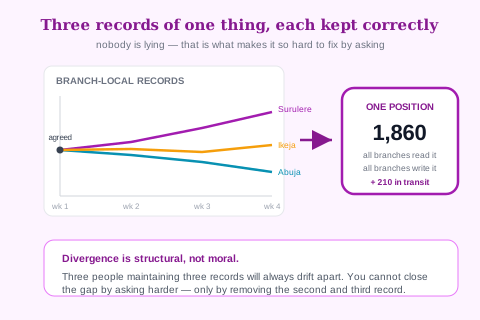
The architectural decision that matters is whether each branch has its own stock record or whether every branch reads from and writes to one shared position. It sounds abstract until you watch the difference play out.
Branch-local records
- Head office asks for figures and waits
- A transfer is agreed verbally and recorded twice, differently
- Stock available at branch B is invisible to a customer standing in branch A
- Reconciliation is a monthly project with a designated victim
- The person who can explain a variance has already gone home — three weeks ago
One shared position
- Head office looks; nobody is asked for anything
- A transfer is a dispatch and a receipt, with in-transit stock owned by neither branch
- A customer in branch A can be sold, or promised, what branch B genuinely holds
- Reconciliation is a daily five-minute task per branch
- A variance has a shift, a name and a date attached before anyone has left the building
Getting there without stopping trading
-
Count every branch properly, once
A real physical count per location, reconciled and signed. Every number after this is measured from this line — and a soft baseline poisons a year of reporting.
-
Put the point of sale on the stock record
Every sale moves inventory in the same second, in every branch. Until this is true, nothing downstream can be trusted, however good it looks.
-
Start the daily close immediately
Before any clever configuration. Sales against banking, per branch, per shift, every day. This is where the culture change actually happens.
-
Govern transfers
Dispatch and receipt as two separate events with two different people. In-transit stock belongs to neither branch until confirmed received.
-
Lock pricing, then delegate discounting deliberately
A central price list with discount authority granted explicitly to named roles — so a discount is a decision on the record rather than a conversation at the counter.
-
Add cycle counting, then reorder logic
Count a slice continuously rather than shutting down annually, and only then automate replenishment. Cycle counting vs annual stocktake explains why the annual ritual finds problems too late to fix.
Resist the temptation to open branch three first
The controls that make two branches legible are the same ones that make six legible, and they cost far less to install at two. Retailers who expand first and systematize later spend the intervening period unable to tell which of their branches is actually profitable — and usually discover the answer was "not the newest one."
What the numbers should tell you once it works
The point of all this is not tidiness. It is being able to answer questions that are impossible to answer from presence alone: which branch actually makes money after its own costs, which lines sell in Surulere and die in Abuja, how much capital is asleep on your shelves, and which location has a receiving problem rather than a sales problem.
Those answers come from a small number of well-understood measures — inventory turnover per branch and per category, ABC analysis to focus attention where the money is, and honest dead stock review. None of them are exotic. All of them are impossible when each branch keeps its own version of the truth.
If you are choosing a system rather than tightening one, the evaluation rubric is in our Nigeria ERP buyer's guide. If your branches are fed by your own warehouses and vans, the supply side of the same operation is covered in inventory and distribution in Lagos.
Our take
Multi-branch retail is not a bigger version of single-shop retail; it is a different discipline, and the transition point is branch two, not branch five. Install one shared stock position, a daily close per shift, and governed transfers — in that order — and you can add locations without adding blind spots. Skip them and every new branch makes your business larger and less knowable at the same time.
See every branch on one position
Live stock across all locations, governed transfers with in-transit visibility, and a daily close per branch and per shift that reconciles cash, transfers and POS against system sales.
Explore AWRA for NigeriaFrequently asked questions
How many branches before this is worth it?
Two. The instinct is to wait until four or five, but the failures — divergent stock records, transfers on trust, variances nobody owns — begin the day the second location opens, and they are dramatically cheaper to fix at two branches than at five. Retailers who systematize at two expand smoothly; those who wait spend the intervening years unable to say which branch is genuinely profitable.
Can a branch see what other branches have in stock?
Yes — that is one of the main reasons to run a shared position rather than branch-local records. Staff in one location can see what another genuinely holds, which turns a lost sale into a transfer or a promise you can actually keep. Stock in transit between branches is shown separately and belongs to neither branch's sellable position until it is confirmed received.
Does the daily close have to be daily?
In practice, yes, and per shift rather than per day where you run more than one. The entire value comes from asking the question while the answer still exists — a discrepancy examined the same evening usually has a mundane explanation someone can give you, while the same discrepancy examined weeks later is unanswerable and gets absorbed. Once variances start being absorbed, the control has stopped working even though the report still runs.
How do we stop branch staff discounting away our margin?
With a central price list plus discount authority granted explicitly to named roles, rather than by asking people to be disciplined. A discount then becomes a recorded decision by someone authorized to make it, and margin by branch becomes something you can actually measure. The goal is not to eliminate discounting — it is to make it visible and attributable rather than ambient.
Will it work if some branches have unreliable internet?
Yes. Capture is offline-capable for stock and asset movement on ordinary devices and syncs when the connection returns, so a branch keeps selling and recording through an outage rather than reverting to paper and back-entering later. This matters more than buyers expect, because a system that stops working during an outage teaches staff to keep a parallel manual process — and then you are running two systems again.
