
Multi-Branch Retail in South Africa: One Price, One Stock Position
Your customer checked the price online before driving to the branch, and a promotion that ended on Sunday is still on a shelf edge in Bloemfontein. Price governance across provinces, promotions that expire everywhere at once, and the reserved-stock problem that omnichannel quietly creates.
Multi-branch retail used to be forgiving about small inconsistencies. A branch that ran a slightly different price, or held stock the head-office report did not know about, caused an argument at month-end and nothing worse. That tolerance is gone, and it was not a system that removed it — it was the customer, who now checks before leaving the house.
Once a shopper can see your price and your availability before they arrive, every internal inconsistency becomes an external one. A price that did not propagate is no longer a reporting variance; it is a conversation at the till that the cashier cannot win. Stock that showed as available and is not is no longer a picking problem; it is a wasted trip across a city.
This post is about the three disciplines that hold a South African branch network together under that scrutiny: one price, one stock position, and a promotion that ends everywhere on the same evening.
How much price control should a branch have?
This is treated as an ideological question and it is really an operational one. Total central control is not obviously right in a country where a coastal branch and an inland one face genuinely different competitors, and total local freedom is not obviously wrong until you try to run a national promotion.
Where price authority sits
Locked central pricing
One price nationally. Simple, defensible, easy to advertise — and it will lose you margin in the strong locations and volume in the weak ones.
Central price, bounded local discretion
A national price with a documented tolerance and an approval above it. Usually the right answer: the exception exists, it is visible, and somebody owns it.
Regional price bands
Coastal, inland and rural bands set centrally. Works well for genuinely different cost-to-serve, and stays advertisable if the bands are few and stable.
Branch-set pricing
Maximum responsiveness, and no national promotion you can run with confidence. Defensible only for a small network where the manager is effectively the owner.
The position matters less than whether you have actually chosen one. Most networks in trouble have never decided — they have central pricing in policy, branch pricing in practice, and no record of which prices are deliberate exceptions and which are simply stale.
The promotion that would not end
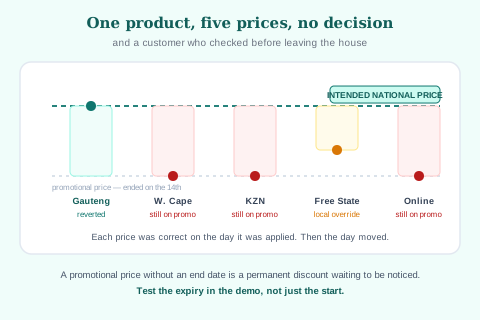
Promotions expose the pricing architecture more sharply than anything else, because they have a beginning and an end and they run across every location at once. When a promotion fails to end cleanly, it does so in three places and each costs differently.
A national promotion that ended late in four branches
Illustrative figures indexed to 100, not a quotation. The arithmetic is the uncomfortable part: an 18% overrun against a 22% margin removes four-fifths of the profit on those units, and it continues silently until somebody notices a shelf edge. Multiply by four branches and a fortnight and this single failure costs more than most retail systems do in a year.
A promotion is not a price change. It is a price change with an expiry date, and the expiry is the half nobody tests.
The system requirement is unremarkable: prices carry effective dates, promotional prices carry an end date as well as a start date, and the reversion is automatic rather than a task somebody has to remember on a Sunday night. What makes this a real problem is that the failure is silent — no error appears, nothing breaks, and the only symptom is a margin that came in slightly under plan for reasons everybody attributes to the market.
One stock position, seen from the outside
The second discipline is availability, and the difficulty here is not accuracy in the warehouse sense. It is that "available" now has to mean something to a person who is not standing in your store.
On-hand quantity is not availability. A branch holding twelve units of which five are on a click-and-collect order, two are damaged and awaiting write-off and one is on the shop floor as a display has four units genuinely available. A system that publishes twelve will sell eight of them twice.
-
Give reservation a real state
Stock committed to an online order, a layby or a quotation is not available. If reservation is only a note on the order rather than a state on the stock, the shelf will sell it and somebody will phone a customer with an apology.
-
Separate sellable from held
Damaged, quarantined, display and returned-pending-assessment units are all physically present and none of them are sellable. One quantity field cannot represent both facts.
-
Publish availability, not on-hand
Whatever a customer sees — online, in an app, or from a call centre — should be the net figure after reservations and holds. Publishing the gross number is a choice to disappoint a predictable number of people every week.
-
Decide what happens when a branch is short
Fulfil from another branch, offer collection later, or decline honestly. All three are acceptable; what is not acceptable is a system that promises and a person who improvises.
-
Cycle count by class, not once a year
High-value and fast-moving lines counted weekly, everything else on rotation. Annual counts tell you about a discrepancy long after the trail that would have explained it has gone cold.
The demo test for availability
Ask them to place an online order that reserves stock at a branch, then attempt to sell the same units at that branch's till. The correct behaviour is that the till cannot see them. A warning the cashier can dismiss is not a control — it is a record of the moment your customer promise was broken by someone who was trying to be helpful.
Branch accountability without branch isolation
The tension in every branch network is that you want managers accountable for a result they control, while wanting stock and pricing governed nationally. Those pull in opposite directions and the resolution is to be precise about what each branch owns.
- A branch owns its shrinkage, not its price. Count accuracy, cash-up variance and write-offs are genuinely local and should be measured locally, weekly.
- A branch owns its service level, not its stock. If replenishment is central, the branch cannot be blamed for a stockout — but it can be held to how quickly it flagged one.
- Every exception has a name attached. A discount, a price override, a write-off or a negative count adjustment should carry the person who authorised it. Not to punish, but because unattributed exceptions are the pattern under which real losses hide.
- Cash-up variance is a daily number, not a monthly one. By month-end nobody remembers the Tuesday it started, and the trail is gone.
- Compare branches on the things they control. A national ranking on gross margin mostly measures location. A ranking on count accuracy and cash variance measures management.
The transfer mechanics behind all of this — the in-transit window, long inland legs and what an emergency transfer really costs — are covered in inventory for South African distributors and retail rather than repeated here.
Where to go next
The overall purchase decision, including whether your existing point-of-sale and finance systems need replacing at all, is in the South Africa buyer's guide. The VAT evidence side of retail transactions is in SARS, VAT and rand operations, and if you are also running staff across many sites, the honest position on payroll is in payroll, PAYE, UIF and SDL.
Our take
Decide where price authority sits and write it down, put an end date on every promotional price so the reversion is automatic, and never publish on-hand quantity as availability. Those three are cheap, unglamorous and worth more to a South African branch network than any analytics module — because each of them prevents a specific, silent, repeating loss that the customer notices before you do.
See one price and one stock position across your branches
Central pricing with governed local exceptions, promotions that expire on schedule, and availability that nets off what is already promised to somebody else.
Explore AWRA for South AfricaFrequently asked questions
Can we set prices centrally but let branches respond to local competition?
Yes, and for most networks that is the right arrangement. A national price with a documented tolerance and an approval required beyond it gives you advertisable consistency while keeping the exception visible and owned. The important part is that a local price is recorded as a deliberate exception with a person attached, rather than being indistinguishable from a price that simply never updated.
How do we stop a promotion running past its end date?
Promotional prices should carry an end date as well as a start date, so reversion to the normal price is automatic rather than a task somebody performs on a Sunday evening. This failure is expensive precisely because it is silent — nothing breaks, no error appears, and the margin shortfall is usually attributed to trading conditions. Test the end date in the demo, not just the start.
Does stock reserved for an online order stop the branch selling it?
It should, and that is the behaviour to test. Reservation needs to be a state on the stock rather than a note on the order, so that committed units drop out of what the till and the website can sell. Ask for the demo where an online order reserves units and the branch then tries to sell the same ones — a warning the cashier can dismiss is not a control.
What counts as available stock?
On-hand quantity less anything reserved, damaged, quarantined, on display or awaiting assessment. Those categories are all physically present and none of them are sellable, so a single quantity field cannot represent both facts. Publishing gross on-hand to customers is a decision to disappoint a predictable number of them every week, and the disappointment is more expensive than the stock.
Can it handle a branch fulfilling an order for another branch?
Yes, as a governed transfer with a real in-transit state so the stock belongs to neither location while it is moving. Whether you should do it routinely is a commercial question — on South African distances, an urgent part-load transfer can cost a substantial share of the unit value, which is worth knowing per transfer rather than discovering in an annual freight total.
Does it include a point-of-sale till?
AWRA covers sales capture, inventory, pricing, procurement and the operations layer. If you run specialised retail till hardware or a dedicated point-of-sale product you are happy with, the sensible arrangement is usually to keep it and put governed stock, pricing and procurement underneath — which is the same "underpin rather than replace" logic set out in the buyer's guide. Decide before go-live which system owns each fact, and write it down.
