
Inventory & POS for Accra Retail and Wholesale
Accra traders often run retail and wholesale out of the same stock, at two different prices, for two different kinds of customer — and then wonder why margin is impossible to read. How to separate the two without splitting the business in half.
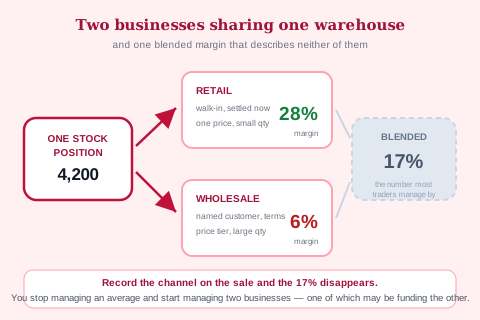
The classic Accra trading business is really two businesses sharing a warehouse. One sells cartons to shopkeepers who buy on relationship, on terms, and expect a price that reflects volume. The other sells singles to whoever walks in, at a price nobody negotiates. Both draw from the same shelves, both are recorded in the same book, and at the end of the month a single blended margin figure tells you almost nothing about either.
That blending is the central problem, and it is not solved by discipline or by working harder. It is solved by recording the channel on the transaction — which sounds trivially small and turns out to change what you can see about your own business more than any other single change.
Retail and wholesale are not the same transaction
They look similar at the counter and behave completely differently on your books.
A retail sale
- Anonymous customer, settled immediately
- One price, rarely negotiated
- Small quantities, high transaction count
- Cash and mobile money dominate — reconciled per shift
- Margin per unit is high and reasonably stable
A wholesale sale
- A named customer with a history and, often, terms
- A price tier — and a discount that should be authorized, not improvised
- Large quantities, low transaction count, big cedi value each
- Part payment, credit and collections enter the picture
- Margin per unit is thin, so a small pricing error is a large loss
The consequence of not distinguishing them is specific and expensive. Blended margin hides the fact that a wholesale line may be running at a loss while retail on the same item subsidises it. You conclude the product is fine. It is not fine — half of it is fine and the other half is quietly funded by the first half.
A blended margin is an average of two answers you needed separately. It is not wrong, exactly — it is just never the number you actually needed.
Credit is the wholesale risk nobody prices in
Retail settles at the counter. Wholesale frequently does not, and the gap between delivering goods and collecting money is where trading businesses actually fail — not on margin, on cash. A trader can be profitable on paper and unable to restock, which is a peculiar and dangerous position to be in because everything looks fine except the bank balance.
The controls are unglamorous and effective: a credit limit per customer that the system enforces rather than suggests, ageing you look at weekly rather than when someone stops answering their phone, and an explicit link between a customer's balance and their ability to take more goods. Most trading businesses have all the necessary information and none of the enforcement, so the limit exists as an opinion the busiest salesperson can overrule.
Why thin wholesale margin makes credit fatal
Illustrative. This is the arithmetic that makes an enforced credit limit worth more than a good month — one bad debt can consume the margin on five times the sales that created it.
The controls, in the order that pays
-
Count the stock properly, once
A real physical count, reconciled and signed. Everything measured afterwards is measured from this line, and a soft baseline quietly corrupts a year of reporting.
-
Record the channel on every sale
Retail or wholesale, on the transaction, from day one. This is the smallest change on this list and it unlocks more insight than the rest combined.
-
Put wholesale customers on price tiers
A defined tier per customer rather than a price negotiated at the counter, with discount authority granted explicitly to named roles. A discount then becomes a recorded decision rather than a conversation.
-
Enforce credit limits
The limit blocks rather than warns, and ageing is reviewed weekly. This is the control that protects your cash rather than your margin — and cash is what kills trading businesses.
-
Close daily, per till and per shift
Cash and mobile money reconciled against system sales the same evening, while a discrepancy still has an explanation someone can give you.
-
Then look at what turns and what does not
Inventory turnover by channel and category, ABC analysis to focus attention, and honest dead stock review. All impossible before the steps above.
The one-line change most traders skip
If you implement nothing else from this guide, record the channel on every sale. It costs nothing, changes no workflow, and within one month you will be able to see which of your two businesses is actually making money. Most traders are surprised — and a meaningful number discover the surprise is not the one they expected.
Imported stock, and the cost you did not see
Most Accra traders import at least part of their range, which means the cost side carries the same exposure covered in our Ghana buyer's guide: a supplier invoice converted at an assumed rate, with duty, freight and clearing arriving separately and too late to influence the price already set.
For a wholesaler on thin margin this is not a rounding issue — it is the whole margin. A landed-cost error of a few percent on a retail line reduces a comfortable margin to a slightly less comfortable one. The same error on a 6% wholesale line eliminates it. That asymmetry is why importing wholesalers need landed cost discipline more urgently than almost anyone else in the market.
What we do and do not do
What AWRA OpsHub does today
- One stock position feeding both channels, with the channel recorded on every sale and margin readable separately.
- Customer price tiers and discount authority granted to named roles.
- Credit limits and ageing, with the limit enforced rather than suggested.
- Daily close per till and per shift, reconciling cash and mobile money against system sales.
- Landed cost on imported stock, at the rate actually paid.
- Governed transfers between shop, warehouse and any additional location.
More we can add to your workspace
- GRA electronic invoicing — our fiscal integration today is Kenya's eTIMS, and it is Kenya-only.
- A maintained Ghanaian levy stack — one VAT preset ships today and further components are configurable by you; us maintaining them as dated presets is a build.
Where we point you to a specialist
- We are not a credit bureau. We enforce the limit you set; we cannot tell you whether a customer deserves it.
- We do not provide trade finance or factoring.
Confirm all tax rates and treatments with GRA or your adviser. This is not tax advice.
What we can build for Ghana on top of the standard product
Everything listed above as something we can add describes what ships in the standard product today — it is a starting point for Ghana, not a limit on what AWRA OpsHub can do there. Kenya's eTIMS integration and its maintained payroll engine are in the product because Kenyan clients needed them and commissioned them; neither appeared by itself. The same door is open here. If GRA e-invoicing, a bank or mobile money feed, a statutory return format, a rule specific to how your operation runs, or a link to a system you already have is what stands between you and a decision, tell us and we will scope it as a build — written spec, timeline and price — before you commit to anything.
GRA e-invoicing and the levy stack
Electronic invoicing against GRA's published interface, and a maintained multi-component levy stack we keep current for you instead of leaving the effective-from dates in your hands.
MoMo, cards and bank feeds
Mobile money settlement files, card acquirer reports and bank statement feeds pulled into the Payments Register, so collections reconcile against invoices without anyone re-keying a statement.
The operational work, which is what most commissions actually are
An extra approval stage in a chain that does not match the standard one, a custom field set on employees or assets that only your sector needs, an expiry that has to block an order rather than send an email, a report your board asks for in a shape nothing produces, or a scanner or weighbridge feeding the goods-in door. These are the commissions we are asked for most often and the smallest ones we quote — and unlike a revenue-authority pipeline, none of them waits on a regulator.
Payroll and statutory returns
PAYE and SSNIT contribution schedules produced in the layout your filing body expects, generated from live payroll records rather than rebuilt in a spreadsheet each month.
Systems you already run
The accounting package, CRM, online store or custom database you intend to keep — connected through our API so a fact is entered once and appears everywhere it is needed.
How it works: you describe the requirement, we return a written scope, timeline and cost, and once agreed it is built into your environment and maintained as part of the product. No roadmap slide, and no pretending in a demo that something exists when it does not.
Tell us what you need integratedOur take
Record the channel, tier the wholesale prices, and enforce the credit limit. Those three changes cost nothing operationally and will tell you, within a month, which half of your business is carrying the other. Everything else — turnover analysis, reorder logic, multi-location — is worth doing afterwards and nearly worthless before.
See both channels separately
One stock position, retail and wholesale margin readable apart, customer price tiers, enforced credit limits, and a daily close that reconciles cash and mobile money against system sales.
Explore AWRA for GhanaFrequently asked questions
Can retail and wholesale run off the same stock?
Yes, and they should — splitting the stock into two pools creates transfer overhead and a reconciliation problem without solving anything. What matters is that the channel is recorded on each sale so that margin, turnover and customer behaviour can be read separately for each, while both continue to draw from a single position that always reflects what you physically hold.
How do price tiers work for wholesale customers?
Each wholesale customer is assigned a tier that determines their price, rather than the price being negotiated fresh at each transaction. Discount authority beyond the tier is granted explicitly to named roles, so any departure from the tier is a recorded decision by someone entitled to make it. The goal is not to eliminate flexibility but to make it visible — margin erosion in trading businesses is almost always a hundred small unrecorded concessions rather than one big one.
Does the system enforce credit limits or just warn?
It enforces them — a limit that only warns is not a limit, it is a note that gets dismissed by whoever is busiest. Ageing is visible alongside the limit so you review exposure weekly rather than discovering it when a customer stops answering. Given how thin wholesale margins typically are, one enforced limit can be worth more than a good month of sales.
We import most of our range. Does that change the setup?
It makes landed cost the priority rather than a refinement. Foreign-currency purchases record the rate actually paid, and duty, freight, clearing and handling are folded into the true unit cost of the goods received. On a thin wholesale line a landed-cost error of a few percent does not reduce your margin — it removes it, so importing wholesalers need this discipline more urgently than almost anyone else.
Does it handle Ghanaian VAT on sales?
It keeps VAT-aware records with net, tax and gross separated on every line, and the cedi and a Ghana VAT rate ship as built-in presets. Ghana's indirect tax position is layered, and further components are configured by you with their own rates, dates and treatment rather than shipped as a maintained stack. It does not integrate with GRA electronic invoicing. Confirm rates and treatments with GRA or your adviser.
