
ERP Software in Ghana: A Practical Buyer's Guide (2026)
A practical, vendor-honest guide to choosing operations software in Ghana in 2026 — what a system must do when the cedi moves and the tax position is layered, how to test every claim in the demo, what to budget, and the straight answer on GRA e-invoicing, VAT levies and Ghanaian payroll.
Ghanaian businesses tend to arrive at this decision from a different direction than their neighbours. The trigger is rarely growth alone. More often it is a specific bad afternoon: a tax position that took four days to reconstruct, an importer discovering the consignment they priced in March cost considerably more than they thought, or a lender asking for stock records that simply do not exist in a form anyone can check.
Those three afternoons have one thing in common. In each case the information existed — somebody knew the rate, somebody had the delivery note, somebody remembers the levy treatment — but it was never captured in a form that survives the week. That is what you are actually buying when you buy operations software, and it is worth being clear about it before any vendor starts a demo.
This guide is deliberately vendor-honest. Where AWRA OpsHub does something, we say so and tell you how to test it. Where it does not — GRA electronic invoicing, a maintained levy stack, Ghanaian statutory payroll — we say that plainly, because the most expensive purchases in this category are made on claims nobody was asked to demonstrate.
Three questions that decide the purchase
Strip away the feature lists and a Ghanaian buyer is really asking three things. Everything else is detail.
Question one
Does every sale move stock?
If a sale can happen without inventory moving in the same second, your stock position starts drifting immediately and nobody can say when the drift began. Test it live: record a sale, watch the level drop, then run a variance report.
Question two
Does an approval actually block?
A control that warns and lets you proceed is not a control — it is a log of the moment you were overruled. Try to raise a purchase order above the threshold without approval and watch what the system does.
Question three
Is cost recorded at the rate you paid?
If imported goods carry an assumed rate and no duty, freight or clearing, every margin figure downstream is fiction. Enter a foreign-currency purchase at a rate you choose and watch the unit cost change.
A system that answers all three well is worth buying even if its reporting is plain. A system that answers none of them is not rescued by a beautiful dashboard, because reporting is downstream of records and a dashboard over bad records is simply a faster way to be confidently wrong.
The cedi problem, shown rather than described
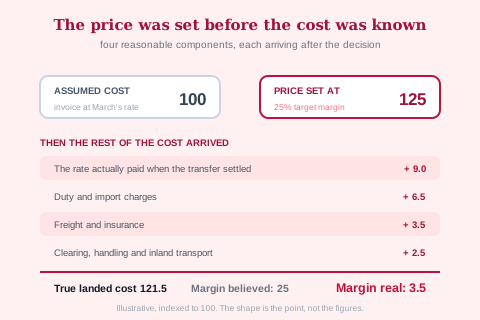
Importers understand exchange-rate exposure in the abstract. What is harder to see is how much of it hides inside a single carton, because the error is never in one big number — it is spread across four small ones that each look reasonable.
What one imported carton actually cost you
Illustrative figures, indexed to 100 for clarity — not a quotation and not tax advice. The point is the shape, not the numbers: price this carton off 100 with a 25% target and you believe you made 25. You made 3.5.
Nothing in that stack is exotic. It is landed cost, applied consistently, per consignment. What makes it hard without a system is that each component arrives at a different time from a different party, and by the time the last one lands the goods have already been priced and half of them sold.
Margin is not a number you set. It is a number you discover afterwards — unless the system was recording what things actually cost while they were arriving.
The buyer's scorecard
Demos are built to look good — that is their job. The value is entirely in what you make the vendor do in front of you, on your data, with the network behaving as it behaves in your business.
Ghana operations software scorecard
Every row below should be demonstrated live. Not described, not screenshotted, not scheduled for a future release.
Every sale moves inventory in the same second
Make them prove it: Record a sale, watch the stock level drop live, then run a variance report against a physical count.
Landed cost per consignment, in cedi
Make them prove it: Add duty, freight and clearing to an import and watch the unit cost change — then show margin on a sale of that item.
Foreign currency recorded at the rate actually paid
Make them prove it: Enter one GHS and one USD purchase at a rate you choose, and show both on one cost report with the FX visible.
Approvals that refuse rather than warn
Make them prove it: Attempt a purchase order above the threshold with no approval. The correct outcome is a refusal, not a warning you can dismiss.
Net, tax and gross separated on purchases as well as sales
Make them prove it: Enter a purchase and show the input side of the tax position as a report rather than a reconstruction.
Additional tax lines configurable with effective dates
Make them prove it: Ask them to add a second tax component with its own rate, start date and inclusive or exclusive treatment, live.
Governed transfers between locations
Make them prove it: Move stock from Accra to Kumasi and show it in transit — belonging to neither location until received.
Works offline
Make them prove it: Airplane-mode the device, record a receipt and a count, reconnect, and watch it sync without duplicating.
Support in a timezone that is awake when you are
Make them prove it: Ask for median first-response time in writing, and who answers on a Saturday.
Honest about GRA e-invoicing
Make them prove it: Ask to watch it work. Prefer the vendor who says "not built, here is what we do instead" to the one who waves the question away.
GRA, VAT levies and the cedi — the straight answer
Ghana's indirect tax position is layered rather than single-rate, and that layering is exactly where software claims get slippery. Here is ours, stated the way we would state it across a table.
What AWRA OpsHub does today
- The Ghanaian cedi and a Ghana VAT rate ship as built-in presets in our tax and currency configuration.
- VAT-aware records on purchases as well as sales — net, tax and gross separated line by line at the point of entry.
- Additional tax lines you can configure with their own rates, effective dates and inclusive or exclusive treatment.
- Foreign-currency purchases at the rate actually paid, with landed cost loaded onto imported goods.
- The full operations layer — inventory across locations, procurement with enforced approvals, three-way matching, asset registers, donor and budget tracking, offline capture.
More we can add to your workspace
- GRA electronic invoicing. Our fiscal e-invoicing integration is Kenya's eTIMS today, and it is Kenya-only — which is the pattern a second authority follows.
- A maintained Ghanaian levy stack. One VAT preset ships today and the other components of your indirect tax position are configurable by you; us maintaining them as dated, versioned presets is a build, on the pattern the Kenyan tax layer already follows.
- Turnkey Ghanaian statutory payroll — PAYE and SSNIT automated the way Kenyan PAYE, NSSF and SHIF already are.
Where we point you to a specialist
- We do not file returns and we do not interpret Ghanaian tax rules.
- We are not a customs or clearing system.
That second point is the one most worth pausing on. Because Ghana's levy treatment differs between components, a vendor claiming to "handle Ghanaian VAT" out of the box is claiming something specific — ask exactly which components are maintained, by whom, and what happened the last time one changed. Confirm all rates and treatments with GRA or your own tax adviser; nothing here is tax advice.
What we can build for Ghana on top of the standard product
Everything listed above as something we can add describes what ships in the standard product today — it is a starting point for Ghana, not a limit on what AWRA OpsHub can do there. Kenya's eTIMS integration and its maintained payroll engine are in the product because Kenyan clients needed them and commissioned them; neither appeared by itself. The same door is open here. If GRA e-invoicing, a bank or mobile money feed, a statutory return format, a rule specific to how your operation runs, or a link to a system you already have is what stands between you and a decision, tell us and we will scope it as a build — written spec, timeline and price — before you commit to anything.
GRA e-invoicing and the levy stack
Electronic invoicing against GRA's published interface, and a maintained multi-component levy stack we keep current for you instead of leaving the effective-from dates in your hands.
MoMo, cards and bank feeds
Mobile money settlement files, card acquirer reports and bank statement feeds pulled into the Payments Register, so collections reconcile against invoices without anyone re-keying a statement.
The operational work, which is what most commissions actually are
An extra approval stage in a chain that does not match the standard one, a custom field set on employees or assets that only your sector needs, an expiry that has to block an order rather than send an email, a report your board asks for in a shape nothing produces, or a scanner or weighbridge feeding the goods-in door. These are the commissions we are asked for most often and the smallest ones we quote — and unlike a revenue-authority pipeline, none of them waits on a regulator.
Payroll and statutory returns
PAYE and SSNIT contribution schedules produced in the layout your filing body expects, generated from live payroll records rather than rebuilt in a spreadsheet each month.
Systems you already run
The accounting package, CRM, online store or custom database you intend to keep — connected through our API so a fact is entered once and appears everywhere it is needed.
How it works: you describe the requirement, we return a written scope, timeline and cost, and once agreed it is built into your environment and maintained as part of the product. No roadmap slide, and no pretending in a demo that something exists when it does not.
Tell us what you need integratedWe go further into that distinction — including how to configure the layers properly and how to test a vendor's claim — in GRA, VAT levies and cedi operations.
The buying sequence: stock-first, not software-first
The most common way to waste money here is to buy the right system in the wrong order — reporting before records, payroll before stock, five modules before anyone has counted a warehouse.
-
Count everything once, properly
A real physical count per location, reconciled and signed off. Every number for the next year is measured from this line, so a soft baseline quietly undermines everything built on it.
-
Make every sale move stock
No batch updates at close of business. This single rule is what turns inventory from an opinion into a record, and it is the precondition for everything downstream.
-
Purchasing with approvals and landed cost
Requisition, approval, order, receipt, match — with imports costed at the rate actually paid. Margin gets defended at the door rather than explained afterwards.
-
Regional visibility and governed transfers
Accra, Kumasi, Takoradi and the field on one position, with in-transit stock owned by nobody until it is confirmed received.
-
Then reporting, for decisions and for lenders
Statements generated from live records rather than typed for the occasion. Lenders and investors can tell the difference immediately, and so can you.
The sector-neutral version is in our ERP implementation checklist, and if you have not yet decided whether to move at all, the true cost of running on spreadsheets is the honest baseline against which to measure any quote.
What to budget
Locally-priced cloud platforms start in the tens of dollars a month for small teams and scale with users, locations and modules. That figure is the smallest line in your real budget. The three that matter more are rarely quoted:
| Cost | What it really is | How to size it |
|---|---|---|
| Training time | Your people learning a new way of working, in working hours | Count the hours of the staff who key transactions — storekeepers and clerks, not managers |
| Data cleanup | Somebody reconciling opening stock and master data before go-live | One serious physical count per location, plus an item and supplier list with an owner |
| Year two, not month one | The locations, users and modules you will add as you grow | Price the business you are becoming; per-module pricing that looks cheap now can balloon |
Compare three-year totals including support rather than first-month prices — the method is set out in our ERP pricing guide, where the currency changes but the arithmetic does not.
Red flags
- "Fully integrated with everything." Integration is the most over-claimed word in this category. Make them show it running.
- Vagueness about which tax components are maintained. In Ghana specifically, "we handle VAT" is not an answer — ask which layers, maintained by whom, updated how fast.
- No exchange-rate story. If they cannot show a purchase recorded at a specific rate with landed cost loaded, they have not built for an importing market.
- Approvals that only warn. A control you can click past is documentation, not governance.
- Tax rules stated as settled fact. A trustworthy vendor hedges to GRA and your adviser rather than performing confidence about someone else's rules.
- No migration plan. Master data and verified opening balances should migrate; history stays archived. A vendor with no opinion here has not done it before.
Where to go next
The rest of this series splits by what you actually run: inventory and POS for Accra retail and wholesale for traders and shopkeepers, procurement for Ghanaian NGOs and enterprises where governance is the pressure, cocoa and agribusiness operations for aggregators and processors, and payroll, PAYE and SSNIT — where, as in Nigeria, we mostly argue against ourselves.
If you operate in more than one country, the group-level discipline is the same one documented in one ERP across the EAC and, for the West African side, in our Nigeria buyer's guide.
Our take
Buy for stock accuracy, enforced approvals and true landed cost in cedi — in that order — and treat every compliance claim as something to watch working rather than something to believe. In Ghana add one extra question that most buyers forget: which parts of my tax position does this vendor actually maintain, and which am I quietly taking on myself?
See what an honest operations system looks like for Ghana
Stock across every location, procurement with real approvals, landed cost at the rate you actually paid, and configurable tax lines — with straight answers about GRA and payroll.
Explore AWRA for GhanaFrequently asked questions
Does AWRA OpsHub integrate with GRA electronic invoicing?
Not as a built-in integration today. Our fiscal e-invoicing integration is Kenya's eTIMS and it is Kenya-only. In Ghana, AWRA holds your operational and sales records and you continue to meet GRA requirements through your existing process, reconciling the two on a regular rhythm. If direct GRA integration is essential to your workflow, make it a written requirement before committing — with us or any vendor — and confirm current rules with GRA or your tax adviser.
Does it handle Ghana's VAT and the associated levies?
The cedi and a Ghana VAT rate ship as built-in presets, and records separate net, tax and gross on every sales and purchase line. Ghana's indirect tax position is layered, and we ship one maintained VAT preset rather than a maintained levy stack — additional tax lines can be configured with their own rates, effective dates and inclusive or exclusive treatment, but those definitions are yours to specify and keep current. Have your adviser define them and confirm current rates and treatments with GRA.
How does it handle imports when the cedi moves?
Foreign-currency purchases record the exchange rate actually applied to that transaction, and landed cost folds duty, freight, clearing and handling into the true unit cost of the goods received. That means margin is measured against what the consignment genuinely cost rather than against a rate assumed when you priced — which for most importers is the difference between a believed margin and a real one.
What about Ghanaian payroll?
Our turnkey statutory payroll engine is maintained for Kenya only, so Ghanaian PAYE and SSNIT are not automated for you and nothing is filed or remitted on your behalf. We recommend a Ghanaian payroll specialist for the statutory layer, with AWRA holding employee records, attendance, leave and payroll cost allocation. Earnings and deductions can be configured manually to your adviser's specification, but you own those rules.
How much should a Ghanaian SME budget?
Locally-priced cloud platforms start in the tens of dollars a month for small teams and scale with users, locations and modules. The larger costs are training time and data cleanup, which every business faces regardless of vendor. Compare three-year totals including support and the locations you plan to open, rather than the first month's price.
Do we need offline capability in Accra?
In a city office you may rarely need it, but the moment you run a regional branch, a field team, a delivery route or a farm-gate buying point you will. Offline-first capture on ordinary Android devices costs nothing extra to have and prevents work stopping when a connection drops. Treat it as something to test in the demo rather than a feature to skip.
