
GRA, VAT Levies & Cedi Operations: What to Look For in a System
Ghana's indirect tax position is layered, not single-rate — and that layering is precisely where software claims turn slippery. What "we handle Ghanaian VAT" should mean, what it usually means, and the questions that tell the two apart before you sign.
In most markets a buyer can ask "does it handle VAT?" and receive an answer that means roughly one thing. In Ghana that question has several possible answers and a vendor can give you the most flattering one without technically lying. This guide exists so you can ask a better question.
Nothing here is tax advice, and this guide deliberately states no rates. Ghana's indirect tax components, their rates, which apply to your business, and how each is treated in a computation are matters for GRA and for your own tax adviser — and they change. What this guide covers is the shape of the problem and what a business system should be expected to do about it.
Why "one rate" thinking fails here
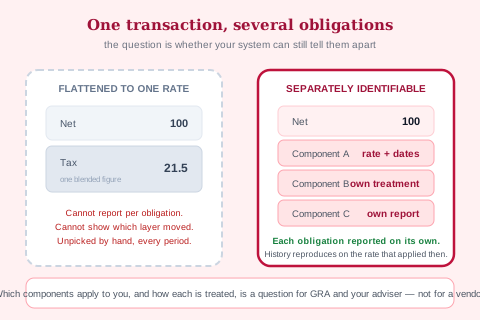
A single-rate mental model — take the net, apply one percentage, done — is how most accounting software is built and how most demos are given. Ghana's position does not reduce to that cleanly, because more than one component can sit on the same transaction and they do not all behave identically.
The operational consequence is what matters to you. When several components apply and their treatment differs, the computation is no longer a single multiplication that anyone can eyeball. It becomes a defined sequence — and a defined sequence is either encoded correctly in your system, or it is being done in someone's head every month. The second option works right up until that person is on leave.
A layered tax position is not harder to compute. It is harder to compute the same way twice — and consistency, not difficulty, is what an authority actually examines.
What a system should genuinely be able to do
Independent of which components apply to you, there is a short list of capabilities that make a layered position manageable. Ask for each one specifically.
The capability list, in priority order
- More than one tax component on a single transaction line, each identifiable in reporting rather than merged into a single tax figure
- Per-component treatment — whether a component is inclusive or exclusive, and whether it participates in the base another component is computed on
- Effective dates on every rate, so a change is a new dated rate rather than an edit that silently rewrites history
- Purchases treated as seriously as sales, so the input side of your position is a report rather than a reconstruction
- Component-level reporting, so you can produce each obligation separately instead of unpicking one blended number
- An audit trail on rate changes — who changed a rate, when, and what it was before
That third point does more work than buyers expect. Rates change, and a system that lets you simply overwrite a rate has quietly falsified every historical transaction computed on the old one. Dated rates mean last year's records still reproduce last year's numbers, which is the entire basis on which an audit is survivable.
Where our boundary sits
We will be more specific than most vendors are, because this is the exact point at which buyers get quietly disappointed six months later.
What AWRA OpsHub does today
- The Ghanaian cedi and a Ghana VAT rate ship as built-in, maintained presets.
- Additional tax components you can configure yourself — each with its own rate, effective-from and effective-to dates, and inclusive or exclusive treatment.
- VAT-aware purchasing as well as sales, with net, tax and gross separated at the point of entry.
- Reporting from live records rather than from a month-end reconstruction.
- An audit trail over the records and the rate definitions.
More we can add to your workspace
- A maintained Ghanaian levy stack. One VAT preset ships today and further components are yours to define; us defining them and keeping them current when they change is a build, on the pattern the Kenyan tax layer already follows.
- GRA electronic invoicing. Our fiscal e-invoicing integration is Kenya's eTIMS today, and it is Kenya-only — the pattern a second authority follows.
Where we point you to a specialist
- We do not file returns, and nothing is submitted to GRA on your behalf.
- We do not tell you which components apply to you or how each should be treated — that is your adviser's work, and it is worth paying for once properly.
This is the honest trade. You get a system that can represent a layered position accurately; you do not get someone else taking responsibility for what the layers are. Any vendor claiming the latter should be asked exactly which components they maintain, who updates them, and how quickly they moved the last time something changed.
Everything in that second column can be built for you
That list describes what ships in the standard product today — not the limit of what AWRA OpsHub can do in Ghana. Kenya's eTIMS integration exists because Kenyan clients needed it and commissioned it; it did not appear by itself. The same door is open here. If GRA e-invoicing, a maintained Ghanaian levy stack, a MoMo settlement feed or a specific return format matters to your operation, say so and we will scope it as a build — written spec, timeline and price — before you commit to anything.
GRA e-invoicing and the levy stack
Electronic invoicing against GRA's published interface, and a maintained multi-component tax stack we keep current for you instead of leaving the effective-from dates in your hands — built the way eTIMS was built, with retries, a failure queue and a reconciliation report.
MoMo, cards and bank feeds
Mobile money settlement files, card acquirer reports and bank statement feeds pulled into the Payments Register, so collections reconcile against invoices without anyone re-keying a statement.
Payroll and statutory returns
PAYE and SSNIT contribution schedules produced in the exact layout your filing body expects, generated from live payroll records rather than rebuilt in a spreadsheet each month.
Systems you already run
The accounting package, CRM, online store or custom database you intend to keep — connected through our API so a fact is entered once and shows up everywhere it is needed.
How it works: you describe the requirement, we return a written scope, timeline and cost, and once agreed it is built into your environment and maintained as part of the product. We publish scope rather than a roadmap slide, and we will not pretend in a demo that something exists when it does not.
Tell us what you need integratedHow to set it up properly, once
The work here is front-loaded and then largely done. Organizations that get it wrong are almost always the ones that skipped the first step.
-
Have your adviser write the specification down
Which components apply to your business, each rate, the treatment of each, and how they interact. On paper, signed, dated. This is the artefact you configure from and the artefact you re-check against when something changes.
-
Configure each component separately, with dates
Never as a single blended rate, however tempting. A blended rate is unauditable, cannot be reported per obligation, and becomes wrong the moment one component moves.
-
Test against transactions you already know the answer to
Take three real historical transactions with figures your accountant has already agreed, enter them, and check the system reproduces them exactly. This is the only real proof of correct configuration.
-
Apply the same discipline to purchases
Most organizations configure sales carefully and treat purchases loosely, then wonder why the input side takes days to assemble. It takes days because it was never captured.
-
When a rate changes, add a dated rate — never edit
The old rate stays, closed with an end date; the new one starts. History continues to reproduce, which is exactly what you need when someone asks about a transaction from two years ago.
The test that catches bad configuration
Re-run last quarter's figures through the newly configured system and compare against what your accountant actually filed. If they match to the cedi, your configuration is right. If they do not, find out why now — while it is a configuration question and not yet a filing question.
The cedi side of the same problem
Tax and currency intersect for anyone importing. The value on which tax is computed depends on a conversion, and a conversion depends on a rate that was either recorded or invented. If your system applies a single global exchange rate updated whenever someone remembers, your tax base and your cost base are both approximations that drift apart over time.
Recording the rate against each transaction and folding duty, freight and clearing into landed cost fixes both at once. It is the same discipline that protects your margin, which is a useful thing about doing this properly: the control that keeps you accurate for GRA is the control that tells you what you actually earn. The full arithmetic is worked through in our Ghana buyer's guide.
Four questions for any vendor
- "Which Ghanaian tax components do you maintain as presets, and which would I configure myself?" A precise answer is a good sign regardless of what it is. Vagueness is the warning.
- "Show me two tax components on one transaction line, reported separately." If everything collapses into a single tax figure, you will be unpicking it monthly forever.
- "Change a rate with an effective date, then show me last quarter still computing on the old one." This separates real tax handling from a settings field.
- "Show me GRA e-invoicing working, live." Not a roadmap, not a partner, not a recording. If the honest answer is no, a vendor who says so plainly is telling you something valuable about everything else they claim.
The same four questions, with different acronyms, have exposed the same over-claim in every market we have written about — FIRS in Nigeria, EFRIS in Uganda, EBM in Rwanda. Only the vocabulary changes.
Our take
Do not buy a system because it says it handles Ghanaian VAT. Buy one that can represent several components separately, with dated rates, on purchases as well as sales — and get your adviser to write the specification down once, properly, before you configure anything. The layering is manageable. What is not manageable is a blended number nobody can decompose when it is questioned.
See a tax position you can decompose
Configurable tax components with dated rates and per-component treatment, VAT-aware purchasing as well as sales, and reporting from live records — with a straight answer about GRA e-invoicing.
Explore AWRA for GhanaFrequently asked questions
Does AWRA ship Ghana's VAT and levies configured out of the box?
It ships the Ghanaian cedi and a Ghana VAT rate as maintained presets. It does not ship a maintained levy stack — any further components of your indirect tax position are configured by you, with their own rates, effective dates and inclusive or exclusive treatment, and kept current by you when they change. We would rather state that plainly than let you discover it at your first filing.
Can it apply more than one tax component to a single transaction?
Yes, and each remains separately identifiable in reporting rather than being merged into one tax figure. That matters because obligations are reported separately, and a system that collapses several components into a single blended number leaves you unpicking it manually every period — which is both slow and, over time, inconsistent.
What happens when a rate changes?
You add a new rate with an effective-from date and close the old one with an effective-to date, rather than overwriting the existing value. Historical transactions continue to compute on the rate that applied when they occurred, so last year's records still reproduce last year's numbers. Overwriting a rate silently falsifies every historical transaction computed on the old one, which is exactly the situation you do not want to discover during a review.
Does it integrate with GRA electronic invoicing?
No. Our fiscal e-invoicing integration is Kenya's eTIMS and it is Kenya-only. In Ghana the system holds your operational and sales records and you continue to meet GRA requirements through your existing process, reconciling the two on a regular rhythm. If direct integration is essential, make it a written requirement before signing with any vendor and confirm the current rules with GRA or your adviser.
How do we know our configuration is correct?
Re-run a period you have already filed. Take last quarter's real transactions, enter or import them into the configured system, and compare the output against what your accountant actually filed. If they match, the configuration is right; if not, you have found a configuration problem while it is still only a configuration problem. It is the single most useful hour anyone spends during implementation.
