
ETA E-Invoicing in Egypt: Pairing a Certified Filer With Your Operations System
Egypt's electronic invoicing regime is not an integration you can defer to phase two, and we do not provide it. What a clearance-style regime actually changes about your architecture, the three arrangements that work, and what to demand from whoever does provide it.
There is a category difference between a tax regime that asks you to report what you sold and one that asks you to register each sale as it happens. Most of the markets we write about are in the first category. Egypt, for the taxpayers it covers, is in the second — and that difference does more to your software architecture than any feature comparison will.
We should say immediately that we are not the answer to this. AWRA OpsHub has no integration with the Egyptian Tax Authority. Our only fiscal e-invoicing integration is Kenya's eTIMS and it is Kenya-only. This post exists anyway, because the architectural question it raises is one we get asked constantly and because most of the advice available on it is written by people selling the thing they are describing.
Nothing here is tax or legal advice, and nothing here should be relied on to establish what applies to you. Egypt's electronic invoicing and receipt obligations have been introduced in phases by taxpayer category; confirm your own position, its scope and its timing with the ETA or your tax adviser.
What a clearance regime changes
In a report-later regime, your systems can do whatever you like as long as the numbers you eventually submit are right and supportable. The document you hand a customer is a commercial artefact; the tax position is assembled afterwards.
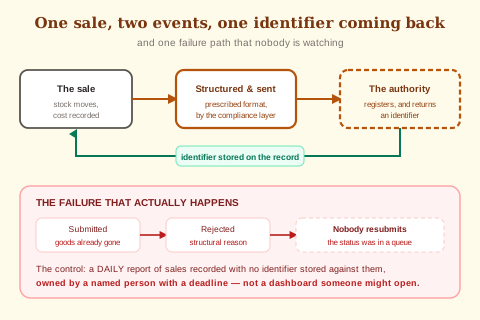
Under a clearance-style regime the document itself becomes a regulated object. It has to be produced in a prescribed structure, registered with the authority, and carry whatever identifier that registration returns. The consequence for architecture is specific and easy to miss: whichever system issues that document is now performing a compliance function, and no other system may quietly issue a competing one.
The question stops being "can our software produce an invoice". It becomes "which single system is allowed to".
Three arrangements that work
There are only three real shapes here, and vendors will each tell you theirs is the only sensible one. All three are defensible; they fail differently.
Shape one
One vendor does everything
An Egyptian platform that runs operations and handles registration in the same product. Fewest moving parts, one accountable party, and the strongest reason to buy locally rather than internationally. The cost is that you have coupled your entire operations choice to your compliance choice — changing either later means changing both.
Shape two
A compliance product issues, operations records
A dedicated e-invoicing solution owns document issuance and registration; your operations system owns stock, procurement, costing and assets, and stores the returned identifier against the transaction. This is where we fit, when we fit at all. The cost is a boundary you must govern deliberately.
Shape three
Middleware between the two
A service that takes documents from your system, structures and registers them, and returns the result. Flexible and common at scale. The cost is a third party in the chain and a failure mode — silent rejection — that belongs to nobody unless you assign it.
Notice what is not on that list: an arrangement in which your operations system issues an unregistered invoice and somebody reconciles later. That is not a shape, it is an exposure, and it is what happens by default when nobody draws the boundary explicitly.
The failure everyone forgets: silent rejection
Ask any organization operating under a clearance regime what actually goes wrong and you will not hear about the happy path. You will hear about the document that was submitted, rejected for a structural reason, and never resubmitted — because the rejection arrived somewhere nobody was watching.
This is a monitoring problem dressed as a technical one. The goods left, the customer was invoiced commercially, the money may even have arrived. The only thing missing is the registration, and nothing in the day-to-day operation of the business surfaces its absence.
-
Store the returned identifier against the operational record
Whatever the registration returns should live on the transaction in your operations system, not only in the compliance tool. This is the single design decision that makes everything below possible.
-
Run a daily unmatched report
Sales recorded operationally with no registration identifier attached. It should be a very short list, looked at by a named person, every working day. Not weekly.
-
Give rejections an owner and a clock
A rejected submission is a task assigned to a person with a deadline, not a notification in a queue. Decide who that is before go-live, and decide who covers for them.
-
Reconcile counts, not just values
Number of documents issued operationally against number registered, per period. Value reconciliation can balance while a document is missing; count reconciliation cannot.
-
Rehearse the outage
Ask both vendors what happens when the authority's service is unavailable, what the fallback is, and how the backlog clears. Get the answer before you need it rather than during.
Questions for whoever provides your compliance layer
These are for the compliance vendor, not for us. We include them because buyers frequently interrogate the operations vendor hard and the compliance vendor barely at all, which is precisely backwards given where the consequences sit.
Five questions worth asking before you sign
What exactly do you submit, and what remains ours?
The answer you will get
A description of the integration and a reference to full compliance.
What to press on
Get a written list of every document type handled and every one not handled. Credit notes, debit notes, returns and receipts are where the gaps usually are, and they are exactly the documents that arrive on a bad day.
How do we find out about a rejection?
The answer you will get
A dashboard, an email, or a status field.
What to press on
Ask what happens if nobody logs in for three days. A status visible only to someone who goes looking is not a control. Push for something that appears in an operational routine somebody already performs daily.
What happens during an outage at the authority?
The answer you will get
Queued and retried automatically.
What to press on
Ask how the queue is visible, how long it can hold, what you are permitted to do commercially in the meantime, and how you would know the queue had stopped draining. "Automatic" is the most comfortable word in this category and the least specific.
Who keeps you current when the specification changes?
The answer you will get
We track changes and update the platform.
What to press on
Ask for the last two specification changes, when they shipped, and how customers were told. A vendor doing this properly answers with dates; one who is not describes a process.
If we change our operations system, what happens to you?
The answer you will get
We integrate with anything.
What to press on
Ask what the integration actually is and who maintains it. This question protects your future freedom and is nearly always skipped in a first meeting.
What we do, plainly
What AWRA OpsHub does today
- Operational and commercial records — sales, stock movement, cost, margin, customer history — captured as the transaction happens.
- A place to store the registration identifier returned by whatever performs the submission, held against the transaction rather than in a spreadsheet.
- Net, tax and gross separated line by line on purchases as well as sales, at the point of capture.
- Documents attached to the transaction — order, approval, delivery note, invoice copy — retrievable from the record.
- Reporting from the operational records, including sales without a stored identifier if you configure it that way.
- The rest of the operations layer — procurement with enforced approvals, inventory across locations, assets, landed cost, offline capture.
More we can add to your workspace
- A connection to the Egyptian Tax Authority: submission, registration, clearance and retrieval.
- Document structuring to any prescribed fiscal format, and no e-receipt capability.
- Handling of rejections or resubmission — we never see them, because we never send anything.
- An Arabic interface and a right-to-left layout, which for many Egyptian organizations is the more immediate obstacle.
- Turnkey Egyptian statutory payroll — our maintained engine covers Kenya today, and a second country is built the same way.
Where we point you to a specialist
- We do not file returns, and we do not interpret Egyptian tax rules or determine what applies to you.
If you take one practical thing from this post, take the identifier-storage point. Whoever your compliance vendor turns out to be, insist that the registration identifier comes back and lands on your operational record. It costs almost nothing at implementation, it is nearly impossible to retrofit, and it is what makes a daily unmatched report possible — which is the control that catches the failure that actually happens.
Everything in that right-hand column can be built for you
That column describes what ships in the standard product today — not the limit of what AWRA OpsHub can do in Egypt. Kenya's eTIMS integration and its maintained Kenyan payroll engine exist because Kenyan clients needed them and commissioned them; neither appeared by itself. The same door is open here. If ETA submission, an Arabic right-to-left interface or Egyptian statutory payroll is what stands between you and a decision, tell us and we will scope it as a build — written spec, timeline and price — before you commit to anything.
ETA e-invoicing and e-receipts
Document structuring to the prescribed format, submission against the Authority's published interface, and the part vendors skip — rejection handling, resubmission and a daily unmatched report — built the way eTIMS was built.
Arabic and right-to-left interface
Arabic interface text and RTL layout, plus bilingual document templates so what a customer receives and what a clerk works in are not forced into the same language.
Egyptian payroll and social insurance
A maintained Egyptian payroll engine with income tax bands and social insurance contributions, producing schedules in the layout your filing body expects rather than a spreadsheet rebuilt each month.
Banks, payments and your existing systems
Bank feeds and payment gateways into the Payments Register, and the accounting package, CRM or custom database you intend to keep, connected through our API.
How it works: you describe the requirement, we return a written scope, timeline and cost, and once agreed it is built into your environment and maintained as part of the product. We publish scope rather than a roadmap slide, and we will not pretend in a demo that something exists when it does not.
Tell us what you need integratedWhen the honest answer is "buy locally"
- If you want one accountable vendor for compliance and operations, buy an Egyptian platform. That is a legitimate preference and we are not a candidate for it.
- If your staff work in Arabic, buy locally regardless of everything else on this page. Our interface is English only.
- If your volume is low and your operations are simple, a compliance product plus decent bookkeeping may be all you need. Do not buy an operations layer to solve a problem you do not have.
- If your obligation is unsettled, resolve that with the ETA or your adviser before shortlisting anything. Every architecture decision here is downstream of that answer.
- We are worth a conversation when compliance is already handled, your back office works in English, and your real problem is stock, procurement, costing, assets and evidence across several locations.
Where to go next
The full buying frame is in the Egypt buyer's guide, and the reason "localized" needs unpacking into layers is in Arabic, French and the localization nobody tests. The evidence discipline behind any tax position — separate from transmission entirely — is worked through for another market in SARS, VAT and rand operations, and the arithmetic transfers even though the regime does not.
Our take
Treat the fiscal layer as a gate rather than a feature, choose the arrangement deliberately rather than by default, and design for silent rejection because that is the failure that actually occurs. Then insist the registration identifier lands on your operational record. Do that and a two-system architecture is boringly stable — which, in this particular corner of software, is the highest compliment available.
The operations half, alongside your compliance vendor
Stock, procurement with real approvals, [landed cost](/glossary/landed-cost) in pounds and evidence attached to the transaction — with the registration identifier stored where your daily unmatched report can find it.
Explore AWRA for EgyptFrequently asked questions
Does AWRA OpsHub submit invoices to the Egyptian Tax Authority?
No. There is no connection to the ETA of any kind — nothing is submitted, structured, registered, cleared or retrieved, and no e-receipt is produced. Our only fiscal e-invoicing integration is Kenya's eTIMS and it is Kenya-only. Where an Egyptian obligation applies to you, a separate compliant solution handles it and AWRA runs the operations layer alongside. Confirm the scope and timing of your own obligation with the ETA or your tax adviser.
Can we use AWRA at all if we are covered by the e-invoicing regime?
Yes, in a two-system arrangement where a compliance product owns document issuance and registration and AWRA owns stock, procurement, costing, assets and evidence. This is a normal architecture wherever clearance-style regimes exist. It is stable provided each shared fact has exactly one owner — customers, items, prices, stock position and above all invoice numbering — written down before go-live and visible to both vendors.
What is the registration identifier and why does it matter?
It is whatever your compliance solution receives back when a document is successfully registered. It matters because storing it against the operational record is what allows a daily report of sales with no identifier attached — the control that catches the failure that actually happens, which is a submission that was rejected and never resubmitted. Insist on this at implementation; it is cheap then and very hard to retrofit.
What happens when a submission is rejected?
From our side, nothing, because we never send anything — that is entirely your compliance vendor's domain, and it is the question to press them hardest on. What we would urge is that rejection handling is assigned to a named person with a deadline rather than left as a notification in a queue, and that the unmatched report runs daily rather than weekly. The goods have already left the building; the clock is running whether or not anyone is watching.
Should we just buy an Egyptian platform that does both?
Often, yes, and we will say so on the call. A single accountable vendor with Arabic, ETA integration and local payroll is the better purchase for most Egyptian organizations. We become a candidate in a narrower case: compliance already settled, a back office that works comfortably in English, and a genuine operations problem across multiple locations, imports or funded projects.
Does any of this apply to Morocco?
Morocco has been moving toward electronic invoicing requirements, but the position, scope and timing are different from Egypt's and you should confirm the current state with the Direction Générale des Impôts or your adviser rather than assuming the Egyptian pattern transfers. Our own answer is the same in both countries: no integration, no submission, no e-invoicing, anywhere outside Kenya.
