
Procurement for North African NGOs, Associations & Development Programmes
A donor file in English, an approval chain that works in Arabic or French, and a supplier invoice in neither. Governance across a language boundary — plus the scheduling problem that appears the moment a programme spans Cairo and Casablanca.
Procurement governance is usually described as though everyone involved reads the same documents. In North African development work they very often do not. The donor agreement is in English or French. The approval happens between people working in Arabic or French. The supplier invoice arrives in Arabic. The auditor may read one of those three fluently and the others not at all.
Nothing about that is unusual or improper, and organizations manage it every day. What makes it a systems problem is when the translation happens: at the moment of the decision, or two years later under audit, by someone who was not there.
Regulatory requirements for associations, foundations and international organizations differ between countries in this region and change over time. Nothing here is legal advice — your own legal advisers own that question entirely.
Evidence has a language, and it is not always yours
A procurement file is a chain: the need, the approval, the market test, the order, the delivery, the invoice, the payment. In a single-language operation each link is legible to everyone who will ever look at it. Across a language boundary, some links are legible to the field team and some to the donor, and only a few to both.
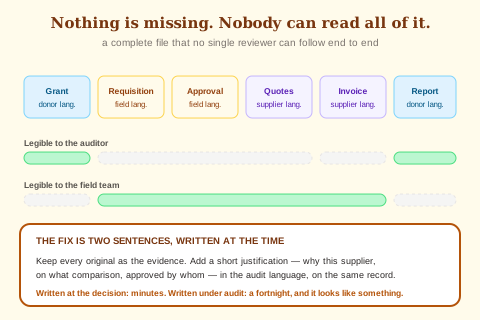
The failure is rarely dramatic. An auditor asks why a supplier was selected, the justification exists — written at the time, in Arabic, by the person who made the decision — and the organization now has to produce a translation, attest to its accuracy, and explain a two-week delay in answering a simple question. Nothing improper occurred. It simply looks slow, and slow looks like something.
Translating evidence at the moment of the decision costs minutes. Translating it under audit costs credibility, which is not a currency you can budget for.
The bilingual evidence discipline
The answer is not to force everyone into one language. It is to be deliberate about which links carry a second-language summary and to create it at the time, not later.
-
Decide the audit language once, in writing
Which language will an external reviewer read this file in? Usually the donor's. Write it into your procurement policy so it is a standing answer rather than a debate per transaction.
-
Keep the original, always
The supplier invoice in Arabic is the evidence. A translation is a convenience attached to it, never a replacement for it. An organization that files only translations has destroyed its own documentation.
-
Summarise the decision, not the document
What needs to cross the language boundary is usually a short justification — why this supplier, on what comparison, approved by whom — rather than a full translation of every attachment. Two sentences at the time beats twelve pages later.
-
Capture it where the transaction lives
The summary belongs on the requisition or the order, attached to the record, not in a parallel English spreadsheet maintained by the programme manager. Parallel files diverge; that is what parallel files do.
-
Name who is accountable for the summary
Usually the approver, because they are the one whose judgement is being documented. If it is delegated to a coordinator writing it up afterwards, you have reintroduced the delay you were trying to remove.
-
Sample it monthly
Ten files, chosen at random, checked for whether an outside reader could follow them. This is a ten-minute control and it is the only way you find out that the discipline lapsed three months ago.
The four-day week
Any programme spanning Egypt and Morocco meets a scheduling constraint that almost nobody plans for, and it is arithmetic rather than culture.
| Egypt office | Morocco office | Consequence | |
|---|---|---|---|
| Typical weekend | Friday and Saturday | Saturday and Sunday | Only Monday to Thursday are working days in both places |
| Days available for a cross-office approval | Sunday to Thursday | Monday to Friday | A chain requiring both signatures has four common days, not five |
| What that does to a two-step approval | Each step can wait up to three days for the other office | Same, in the other direction | A routine approval crossing both offices can take a working week to complete |
| Where it shows up | Missed cut-offs, expedited purchases | Missed cut-offs, expedited purchases | Urgency premiums paid for a delay that was structural, not operational |
Once you see it, the fix is straightforward: set approval thresholds and delegations with a four-day common week in mind, rather than assuming five. What you must not do is leave it undiagnosed, because the visible symptom is people bypassing the process to hit a deadline — which reads as an indiscipline problem and is actually a calendar problem.
Our own position on the working week is stated plainly alongside the other localization layers in Arabic, French and the localization nobody tests: non-working days are configured per organization, so a Friday–Saturday week is a setting rather than a workaround. Approval due dates and escalation read the same setting, so a purchase-order deadline will not land on your weekend or a public holiday. Support SLA targets can be set to count working hours per category as well. Ageing buckets stay on calendar days, which is the convention rather than an oversight.
What a donor actually tests
The file an external reviewer expects to find
- A requisition naming the grant, project or budget line it will be charged to, recorded when the need arose rather than allocated at month-end.
- An approval dated before the commitment, at the right threshold, by someone authorised — the date order matters as much as the approval itself.
- A market test proportionate to the value, with the quotes you did not choose kept alongside the one you did.
- A documented exception where a single source was unavoidable, written at the time, explaining why — this is expected and acceptable; an undocumented single source is not.
- The order, the delivery evidence and the invoice, in that sequence, matched to each other.
- A short justification legible in the audit language, so the reasoning survives the language boundary.
- The supplier file current at the date of payment — registration, banking details, any required documentation, with expiry dates tracked rather than remembered.
- For assets, the funder attribution, location and named custodian, plus whatever the grant says happens to the asset at the end of the programme.
Nothing on that list is exotic and none of it is specific to this region. What is specific is that three of those items are likely to originate in a different language from the one they will be read in, which is why the discipline above is worth building deliberately rather than assuming it will emerge.
Small teams, real controls
Every governance framework assumes the requester, approver, receiver and payer are four different people. In a country office of six they are frequently two, and pretending otherwise produces controls that exist on paper only.
- Document the overlap rather than hiding it. A disclosed and mitigated overlap is a conversation; an undisclosed one discovered by an auditor is a finding.
- If you can only afford one separation, separate approving the purchase from confirming the goods arrived. That is the pair that matters most.
- Move high-value approvals to a regional office or a board member, at a threshold you can genuinely live with. A threshold set unrealistically low gets bypassed within a month and never enforced again.
- Use the audit trail as the compensating control. When roles must overlap, an immutable record of who did what and when is what makes the overlap survivable.
- Have someone outside the chain sample ten transactions monthly. Cheap, unglamorous, and the control most likely to actually catch something.
- Write the delegation matrix in both working languages. A control nobody can read is not a control, and this is the document people consult under pressure.
What we do and do not do
What AWRA OpsHub does today
- Procurement with approvals that refuse rather than warn, thresholds, RFQs, quotation comparison with unsuccessful quotes retained, and three-way matching.
- Grant, project and funder attribution captured at the point of request, with live budget burn and restricted funds tracked separately.
- Supplier records with documents attached and expiry dates tracked, so a lapsed document becomes visible rather than sitting quietly in a file.
- Asset registers with funder attribution, location, condition, named custody and disposal records.
- Free-text justification fields on requisitions and orders, which is where a second-language summary belongs, held against the transaction itself.
- Offline capture for field sites, so evidence is created where the work happens rather than typed up on return.
More we can add to your workspace
- An Arabic or French interface, with right-to-left layout. The system is in English today and so are the documents it produces. For many organizations in this region this is the deciding item.
- Translation. We store what you write, in whatever language you write it. Translating, detecting language, or checking that a summary matches its original is the build.
- Fiscal e-invoicing, a filing, statutory returns in Egypt or Morocco.
- Statutory payroll for either country — our maintained engine covers Kenya only.
- Detecting collusion, verifying that a quote is genuine, or spotting that a supplier is related to a member of your staff are judgements about intent. Systems enforce process; people audit intent.
Where we point you to a specialist
- We do not interpret donor rules or local association regulations, both of which change and belong with your compliance and legal advisers.
The interface language line deserves the emphasis. An international organization whose country office works in English will find this workable; a national association whose staff work in Arabic or French will not, and should buy locally or from a vendor who has done the translation work. We would rather lose that conversation early than deliver a system that quietly goes unused while people keep the real records elsewhere.
What we can build for Egypt on top of the standard product
Everything listed above as something we can add describes what ships in the standard product today — it is a starting point for Egypt, not a limit on what AWRA OpsHub can do there. Kenya's eTIMS integration and its maintained payroll engine are in the product because Kenyan clients needed them and commissioned them; neither appeared by itself. The same door is open here. If ETA e-invoicing, an Arabic right-to-left interface, a bank or mobile money feed, a statutory return format, a rule specific to how your operation runs, or a link to a system you already have is what stands between you and a decision, tell us and we will scope it as a build — written spec, timeline and price — before you commit to anything.
ETA e-invoicing and e-receipts
Document structuring to the prescribed format and submission against the Authority's interface, including the part vendors skip — rejection handling, resubmission, and a daily report of sales with no registration identifier.
Arabic interface, banks and payments
Arabic text with right-to-left layout and bilingual document templates, plus bank feeds and local payment gateways wired into the Payments Register.
The operational work, which is what most commissions actually are
An extra approval stage in a chain that does not match the standard one, a custom field set on employees or assets that only your sector needs, an expiry that has to block an order rather than send an email, a report your board asks for in a shape nothing produces, or a scanner or weighbridge feeding the goods-in door. These are the commissions we are asked for most often and the smallest ones we quote — and unlike a revenue-authority pipeline, none of them waits on a regulator.
Payroll and statutory returns
An Egyptian payroll engine with income tax bands and social insurance contributions, producing schedules in the layout your filing body expects rather than a spreadsheet rebuilt each month.
Systems you already run
The accounting package, CRM, online store or custom database you intend to keep — connected through our API so a fact is entered once and appears everywhere it is needed.
How it works: you describe the requirement, we return a written scope, timeline and cost, and once agreed it is built into your environment and maintained as part of the product. No roadmap slide, and no pretending in a demo that something exists when it does not.
Tell us what you need integratedWhere to go next
The country buying frames are in the Egypt buyer's guide and the Morocco buyer's guide. For multi-country programmes, the consolidation discipline is in multi-country NGO operations, and the funded-asset problem is treated in more depth in procurement and asset management for South African NPOs.
Our take
Decide your audit language once, keep every original, and write a two-sentence justification in the audit language at the moment of the decision rather than under pressure two years later. Then set your approval thresholds for a four-day common week instead of a five-day one. Those two habits cost almost nothing and they remove the two failures that most reliably make competent North African programme teams look disorganised to people who were not in the room.
See governed procurement with the evidence attached
Approvals that refuse, unsuccessful quotes retained, supplier documents with expiry dates, and a justification field on every record — with straight answers about interface language before you commit.
Explore AWRA for EgyptFrequently asked questions
Can the system hold documents and justifications in Arabic or French?
It stores whatever you type, in any language, and attaches whatever files you upload — so an Arabic invoice and an Arabic justification can both live on the transaction. What it does not do is present the interface in Arabic or French, lay out right-to-left, or translate anything. The practical arrangement organizations use is to keep the original document as the evidence and add a short justification in the audit language on the same record, written at the time by the approver.
Is the interface available in Arabic or French?
No. The interface is English only, with no right-to-left layout, and documents such as purchase orders are produced in English. For an international organization whose country office already works in English this is usually workable. For a national association whose staff work in Arabic or French it is likely to be disqualifying, and a local vendor is the better purchase. Test it with the people who will actually key transactions before deciding anything else.
How do we handle a single-source purchase?
As a documented exception rather than an absence. The system can require a justification on the requisition and hold the approval at the appropriate threshold, so the file shows that a single source was a decision somebody took and explained, rather than the only quote anyone happened to obtain. Donors and auditors generally accept documented single-sourcing where it is genuinely unavoidable; what they do not accept is a file with one quote in it and no explanation.
Does it track donor-funded assets?
Yes. Attribution to the grant or funder is captured when the asset is acquired and stays on the record alongside location, condition, verification history and the named person who holds it. Any end-of-programme obligation — retain, transfer, hand over, dispose — can be held against the asset itself rather than only in the grant agreement, so at programme close the question is answerable from the register rather than from the agreement archive.
Can approvals reflect our delegation matrix?
Yes — thresholds, sequences and multi-step chains can be configured, and approvals refuse rather than warn. One piece of local advice: set those thresholds with a four-day common working week in mind if your chain spans Egypt and Morocco, because the two countries share only Monday to Thursday. Chains designed for a five-day week generate deadline pressure that people resolve by going around the process.
Do you handle Egyptian or Moroccan tax filing?
No. There is no e-invoicing integration, no filing and no statutory return output in either country, and no statutory payroll — our maintained fiscal and payroll engines cover Kenya only. AWRA holds the operational and procurement records; your compliance obligations stay with local specialists and your own advisers. Confirm current requirements with the relevant authority.
