
ERP Software in Egypt: A Practical Buyer's Guide (2026)
In Egypt, "is it localized?" has at least five different answers depending on which layer you mean — and one of those layers is not optional. A layer-by-layer buyer's guide to operations software in 2026, including a frank account of where we are the wrong purchase.
Egyptian buyers ask a question that sounds simple and is not: is this system localized for Egypt? Every vendor says yes. Almost all of them are telling the truth about the layer they have in mind, and almost none are telling you which layer that is.
So this guide is organised by layer rather than by feature. Currency, tax arithmetic, fiscal transmission, statutory payroll, working language, working week — six different things wearing one word. A vendor can be excellent at three of them and absent from the other three, which is exactly our own position and the reason this guide is written the way it is.
Nothing here is tax or legal advice. Confirm every obligation, rate and deadline with the Egyptian Tax Authority or your own tax adviser.
Start with the layer that is not optional
Most markets let you sequence a software purchase in whatever order suits you. Egypt does not, because electronic invoicing here is a regime rather than a convenience — the Egyptian Tax Authority administers an e-invoicing and e-receipt framework whose scope has been extended in phases by taxpayer category. Whether and how it applies to you is a question for the ETA or your adviser, and it is the first question, not the fifth.
That single fact reorders the whole purchase. In Kenya or Ghana a buyer can choose an operations platform and treat fiscal integration as a later negotiation. In Egypt, if an obligation applies to you, you need a compliant answer to it before anything else — and then you choose what runs your operations around it.
Everywhere else, compliance is a column in the comparison. In Egypt it is the gate you pass through before the comparison begins.
We do not provide that compliant answer. Our fiscal e-invoicing integration is Kenya's eTIMS and it is Kenya-only. The full treatment of what that means in practice — and it is more workable than it sounds — is in ETA e-invoicing and what it means for your operations system.
The layers, and our honest status on each
Here is the whole picture in one place, scored against ourselves. Use the same six rows on every vendor you shortlist.
Egypt: which localization do you mean?
The Egyptian pound
EGP ships as a built-in currency preset, and transactions in foreign currency record the rate actually applied rather than a standing assumption. Given the pound's recent history this is worth more here than in most markets.
A VAT rate and VAT-aware records
An Egypt value added tax rate ships as a preset, and net, tax and gross are separated line by line on purchases as well as sales, at the point of capture.
Additional tax components
Further tax lines can be configured with their own rates, effective dates and inclusive or exclusive treatment. Configurable means you own them: we ship one maintained VAT preset, not a maintained Egyptian rate history.
ETA electronic invoicing
No integration, no clearance, no submission, no e-receipt. This is the layer where getting it wrong is not merely inconvenient, and it is the reason a second system is normal here rather than a failure.
Egyptian statutory payroll
Income tax withholding and social insurance are not calculated, produced or submitted for you. Our maintained statutory payroll engine covers Kenya only.
Interface and documents in Arabic
The interface is English only. No Arabic, no French, no right-to-left layout, and documents are produced in English. For some Egyptian organizations this is irrelevant; for others it ends the conversation, and it should.
The Friday–Saturday working week
Non-working days are set per organization, so Friday and Saturday is a setting rather than a workaround. Leave-day arithmetic, the attendance present-rate average and workflow due dates all read it, along with your public holidays. Support SLA targets can be set to count working hours too, per ticket category. Ageing buckets stay on calendar days, which is the convention everywhere.
Three of those seven are marked against us. If your requirement sits mainly in the bottom half of that stack, buy locally — an Egyptian vendor with Arabic, ETA integration and local payroll will serve you better than we will, and we would rather tell you that here than in month three. The rest of this guide is for buyers whose requirement sits in the top half and in the operations layer underneath all of it.
What a second system actually looks like
Egyptian buyers often hear "you will need two systems" as a warning. It is not. It is the normal architecture in any market with a clearance-style fiscal regime, and it works well provided one rule is obeyed: each fact has exactly one owner.
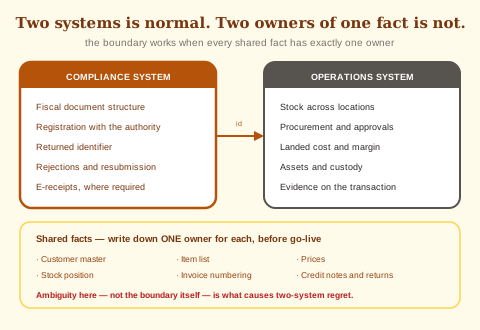
The failure mode is never the existence of the boundary — it is ambiguity about which side owns the customer master, the item list, the price and the stock position. Write that down before go-live, in a document both vendors have seen, and the arrangement is stable for years.
-
Settle the fiscal layer first
Establish what your obligation is with the ETA or your adviser, and choose whatever satisfies it. Everything else in this list is downstream of that answer.
-
Name the owner of each shared fact
Customers, items, prices, stock, invoice numbering. One owner each, written down. Ambiguity here is the single largest cause of two-system regret.
-
Count everything once, properly
A real physical count per location, reconciled and signed off. Every operational number for the next year is measured from this line.
-
Make every sale and issue move stock
No end-of-day batch updates. This is what turns inventory from an opinion into a record, and it is the precondition for costing, margin and replenishment.
-
Put teeth in the approvals
Requisition, approval, order, receipt, three-way match — with thresholds that refuse rather than warn. A control you can click past is a log of the moment you were overruled.
-
Then costing, in pounds, at the rate actually paid
Landed cost on imports, folded into unit cost before pricing. In an economy where the currency has moved as much as this one, this is the discipline that decides whether your margin is real.
The pound, and why costing discipline matters more here
Every importing market has an exchange-rate problem. Egypt's version has a particular shape: the gap between the rate you assumed when you priced and the rate that applied when the payment actually settled can be large, and the time between those two moments can be long.
One imported consignment, priced early and paid late
Illustrative figures indexed to 100, deliberately not tied to any actual rate or period — not a quotation and not tax advice. The shape is the point: price this off 100 with a 20% target and the margin you believe you earned is not merely reduced, it is gone. The fix is not forecasting the currency. It is recording what each consignment genuinely cost, per consignment, at the rate that applied.
This is ordinary landed cost applied with discipline. The comparison with Morocco — where the currency behaves quite differently and the exposure hides somewhere else entirely — is in multi-currency operations in Egypt and Morocco.
The buyer's scorecard
Everything below is demonstrable live. Not described, not screenshotted, not scheduled for a release.
Egypt operations software scorecard
Weighted for a buyer who has already settled the fiscal layer and is choosing what runs the operation around it.
A clear, specific answer on ETA e-invoicing
Make them prove it: Ask exactly what is transmitted, by whom, and what happens if a submission is rejected. Prefer "we do not do this, here is who does" to any answer that reframes the question.
Every sale moves inventory in the same second
Make them prove it: Record a sale, watch the stock level drop live, then run a variance report against a physical count.
Foreign currency recorded at the rate actually paid
Make them prove it: Enter a purchase at a rate you choose, settle it at a different one, and show where the difference lands.
Landed cost per consignment, in pounds
Make them prove it: Add duty, freight and clearing to an import, watch the unit cost change, then show margin on a sale of that item.
Approvals that refuse rather than warn
Make them prove it: Attempt a purchase order above the threshold with no approval. The correct outcome is a refusal you cannot dismiss.
Net, tax and gross separated on purchases as well as sales
Make them prove it: Enter a purchase and show the input side as a report rather than a reconstruction.
Which system owns each shared fact
Make them prove it: Ask them to draw the boundary with your compliance system on a whiteboard. A vendor who cannot has not done this before.
The interface language your staff actually read
Make them prove it: Put the person who will key transactions in front of it for ten minutes. Not the finance manager — the storekeeper.
Governed transfers between locations
Make them prove it: Move stock between two branches and show it in transit, belonging to neither until received.
Which days the system treats as the weekend
Make them prove it: Ask directly, then ask which calculations read the answer. If they have to check either, this product has not been operated in this region.
The straight answer
What AWRA OpsHub does today
- The Egyptian pound and an Egypt VAT rate ship as built-in presets in our tax and currency configuration.
- VAT-aware records on purchases as well as sales — net, tax and gross separated line by line at the point of entry.
- Foreign-currency purchases at the rate actually applied, with duty, freight and clearing folded into landed cost.
- The full operations layer — inventory across locations, procurement with enforced approvals, three-way matching, asset registers with custody, project and donor attribution, offline capture.
- Additional tax lines you can configure with their own rates, effective dates and treatment.
- Documents and evidence attached to the transaction, retrievable from the record rather than from a shared drive.
More we can add to your workspace
- ETA e-invoicing and e-receipt integration. Kenya's eTIMS clearance is built, live and in daily use, which is what makes this a scoped integration rather than new ground.
- Egyptian statutory payroll computation. Income tax withholding and social insurance calculated on the pattern the Kenyan engine already follows.
- An Arabic interface and right-to-left layout. Translation and mirrored layout across the product and the documents it produces.
- Working-day SLA clocks and ageing buckets. Ticket clocks that respect your configured working week, so a Thursday-afternoon ticket does not age straight through the weekend.
Where we point you to a specialist
- Filing returns and interpreting Egyptian tax rules stay with your accountant. We will not submit a return on your behalf or decide a treatment for you.
- Customs and clearing go to a licensed clearing agent. We record what an import cost; what it required is their work.
Read the middle column as a filter rather than a roadmap. If any two of those matter to you today, an Egyptian vendor is the better purchase and we will say so on the call. If none of them do — because your compliance layer is settled, your back office works in English and your problem is stock, procurement, costing and assets — then we are a serious candidate and the rest of this guide applies.
What we can build for Egypt on top of the standard product
Everything listed above as something we can add describes what ships in the standard product today — it is a starting point for Egypt, not a limit on what AWRA OpsHub can do there. Kenya's eTIMS integration and its maintained payroll engine are in the product because Kenyan clients needed them and commissioned them; neither appeared by itself. The same door is open here. If ETA e-invoicing, an Arabic right-to-left interface, a bank or mobile money feed, a statutory return format, a rule specific to how your operation runs, or a link to a system you already have is what stands between you and a decision, tell us and we will scope it as a build — written spec, timeline and price — before you commit to anything.
ETA e-invoicing and e-receipts
Document structuring to the prescribed format and submission against the Authority's interface, including the part vendors skip — rejection handling, resubmission, and a daily report of sales with no registration identifier.
Arabic interface, banks and payments
Arabic text with right-to-left layout and bilingual document templates, plus bank feeds and local payment gateways wired into the Payments Register.
The operational work, which is what most commissions actually are
An extra approval stage in a chain that does not match the standard one, a custom field set on employees or assets that only your sector needs, an expiry that has to block an order rather than send an email, a report your board asks for in a shape nothing produces, or a scanner or weighbridge feeding the goods-in door. These are the commissions we are asked for most often and the smallest ones we quote — and unlike a revenue-authority pipeline, none of them waits on a regulator.
Payroll and statutory returns
An Egyptian payroll engine with income tax bands and social insurance contributions, producing schedules in the layout your filing body expects rather than a spreadsheet rebuilt each month.
Systems you already run
The accounting package, CRM, online store or custom database you intend to keep — connected through our API so a fact is entered once and appears everywhere it is needed.
How it works: you describe the requirement, we return a written scope, timeline and cost, and once agreed it is built into your environment and maintained as part of the product. No roadmap slide, and no pretending in a demo that something exists when it does not.
Tell us what you need integratedWhat to budget
| Cost | What it really is | How to size it |
|---|---|---|
| The subscription | Locally-priced cloud platforms start in the tens of dollars a month and scale with users, locations and modules | Price the business you will be in year two, not the one you are in this month |
| The fiscal layer | Whatever satisfies your ETA obligation, from a separate vendor | Get this quoted first, because it is not optional and it changes the total |
| Training time | Your people learning a new way of working, in an interface that may not be in their first language | Count the hours of the staff who key transactions, and add a margin if English is not their working language |
| Data cleanup | Reconciling opening stock, items and suppliers before go-live | One serious physical count per location, plus a master data list with a named owner |
| The boundary | Keeping two systems agreeing with each other | Decide which system owns each fact before go-live. This is the line item that gets skipped and then costs the most |
Compare three-year totals including support rather than first-month prices — the method is in our ERP pricing guide, where the currency changes but the arithmetic does not.
Red flags
- "Fully compliant with Egyptian requirements." Ask precisely what is transmitted and by whom. This is the claim most worth interrogating in this market.
- Localization answered as one word. Six layers, one syllable. Make them separate the layers.
- Arabic offered via browser translation. That is not localization; it breaks on dynamic content and does nothing for layout direction.
- No exchange-rate story. A vendor who cannot show a purchase recorded at a specific settlement rate has not built for this economy.
- Approvals that only warn. A control you can click past is documentation, not governance.
- No opinion on the two-system boundary. Any competent vendor here has drawn that line before and can draw it for you in five minutes.
Where to go next
The compliance layer is in ETA e-invoicing. The distribution problem specific to this city is in inventory, distribution and retail for Cairo businesses. The localization frame that organises this whole guide is set out in full in Arabic, French and the localization nobody tests, and the regional neighbour's very different situation in the Morocco buyer's guide.
Our take
Settle the fiscal layer before you shortlist anything, then buy the operations layer on stock accuracy, enforced approvals and true landed cost in pounds. Score every vendor layer by layer and refuse to accept the word "localized" without a number attached to it. On our own scorecard we pass the top layers and fail the bottom four — which makes us right for a specific kind of Egyptian organization and wrong for a great many others.
Find out quickly whether we fit
Bring your fiscal arrangement and your working language. In one call we can tell you whether the operations layer is worth discussing or whether you should buy locally.
Explore AWRA for EgyptFrequently asked questions
Does AWRA OpsHub integrate with ETA electronic invoicing?
No. There is no integration with the Egyptian Tax Authority — nothing is transmitted, cleared or submitted, and no e-receipt is produced. Our only fiscal e-invoicing integration is Kenya's eTIMS and it is Kenya-only. Where an ETA obligation applies to you, you need a compliant solution for it from someone else, and AWRA runs the operations layer alongside it. Confirm the scope and timing of your own obligation with the ETA or your tax adviser.
Is the interface available in Arabic?
No. The interface is English only, there is no right-to-left layout, and documents such as invoices and purchase orders are produced in English. This is a genuine limitation rather than a configuration option, and for organizations whose warehouse, branch or field staff work in Arabic it is likely to be disqualifying. For organizations whose back office works in English it is usually a non-issue. Test it with the person who will actually key transactions.
Does it handle the Egyptian pound and Egyptian VAT?
The pound and an Egypt VAT rate ship as built-in presets, and every sales and purchase line separates net, tax and gross at the point of capture. Foreign-currency purchases record the rate actually applied to the transaction rather than a standing assumption. We ship one maintained VAT preset rather than a maintained rate history; additional tax lines are configurable with their own rates and effective dates, but those definitions are yours to specify and keep current. Confirm all rates and treatment with the ETA or your adviser.
What about Egyptian payroll?
Our maintained statutory payroll engine covers Kenya only. Egyptian income tax withholding and social insurance are not calculated, no statutory output is produced, and nothing is submitted or remitted on your behalf. We recommend an Egyptian payroll specialist for that layer, with AWRA holding employee records, attendance, leave and payroll cost allocation to projects and cost centres.
Is it a problem to run two systems?
Not if the boundary is explicit. Two systems is the normal architecture in any market with a clearance-style fiscal regime, and it is stable for years provided each shared fact — customers, items, prices, stock position, invoice numbering — has exactly one owner, written down before go-live and visible to both vendors. What causes regret is not the boundary but ambiguity about it.
Does the system know the Egyptian weekend?
It does once you tell it. Non-working days are configured per organization, so you tick Friday and Saturday and leave-day arithmetic and the attendance present-rate average follow the actual Egyptian week. This was a hardcoded Saturday–Sunday assumption until recently and this guide described it as a workaround for as long as it was one. Workflow due dates and escalation read the same setting and the same public holidays, so an approval deadline will not land on your weekend. Support SLA targets can be switched to working hours per category, so a promise worded in working hours is measured that way. Ageing buckets remain on calendar days — that is the universal convention, not a gap. Ask us to show you the difference during the demo rather than taking either on trust.
When should an Egyptian business not buy from us?
When you need ETA integration in one product, when your staff work in Arabic, when you want Egyptian statutory payroll automated, or when you want a single vendor accountable for all of it. In those cases an Egyptian vendor is the better purchase and we will tell you so. We are a serious candidate when the fiscal layer is already settled, your back office works comfortably in English, and the problem you are solving is stock, procurement, costing, assets and evidence.
