
Inventory, Distribution & Retail for Cairo Businesses
Most distribution advice is written for distance. Cairo's problem is density — forty drops in a few square kilometres, a van holding both the stock and the cash, and a working week that ends on a different day. What that actually demands of a system.
Almost everything written about African distribution is really about distance — long inland legs, stock in transit for days, the port two provinces away. Cairo inverts that. Here the stock is close, the customers are close, and the constraint is that a van can spend four hours covering ground a map says is fifteen minutes apart.
That changes what a system has to be good at. When a route makes forty small drops in a day, the unit of control is not the warehouse and not the branch. It is the route — one vehicle, one person, one shift, holding both your inventory and, very often, your cash.
Get the route right and everything upstream becomes tractable. Get it wrong and no amount of warehouse sophistication saves you, because the losses happen after the goods have left the building and before anyone has written anything down.
The van is a location, not a gap
The single most consequential design decision in high-density distribution is whether the vehicle exists in your system. In most businesses it does not. Stock is issued out of the warehouse in the morning and sales are recorded in the evening, and in between there is a vehicle full of goods that the system has no word for.
The van as a black box
- Stock is written off the warehouse at load-out and sales are keyed at cash-up. The system is right twice a day and wrong in between.
- A shortfall discovered at cash-up has forty possible explanations and no way to narrow them, because nothing was recorded at the drop.
- Returns and refusals are absorbed into the day's difference. Nobody can say which customer refused what, or how often.
- The driver carries an accountability they cannot discharge — there is no record they can point to that says what they delivered.
The van as a stock location
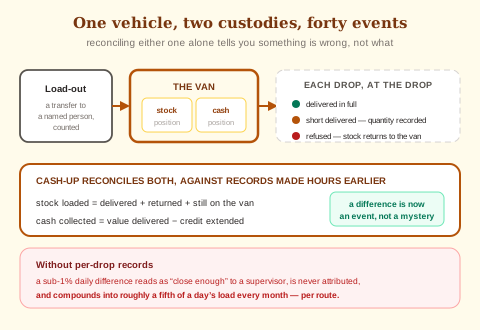
- Load-out is a transfer to the vehicle. The van holds a real, queryable stock position all day, owned by a named person.
- Each drop is a transaction against that position — delivered, partially delivered, refused — recorded where it happened.
- A shortfall is bounded to a drop and a moment rather than to a shift, which is the difference between an investigation and an argument.
- The driver gets a defensible record. That protects the honest majority, which is the point most shrinkage conversations miss.
Custody is not a suspicion. It is the thing that lets a person prove they did their job, which is why the people it protects most are the ones doing it properly.
Two custodies, one person
The complication specific to dense traditional-trade distribution is that the same person is holding two different kinds of value. The stock is one custody. Cash collected at the door is another, and they reconcile against each other only if both were recorded per drop.
What one unreconciled route costs in a month
Illustrative figures indexed to 100 — not a claim about any business, and deliberately using a difference small enough that nobody would escalate it on any given day. That is the entire point: sub-1% daily variance is invisible at the shift level, reads as "close enough" to a supervisor, and compounds into a fifth of a day's load every month, per route. Multiply by your fleet.
The reason to record at the drop is not that drivers are dishonest. It is that a difference measured once a day cannot be attributed, and anything that cannot be attributed gets absorbed. Attribution is the whole mechanism.
The route discipline
-
Load-out is a transfer, signed for
Stock moves from the warehouse to the vehicle against a named person, counted at the point of loading. Not a picking list, not a manifest that lives on paper — a transfer with an owner.
-
Every drop is recorded at the drop
Delivered, short-delivered or refused, captured on a phone at the customer, with a signature or photograph where it matters. Recorded afterwards from memory is the same as not recorded.
-
Cash is captured against the drop, not the day
Collection recorded per customer at the moment it happens. This is the half most often skipped, and it is what turns a cash-up difference from a mystery into a line item.
-
Returns come back onto the vehicle formally
A refusal is stock returning to the van's position, not a note. Goods refused at the door are the most commonly lost category in dense distribution because they are the least ceremonious.
-
Cash-up reconciles both custodies
Stock out plus stock returned equals stock loaded; cash collected equals value delivered less credit extended. Two checks, both against records made hours earlier by the person who was there.
-
Exceptions get a name and a clock
Any unreconciled difference becomes an item with an owner and a deadline. Absorbed differences are how a route develops a habit.
The demo test that matters here
Ask them to run a full route on a phone in airplane mode — load out, six drops with one refusal and one short delivery, cash collected at four of them — then reconnect. Everything should arrive once, in order, timestamped to when it happened rather than when the signal returned. In a city with dense buildings and patchy coverage inside them, a system that only works with a live connection is a system that will be filled in from a notebook at seven in the evening.
The working week, and why it belongs in a distribution post
Replenishment cycles and stock cover are reasoned about in working days, and most software assumes Saturday and Sunday. Egypt's weekend is generally Friday and Saturday. That mismatch does not break anything loudly — it just makes every day-count slightly wrong in the same direction, permanently.
For distribution specifically it shows up in the shape of the week: the pre-weekend peak lands on a different day than the software expects, and reorder points tuned on a wrong week are wrong by a day in the direction that causes stockouts. Our own position, plainly: non-working days are configured per organization, so the HR side of this — leave arithmetic, the attendance present-rate average — follows the Egyptian week once you set it. Ageing buckets and service-level clocks still count elapsed calendar time rather than working days, which is a limit worth knowing rather than one worth hiding. It is covered in full, alongside the other layers, in Arabic, French and the localization nobody tests.
Small-format retail, on the other side of the drop
Much of what a Cairo distributor delivers into is small-format traditional retail, and the systems question there is different again — fewer locations, far more transactions, and credit extended by relationship rather than by policy.
- Credit limits that actually stop a sale. A limit that warns is a limit that will be exceeded by the person most inclined to exceed it. On thin distribution margins, one unrecovered balance eats the profit on a great many delivered cases.
- Ageing measured from delivery, not from invoice. In a fast cycle these diverge quickly, and the delivery date is the one the customer remembers.
- One customer record per customer. Not one per outlet, per route and per spelling. Duplicate customer records are how credit limits get quietly doubled.
- Returns policy encoded, not remembered. What comes back, in what condition, within how long. Otherwise it is negotiated at the door, forty times a day, by the person with the least authority.
- Price by customer group, not by conversation. A pricing structure that lives in a system can be audited; one that lives in a relationship cannot survive the salesperson leaving.
- Cash discipline separate from stock discipline. They fail independently and reconciling only one is how a business discovers the other six months late.
Where to go next
The overall purchase decision, including the fiscal gate you have to pass first, is in the Egypt buyer's guide, and the compliance architecture in ETA e-invoicing. If imports feed your distribution, the costing discipline is in multi-currency operations in Egypt and Morocco. The long-distance version of the same problem — where transit rather than density is the enemy — is in inventory for South African distributors.
Our take
Make the vehicle a real stock location with a named custodian, record every drop at the drop, and capture cash per customer rather than per shift. In dense distribution those three decisions determine your shrinkage more than any warehouse improvement will, because they convert an unattributable daily difference into a specific event somebody can explain. Everything else — routing, replenishment, analytics — is worth having and worth less.
See a route run end to end
Load-out as a transfer, forty drops captured offline, refusals back onto the van, and both custodies reconciled at cash-up against records made at the door.
Explore AWRA for EgyptFrequently asked questions
Can a delivery vehicle be treated as a stock location?
Yes, and in dense distribution it is the most valuable single change you can make. Load-out becomes a governed transfer to the vehicle against a named custodian, the van holds a real queryable stock position through the shift, and each drop is a transaction against it — delivered, short-delivered or refused. That is what turns an unexplained end-of-day difference into a bounded event with a time, a customer and a person attached.
Does capture work without a connection?
Yes. Drops, refusals, returns, photographs and cash collection can be recorded offline on an ordinary phone and sync when the connection returns, timestamped to when the work actually happened. Test this in the demo with airplane mode and a full route rather than a single transaction — the correct behaviour is that everything arrives exactly once, in order. In a dense city where coverage dies inside buildings, this is not an edge case.
How is cash collected on the route handled?
Collection is recorded against the individual drop rather than aggregated at cash-up, so the cash position and the stock position can be reconciled against each other at the end of the shift. Capturing cash only at cash-up tells you that something is wrong without telling you what — which in practice means the difference gets absorbed, which in practice means it recurs.
Will it stop a delivery to a customer over their credit limit?
Credit limits can be enforced rather than advisory, and we would encourage you to set them that way deliberately. A limit that merely warns will be exceeded, and on distribution margins a single unrecovered balance consumes the profit on a large number of delivered cases. What the system cannot do is judge a relationship — if you want a documented override path for a salesperson in the field, design it as an approval rather than as a dismissible warning.
Does the system know that the Egyptian weekend is Friday and Saturday?
Once you set it, yes. Non-working days are configured per organization, and leave-day arithmetic and the attendance present-rate average follow them. This was hardcoded to Saturday and Sunday until recently and this page said so. Workflow due dates and escalation read the same week and the same public holidays. Support SLA targets can be set to count working hours per category. Ageing buckets stay on calendar days, as they do everywhere. We list the remaining gap rather than hide it because it is exactly the kind of detail that surfaces after go-live.
Is the interface available in Arabic?
No. The interface is English only, with no right-to-left layout, and documents are produced in English. For a distribution business this matters most at the edge — the person keying drops on a phone in a van. If your team works in English, it is a non-issue — test that with the actual driver, not the operations manager. If that person works in Arabic, then on the standard product as it ships today this is disqualifying, and you have two routes rather than one: an Egyptian vendor who is Arabic-first out of the box, or Arabic text with right-to-left layout and bilingual document templates commissioned here as a scoped build with a spec, a timeline and a price. We would not pretend the second is a configuration switch. We also will not tell you it is impossible, because it is the single most-requested build in this market and it does not wait on any regulator.
