
FIRS, VAT & Naira Operations: What Your Business System Should Handle
Nigeria is digitizing tax administration fast, and "we handle FIRS" has become the most casually thrown-around sentence in software demos. What VAT and naira operations actually require of your records, what an operations system should and should not claim, and how to buy on evidence instead of assurance.
There are two very different sentences a software vendor can say about Nigerian tax, and most buyers cannot tell them apart in a demo. The first is "our system keeps records that stand up when FIRS asks." The second is "our system files and fiscalizes for you." The first is a records claim. The second is an integration claim. They cost the same to say and differ enormously in what you are actually buying.
This guide separates them. It covers what VAT and naira operations genuinely demand of a business system, where the honest boundary of an operations platform sits, and the specific questions that expose a vendor who has blurred the two. It is not tax advice — every rate, threshold and obligation below should be confirmed with FIRS or your own tax adviser, because they change and because being confidently wrong about someone else's tax rules is expensive.
Start from what tax administration actually needs from you
Strip away the acronyms and a tax authority anywhere wants the same four things: that a transaction happened, that it was valued correctly, that the tax on it was computed and accounted for, and that you can show all three later without reconstructing them from memory. Nigeria is no different — it is simply getting better at asking.
| What the authority ultimately wants | What that demands of your records | Where most businesses fail |
|---|---|---|
| The transaction happened | A dated, sequenced record tied to a customer, an item and a movement of stock | Sales recorded in one place, stock moved in another — or not at all |
| It was valued correctly | Selling price, discounts and the tax treatment captured at the point of sale, not reconstructed | Prices adjusted verbally; the invoice and the ledger disagree |
| Tax was computed and accounted for | VAT-aware records that separate net, tax and gross across every line | One blended figure that has to be unpicked at filing time |
| You can prove it months later | Records that were never re-typed, with an audit trail showing who did what and when | A spreadsheet that has been "cleaned up" three times since |
Notice that none of those four is an integration. They are all consequences of keeping clean operational records in the first place. That is the single most useful thing to understand before you evaluate anything: fiscalization transmits your records; it does not fix them. A business with messy records that connects to an e-invoicing pipeline has not become compliant — it has become faster at transmitting a mess.
Compliance is downstream of clean records. Connect a broken operation to a tax pipeline and you have not solved anything — you have only shortened the distance between your errors and the authority.
VAT and the naira: what your system genuinely has to handle
Two things make Nigerian VAT operationally awkward, and neither is the rate itself.
The first is that VAT touches both ends of your business. Output tax on what you sell, input tax on what you buy — and if purchases are recorded loosely, the input side becomes guesswork exactly when precision matters. A system that captures tax treatment on purchase orders and receipts, not just on sales invoices, is doing half the work most businesses do by hand.
The second is currency. When you buy in dollars and sell in naira, the value on which tax is computed depends on a conversion, and a conversion depends on a rate you either recorded or invented. Recording the rate against the transaction — and folding duty, freight and clearing into the landed cost of the goods — is what keeps your tax base and your margin describing the same reality.
What "VAT-aware records" should mean in practice
- Net, tax and gross are separated on every sales and purchase line — not blended into one figure and split later
- Tax treatment is captured at the point of entry, by the person entering it, not applied in bulk at month-end
- Purchases carry their tax treatment too, so the input side is a report rather than a reconstruction
- Foreign-currency transactions record the rate actually used, so the naira value is traceable to a decision
- Credit notes and adjustments are recorded as their own documents, never as edits to the original — see credit notes vs debit notes
- Nothing can be silently altered after the fact; corrections leave a trail with a name and a timestamp
Where our honesty boundary sits
We would rather lose a deal at the demo than lose your trust in month three. Here is exactly what AWRA OpsHub does and does not do in Nigeria, stated the same way we would state it across a table.
What AWRA OpsHub does today
- The naira and Nigeria's VAT rate as built-in presets in our tax and currency configuration — records, pricing and reporting run in NGN with tax separated line by line.
- VAT-aware purchasing as well as sales, so the input side of your position is a report rather than a rebuild.
- Foreign-currency transactions with the rate recorded against them, and landed cost loaded onto imported goods.
- An audit trail you did not have to maintain — who entered what, when, and what changed since.
- Reporting off live records, so what you hand an accountant was never re-typed for the occasion.
What we can add to the box
- FIRS electronic invoicing. The fiscal e-invoicing integration we ship out of the box is Kenya's eTIMS; Nigerian transmission is build-to-requirement work rather than a stock feature — see the section directly below.
Where we point you to a specialist
- We do not file returns for you. No VAT return, no CIT, no WHT filing — your accountant or tax adviser does that, from records we make cleaner.
- We do not interpret Nigerian tax rules. Rates, thresholds, exemptions and deadlines belong to the authority and to your adviser.
- We are not a customs or clearing system. We record what an import cost you; we do not clear it.
Confirm every rate, threshold and filing obligation with FIRS or your own tax adviser before relying on it. This is not tax advice. Read the middle column as "what we can add" rather than "what is possible" — the next section explains the difference.
Anything in that right-hand column can be built for you
The list above describes what is in the standard product today, not the limit of what AWRA OpsHub can do in Nigeria. We built Kenya's eTIMS integration because Kenyan clients needed it and paid for it to exist; it did not arrive by magic. The same door is open for Nigeria. If FIRS e-invoicing, a specific WHT treatment, a bank feed or a regulator return matters to your operation, tell us and we will scope it as a build — with a written spec, a timeline and a price, before you commit to anything.
Tax and e-invoicing pipelines
FIRS e-invoicing, WHT credit notes, sector-specific levies — built against the authority's published interface, with retries, a failure queue and a reconciliation report, the same way eTIMS was built.
Banks, payments and mobile money
Statement feeds, payment gateways, bulk-payment files and collection accounts wired into the Payments Register so money in and out reconciles without re-keying.
Statutory and regulator reporting
Pension, payroll and industry-regulator returns produced in the exact layout your filing body expects, generated from live records rather than assembled in a spreadsheet each period.
Your existing systems
Whatever you already run and intend to keep — accounting package, CRM, e-commerce store, custom database — connected through our API so one fact is entered once and appears everywhere.
How it works: you describe the requirement, we come back with a written scope, timeline and cost, and it is built into your environment and maintained with the product. We publish scope rather than a "coming soon" roadmap slide, and we will not pretend today that something exists when it does not.
Tell us what you need integratedThe reconciliation pattern that actually works
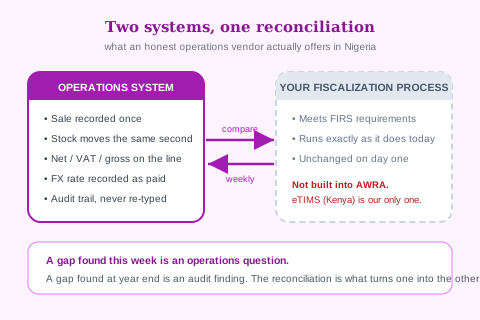
If your operations system does not transmit to FIRS, what should the workflow be? The same one that works in every market where fiscalization and operations are separate systems — and it is more robust than a single-vendor integration, because it survives a change of either side.
-
Sell inside the operations system
Every sale is recorded once, moves stock in the same second, and carries its tax treatment on the line. This is the record of what happened.
-
Fiscalize through your existing process
Whatever mechanism you currently use to meet FIRS requirements continues to run. Nothing about it changes on day one.
-
Reconcile the two on a rhythm
Daily or weekly, compare system sales against what was fiscalized. Gaps are found while people still remember them, not at year end.
-
Investigate a gap as an operations problem
A mismatch almost always means a sale went unrecorded somewhere or a fiscalized document has no operational counterpart. Both are findable the same week.
-
Hand your accountant records, not raw material
Filing becomes a report your adviser reads, rather than a reconstruction project they bill you for.
Why this beats a shaky integration
A reconciliation you run weekly finds problems a black-box integration hides. When a transmission silently fails — and they do — an integrated setup tells you nothing until someone asks. A reconciled setup shows you a gap within days, by design.
The four questions that expose an over-claiming vendor
You do not need tax expertise to run this test. You need four questions and the discipline to sit through the silence after each one.
- "Show me an invoice fiscalize inside your product, live, right now." Not a slide, not a recording, not a partner's product. If the answer involves a future release, that is the answer.
- "What happens when the transmission fails?" A vendor who has actually built this will describe retries, queues and a failure report without pausing. A vendor who has not will describe how rarely it fails.
- "Which of these are you responsible for: recording, computing, transmitting, filing?" Make them draw the line. A vendor unwilling to draw a boundary has not thought about where theirs is.
- "What did you build for Nigeria specifically, versus what is generic?" Currency presets and VAT-aware records are generic and valuable. Fiscal integration is specific and rare. Anyone blurring the two is hoping you will not notice.
The same test surfaced the same problem across every market we have written about — EFRIS in Uganda, EFD receipts in Tanzania, EBM in Rwanda. The acronym changes; the over-claim does not.
If you are earlier in the process and still shortlisting, the full evaluation rubric — including the ten things to make a vendor demonstrate live — is in our Nigeria ERP buyer's guide.
Our take
Buy a system for the quality of the records it produces, not for the compliance logo on its website. Clean records make any fiscalization arrangement workable and any audit survivable; a compliance badge over messy records makes neither. And when a vendor tells you they handle FIRS, the only acceptable follow-up is "show me."
See records that stand up on their own
VAT-aware sales and purchasing, naira and foreign currency with the rate recorded, and an [audit trail](/glossary/audit-trail) nobody has to maintain — plus a straight answer about what we do not do.
Explore AWRA for NigeriaFrequently asked questions
Does AWRA OpsHub transmit invoices to FIRS?
Not as a standard shipped feature. The fiscal e-invoicing integration that ships out of the box is Kenya's eTIMS. In Nigeria, AWRA holds your operational and sales records and you continue to meet FIRS requirements through your existing process, reconciling the two on a regular rhythm. That said, this is a scope boundary rather than a technical limit — eTIMS was built because clients needed it, and FIRS transmission can be scoped and built for you the same way. Tell us what you need and we will come back with a written spec, timeline and price before you commit to anything. Confirm the current rules with FIRS or your tax adviser either way.
Can you build an integration we need that is not in the product yet?
Yes — that is how most of what exists today got here. Tax and e-invoicing pipelines, bank and mobile-money feeds, payroll and regulator returns in a specific filing layout, or a connection to a system you already run and intend to keep: all of it is build-to-requirement work. The process is deliberately unromantic. You describe the requirement, we come back with a written scope, a timeline and a cost, and once agreed it is built into your environment and maintained as part of the product rather than bolted on and forgotten. What we will not do is tell you in a demo that something already exists when it does not.
Does the system compute VAT?
It keeps VAT-aware records — net, tax and gross separated on every sales and purchase line, with the tax treatment captured at the point of entry rather than applied in bulk later. Nigeria's VAT rate ships as a built-in preset alongside the naira. What it does not do is interpret Nigerian tax rules or decide your treatment for you; rates, thresholds and exemptions belong to FIRS and to your adviser, and they change.
Can it file our VAT returns?
No — filing is your accountant's or tax adviser's work, and we would not want it any other way. What the system does is make filing a matter of reading a report from live records rather than reconstructing a quarter from spreadsheets, receipts and memory. Most of the cost of filing is the reconstruction, not the submission.
How should we reconcile system sales against what was fiscalized?
On a short rhythm — daily where volume is high, weekly at minimum. Compare total recorded sales in the operations system against what went through your fiscalization process for the same period, and investigate any gap immediately. A gap almost always means either a sale that was never recorded operationally or a fiscalized document with no operational counterpart, and both are easy to trace while people still remember the day.
We buy in dollars and sell in naira. How does that affect our tax records?
The naira value of a foreign-currency purchase depends on the rate applied, so that rate needs to be recorded against the transaction rather than assumed globally or applied retroactively. AWRA records the rate actually used and folds duty, freight and clearing into the landed cost of the goods, which keeps your cost base, your margin and your tax records describing the same consignment. Confirm the treatment your situation requires with your adviser.
