Cocoa & Agribusiness Operations in Ghana: From Farm Gate to Buyer
Cocoa runs on one of the most structured supply chains in African agriculture — and everything around it, from shea and cashew to maize and vegetables, does not. What operational records both ends of that spectrum need, and where a general operations system honestly stops.
Ghanaian agribusiness contains two very different operating realities, and software conversations go wrong when they are treated as one. Cocoa moves through a long-established, heavily structured chain with defined roles, defined documentation and a regulated marketing structure. Shea, cashew, maize, rice, poultry and horticulture move through nothing of the sort — they are aggregated informally, priced locally and documented lightly.
What both need turns out to be the same thing at different intensities: a trustworthy record made at the point where the commodity changes hands, and a cost basis that survives the journey from farm gate to buyer. Everything else in an agribusiness system is built on that, and no amount of warehouse sophistication compensates for missing it.
The record at the farm gate
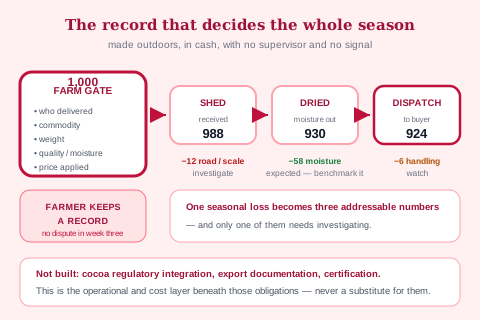
The transaction that determines everything downstream happens outdoors, in cash, between two people, often with no supervisor and rarely with reliable signal. Five things need to be captured at that moment: who delivered, what commodity, the weight, the quality or moisture reading, and the price applied.
Capture those and you have simultaneously addressed farmer disputes, agent accountability, stock valuation and the foundation of traceability. Miss them and the season becomes a reconstruction exercise in which the farmer remembers one weight, the agent remembers another, and the warehouse received a third — with no way to establish which link failed. The Nigerian aggregation guide works through the same mechanics; what differs in Ghana is how much more structure exists at the cocoa end and how little exists everywhere else.
The farmer who leaves holding a record of their weight, grade and price does not return to argue three weeks later. That receipt is a control, not a courtesy — and it changes agent behaviour whether or not anyone ever checks it.
Agent float: cash out, commodity in
Buying agents leave with money and return with produce. Between those two events the business depends entirely on one person's integrity and arithmetic, reconciled days later against a notebook. This is a design problem rather than a character problem, and it has a standard solution.
Float is issued to a named agent as a recorded custody event. Each purchase draws down against it and creates a stock receipt at the same moment, offline if necessary. At the end of the run the arithmetic closes two independent ways: float issued minus purchases recorded should equal cash returned, and commodity physically received should match purchases recorded. Two checks on the same run means a discrepancy has a location, not merely a size.
How an agent run should close
The second check runs in parallel: commodity received at the shed should reconcile to the 17,400 of captured purchases. When both close, the run is clean. When one does not, you know immediately whether the problem is cash or weight — which is most of the investigation.
Loss is a sequence, not a season
Aggregators routinely report a single seasonal loss figure and absorb it. It is never one thing. Part is legitimate moisture loss during drying, which is expected and should be modelled rather than mourned. Part is handling and spillage. Part is the difference between a field scale and a shed scale. And part is not loss at all — it is a record that was never made.
Recording weight at each handover decomposes one unexplained figure into a sequence of small attributable ones. Expected drying loss becomes a process benchmark you compare against; anything beyond it is an exception tied to a specific stage and a specific date. That is the difference between knowing you lost tonnage and knowing where — and only the second is actionable. Perishable chains face the sharper version of this, covered in cold chain and post-harvest losses.
Input credit, where you run it
Many Ghanaian aggregators and nucleus-farmer schemes advance inputs — seed, fertiliser, agrochemicals — and recover the value at harvest. Run informally, this is where the largest unrecorded losses in agribusiness accumulate, because the advance is a physical issue of stock and a debt at the same time, and most operations track only one of the two.
Handled properly, an input advance is simultaneously a stock movement out of the store and a receivable against the named farmer, netted off automatically at produce payment. Recovery rates then become visible during the season rather than discovered as a write-off after it. The mechanics are documented in farm input credit and stock control — the crops and the currency change, the double-entry does not.
What we do and do not do
Cocoa in particular attracts vendors claiming more regulatory integration than they have. Our position is narrow and specific.
What AWRA OpsHub does today
- Farm-gate intake capture — farmer, commodity, weight, quality and price, offline, syncing when signal returns.
- Agent float under named custody, drawn down by recorded purchases and reconciled at end of run.
- Weight and quality at every handover, so loss attributes to a stage rather than to the season.
- Input credit as stock and receivable, netted at produce payment with recovery visible in-season.
- Live stock by commodity, grade and location, with a verifiable cost basis per consignment.
- Quality holds and batch traceability from farmer through to dispatch.
More we can add to your workspace
- A connection into the regulated cocoa marketing structure. Licensed-buyer systems and their documentation, integrated the way any external rail is — a scoped build against a published interface.
- A commodity exchange or price-feed integration.
- GRA e-invoicing — our fiscal integration is Kenya's eTIMS and it is Kenya-only.
Where we point you to a specialist
- We are not an export documentation system. Certificates of origin, phytosanitary paperwork and customs filing go to a licensed agent.
- We do not provide certification. We hold records a certification body or buyer will ask for; the certification is theirs to award.
If your operation sits inside the regulated cocoa chain, treat us as the operational and cost layer beneath your regulatory obligations, never as a substitute for them. Confirm licensing, export and tax obligations with the relevant authorities — they vary by commodity and by destination market.
What we can build for Ghana on top of the standard product
Everything listed above as something we can add describes what ships in the standard product today — it is a starting point for Ghana, not a limit on what AWRA OpsHub can do there. Kenya's eTIMS integration and its maintained payroll engine are in the product because Kenyan clients needed them and commissioned them; neither appeared by itself. The same door is open here. If GRA e-invoicing, a bank or mobile money feed, a statutory return format, a rule specific to how your operation runs, or a link to a system you already have is what stands between you and a decision, tell us and we will scope it as a build — written spec, timeline and price — before you commit to anything.
GRA e-invoicing and the levy stack
Electronic invoicing against GRA's published interface, and a maintained multi-component levy stack we keep current for you instead of leaving the effective-from dates in your hands.
MoMo, cards and bank feeds
Mobile money settlement files, card acquirer reports and bank statement feeds pulled into the Payments Register, so collections reconcile against invoices without anyone re-keying a statement.
The operational work, which is what most commissions actually are
An extra approval stage in a chain that does not match the standard one, a custom field set on employees or assets that only your sector needs, an expiry that has to block an order rather than send an email, a report your board asks for in a shape nothing produces, or a scanner or weighbridge feeding the goods-in door. These are the commissions we are asked for most often and the smallest ones we quote — and unlike a revenue-authority pipeline, none of them waits on a regulator.
Payroll and statutory returns
PAYE and SSNIT contribution schedules produced in the layout your filing body expects, generated from live payroll records rather than rebuilt in a spreadsheet each month.
Systems you already run
The accounting package, CRM, online store or custom database you intend to keep — connected through our API so a fact is entered once and appears everywhere it is needed.
How it works: you describe the requirement, we return a written scope, timeline and cost, and once agreed it is built into your environment and maintained as part of the product. No roadmap slide, and no pretending in a demo that something exists when it does not.
Tell us what you need integratedWhy this becomes a financing conversation
Aggregation is structurally short of working capital: you buy across a season and sell in consignments, so cash is tightest exactly when the buying window is open. Lenders will finance that gap but need to see what you hold and what it cost, from records they can independently re-check.
An aggregator who can produce a live position by commodity and grade, a verifiable cost basis per consignment, and a traceable chain from farmer to dispatch is a different credit proposition from one with a notebook and a confident summary. The same records serve certified and export buyers, who increasingly require provenance rather than assurance. Run the working capital and cash conversion cycle arithmetic before the conversation — the lender certainly will.
Our take
Put a device at the buying point and give the farmer a record. Everything downstream — agent accountability, loss attribution, input-credit recovery, stock valuation, traceability, financeability — depends on that single change, and none of it can be retrofitted from the warehouse end. Aggregators who fix the farm gate first find the rest follows; those who start at the shed spend every season reconciling to a number nobody captured.
Start at the buying point
Offline farm-gate capture with weight, quality and price against a named farmer, agent float under custody, input credit netted at payment, and a cost basis a lender can check.
Explore AWRA for GhanaFrequently asked questions
Does it integrate with the regulated cocoa marketing structure?
No. We do not integrate with the licensed-buyer systems, regulatory documentation or marketing structure that govern the cocoa chain, and you should treat any vendor claiming otherwise with real scepticism. What we provide is the operational and cost layer beneath your regulatory obligations — farm-gate capture, agent float, weight and quality at each handover, stock and cost basis — not a substitute for them.
Will intake capture work at a rural buying point with no signal?
Yes — capture is offline-capable for stock and asset movement on ordinary Android devices and syncs when the connection returns. This is the only workable design here, because buying points are precisely where signal is least reliable and where the record matters most. A system requiring connectivity at the moment of purchase is a system that gets bypassed within a week and replaced by a notebook.
How does input credit recovery work?
An input advance is recorded as two things at once: stock leaving your store, and a receivable against the named farmer. At produce payment the debt is netted off automatically, so the farmer sees crop value less what they owed, and your recovery rate is visible during the season rather than discovered as a write-off afterwards. Tracking only the stock issue or only the debt — which is what most informal schemes do — is where the largest unrecorded losses in agribusiness accumulate.
Can we separate expected drying loss from actual shrinkage?
Yes, by recording weight and quality at each handover — farm gate, shed receipt, after drying, at dispatch — so the total decomposes into stage-by-stage variances. Expected moisture loss becomes a process benchmark you compare against, and anything beyond it appears as an exception tied to a specific stage and date rather than being absorbed into one seasonal figure nobody can explain.
Will this help us access stock financing?
It produces what lenders ask for: a live position by commodity and grade, a verifiable cost basis per consignment, and a traceable chain from farmer to dispatch that can be independently re-checked. We are not a lender and we do not arrange finance, and no system can guarantee a credit decision — but the difference between a notebook and auditable records is often the difference between a conversation and an application.