
Agribusiness & Commodity Trading in Nigeria: From Buying Point to Export
Aggregating cocoa, sesame, cashew, grain or ginger means buying from hundreds of smallholders in cash, in the field, on weight and grade — and then proving every kilogram of it to a buyer, a lender or an exporter. The records that make that provable, and the ones that make it financeable.
Commodity aggregation is one of the few businesses where the most important transaction of the day happens at a roadside, in cash, between two people, with no supervisor present and no receipt worth the name. Multiply that by three hundred farmers, six buying agents and a season, and you have both the value of the business and its entire risk profile in one sentence.
Every problem Nigerian aggregators and commodity traders describe to us traces back to that moment. Weight disputes, moisture arguments, agent float that does not reconcile, quality that degrades between the field and the warehouse, and lenders who will not finance you because they cannot see what you actually hold. Fix the record made at the buying point and most of the rest becomes tractable.
The intake record is the whole business
An intake record that is worth anything captures five things at the moment of purchase: who delivered, what commodity, the weight, the grade or moisture reading, and the price applied. Get those five onto a device at the buying point and you have simultaneously solved farmer disputes, agent accountability, stock valuation and the beginning of traceability.
Miss them and you are reconstructing the season from notebooks. The farmer remembers a different weight. The agent remembers a different price. The warehouse received a different quantity than the one recorded at the buying point, and there is no way to establish where the difference occurred — the road, the scale, the notebook or the agent. All four are possible and none are provable, which is exactly the environment in which losses become permanent.
A farmer who leaves the buying point holding a printed or SMS record of their weight, grade and price does not come back to argue three weeks later. That receipt is a control, not a courtesy.
The pattern is the same one cooperatives elsewhere use for member produce intake and payments — the crops and the currency differ, the discipline does not. What Nigerian aggregation adds is scale and cash: more farmers, more agents, longer distances, and float moving in physical notes.
Agent float is the second unguarded door
Buying agents are dispatched with money and return with commodity. In between, the business is entirely dependent on one person's integrity and arithmetic, and the reconciliation usually happens days later against a notebook. This is not a character problem — it is a design problem, and it is the same one distributors face with van stock, only inverted: cash out, goods in.
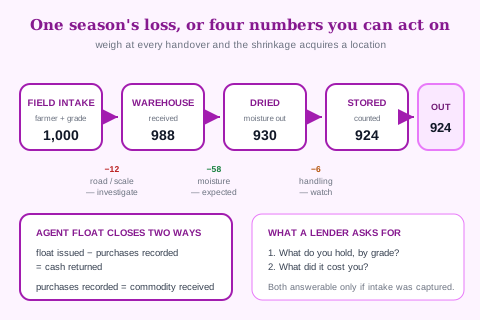
Handled properly, float is issued as a custody event to a named agent. Each purchase draws down against it and creates a stock receipt at the same instant. At the end of the run the arithmetic is closed and unarguable: float issued, minus purchases recorded, equals cash returned — and the commodity received should match the purchases recorded. Two independent checks on the same run. The custody principle is set out in van stock and site custody; commodity buying is the same control facing the other direction.
Float on trust
- Agent leaves with cash and a target, returns with commodity and a notebook
- Purchases reconstructed at the depot, days later, from memory and paper
- A weight discrepancy cannot be traced to the field, the road or the scale
- Farmer disputes are settled by whoever argues more persuasively
- Shortfalls become "the cost of buying upcountry"
Float under custody
- Cash issued to a named agent as a recorded custody event
- Each purchase captured at the buying point, offline, drawing down the float
- Field-recorded weight compared against warehouse-received weight — the gap has a location
- The farmer holds a record of weight, grade and price from the moment of sale
- A shortfall is a variance with a name, a route and a date
Weight loss is not one number
Aggregators routinely report a total loss for the season and treat it as a cost of doing business. It almost never is one thing. Some of it is legitimate moisture loss as the commodity dries — which is expected, predictable and should be modelled, not absorbed. Some is handling and spillage. Some is the difference between a field scale and a warehouse scale. And some is not loss at all.
Recording weight at each handover — field intake, warehouse receipt, after drying or cleaning, at dispatch — turns one unexplained figure into a sequence of small ones, each attributable to a stage and therefore to a cause. That is the difference between knowing you lost tonnage and knowing where. The same logic applied to perishables is covered in cold chain and post-harvest losses.
| Stage | What to record | What the variance tells you |
|---|---|---|
| Field intake | Farmer, commodity, weight, grade/moisture, price | Your true cost per kilogram, and the beginning of traceability |
| Warehouse receipt | Weight received against the consignment dispatched from the field | Whether the gap is in the field, the road, or the scale |
| After drying or cleaning | Weight and grade after processing | Actual moisture loss against expected — a process number, not a mystery |
| Storage | Periodic counts, condition, and stock ageing | Deterioration and the cost of holding for a better price |
| Dispatch | Weight, grade and destination per consignment | What you actually sold, and the traceability the buyer wants |
Why this becomes a financing conversation
The reason to build these records is not tidiness — it is access to capital. Aggregation is working-capital-hungry: you buy across a season and sell in consignments, so the business is permanently short of cash exactly when the buying window is open. Lenders will finance that gap, but they need to see what you hold and what it cost, from records they can trust and re-check.
An aggregator who can produce a live stock position by commodity and grade, a verifiable cost basis per consignment, and a traceable chain from farmer to dispatch is a fundamentally different credit proposition from one with a notebook and a confident summary. The same records also serve certified and export buyers, who increasingly require provenance rather than assurances. The working capital and cash conversion cycle framing is worth reading before any financing conversation, because the lender will be doing that arithmetic whether or not you have.
If you are choosing a system rather than tightening an existing one, the full evaluation rubric for Nigeria is in our ERP buyer's guide. Once the commodity reaches your warehouse and starts moving to buyers, inventory and distribution in Lagos covers the outbound half of the same chain.
What we do and do not do
What AWRA OpsHub does today
- Intake capture at the buying point — farmer, commodity, weight, grade and price, offline, syncing when signal returns.
- Agent float under named custody, drawn down by recorded purchases and reconciled at end of run.
- Weight and grade at every handover, so loss is attributable to a stage rather than to the season.
- Live stock position by commodity, grade and location, with a verifiable cost basis per consignment.
- Quality holds and batch traceability from farmer through to dispatch.
- Landed and processing costs folded into the true cost of what you hold.
More we can add to your workspace
- A commodity exchange or price-feed connection. Live reference prices pulled in against your contracts, so a position is valued from the market rather than from a figure somebody typed.
- FIRS e-invoicing — our fiscal integration is Kenya's eTIMS and it is Kenya-only.
Where we point you to a specialist
- We are not an export documentation system. No certificates of origin, no phytosanitary paperwork, no customs filing.
- We do not provide certification. We hold the records a certification body or buyer will ask for; the certification itself is theirs to award.
- We are not a lender and we do not arrange finance — we produce the records that make you financeable.
Confirm any export, tax or licensing obligation with the relevant authority or your adviser. The commodity trade carries regulatory requirements that vary by crop and by destination market, and none of them are handled here.
What we can build for Nigeria on top of the standard product
Everything listed above as something we can add describes what ships in the standard product today — it is a starting point for Nigeria, not a limit on what AWRA OpsHub can do there. Kenya's eTIMS integration and its maintained payroll engine are in the product because Kenyan clients needed them and commissioned them; neither appeared by itself. The same door is open here. If FIRS e-invoicing, a bank or mobile money feed, a statutory return format, a rule specific to how your operation runs, or a link to a system you already have is what stands between you and a decision, tell us and we will scope it as a build — written spec, timeline and price — before you commit to anything.
FIRS e-invoicing and tax pipelines
Invoice transmission against the authority's published interface, plus WHT credit handling and sector levies — with the parts vendors gloss over: retries, a failure queue and a daily report of sales carrying no fiscal reference.
Banks, cards and transfers
Bank statement feeds, card acquirer settlements and bulk-payment files pulled into the Payments Register, so money in and out reconciles without anyone re-keying a statement.
The operational work, which is what most commissions actually are
An extra approval stage in a chain that does not match the standard one, a custom field set on employees or assets that only your sector needs, an expiry that has to block an order rather than send an email, a report your board asks for in a shape nothing produces, or a scanner or weighbridge feeding the goods-in door. These are the commissions we are asked for most often and the smallest ones we quote — and unlike a revenue-authority pipeline, none of them waits on a regulator.
Payroll and statutory returns
PAYE, pension and NHF schedules produced in the layout your filing body expects, generated from live payroll records rather than rebuilt in a spreadsheet each month.
Systems you already run
The accounting package, CRM, online store or custom database you intend to keep — connected through our API so a fact is entered once and appears everywhere it is needed.
How it works: you describe the requirement, we return a written scope, timeline and cost, and once agreed it is built into your environment and maintained as part of the product. No roadmap slide, and no pretending in a demo that something exists when it does not.
Tell us what you need integratedOur take
Put a device at the buying point and give the farmer a record. Everything else — agent accountability, loss attribution, stock valuation, traceability, financeability — is downstream of that single change, and no amount of warehouse-side sophistication compensates for missing it. Aggregators who fix intake first tend to find the rest follows; those who start at the warehouse are permanently reconciling to a number they never captured.
Start at the buying point
Offline intake capture with weight, grade and price against a named farmer, agent float under custody, and a live stock position with a cost basis a lender can check.
Explore AWRA for NigeriaFrequently asked questions
Will intake capture work at a rural buying point with no network?
Yes — capture is offline-capable for stock and asset movement on ordinary Android devices and syncs when the connection returns, which is the only workable design for this business. Buying points are exactly where signal is least reliable and where the record matters most, so a system that requires connectivity at the moment of purchase is a system that will be bypassed within a week and replaced by a notebook.
How does agent float reconciliation work?
Cash is issued to a named agent as a recorded custody event. Every purchase the agent makes draws down against that float and simultaneously creates a stock receipt, so at the end of the run the arithmetic closes two ways: float issued minus purchases recorded should equal cash returned, and commodity physically received should match the purchases recorded. Two independent checks on the same run means a discrepancy has a location rather than just a size.
Can we give farmers a record of their sale?
Yes, and it is one of the highest-value things you can do. A farmer who leaves holding a record of the weight, grade and price applied has no reason to return and dispute it weeks later, and the existence of that receipt changes agent behaviour at the buying point regardless of whether anyone ever checks it. Treat it as a control rather than a courtesy.
Does it handle moisture loss between intake and dispatch?
It records weight and grade at each handover — field intake, warehouse receipt, after drying or cleaning, and at dispatch — so the total season loss decomposes into stage-by-stage variances. Expected moisture loss then becomes a process number you can compare against, and anything beyond it is visible as an exception attached to a specific stage rather than absorbed into an annual figure nobody can explain.
Will this help us get stock financing?
It produces what lenders ask for: a live stock position by commodity and grade, a verifiable cost basis per consignment, and a traceable chain from farmer to dispatch that can be re-checked rather than taken on trust. We are not a lender and we do not arrange finance, and no system can guarantee a credit decision — but the difference between a notebook and auditable records is usually the difference between a conversation and an application.
