
Inventory & Distribution Software for Lagos Businesses
In Lagos the distance between your warehouse and your customer is measured in hours, not kilometres — and stock spends most of its life in the gap. What inventory and distribution software has to do in a city where traffic, van sales and multiple warehouses conspire to hide your real position.
A Lagos distributor once described the problem to us better than any consultant could: "I know what I bought and I know what came back. The middle is where my money lives, and I cannot see the middle." That is the whole brief for inventory software in this city. Not reports, not dashboards — visibility of the middle.
The middle is stock in transit on a truck stuck on Third Mainland Bridge. It is a van whose driver has been selling since 7am and will reconcile at 6pm, from memory. It is a consignment split across a warehouse in Apapa and a store in Ikeja that neither location fully accounts for. In a compact market you can walk out and look. In Lagos you cannot, so the system has to.
Why multi-location is harder here than the textbook says
Standard advice about multi-warehouse inventory assumes transfers are quick and information is quicker. Lagos inverts that. A transfer can take a full day; the phone call about it takes seconds. So the information arrives before the goods, and everybody starts treating the goods as arrived. That is where phantom stock is born — and phantom stock is what causes you to promise a customer something you cannot deliver.
The fix is not more communication. It is a system where in-transit stock genuinely belongs to nobody: dispatched from the origin, not yet available at the destination, visible to head office the whole time. Until someone at the receiving end confirms what physically arrived, it stays in limbo — and short deliveries surface as a variance at the door instead of a mystery at month-end.
Transfers on trust
- Origin marks the goods gone; destination marks them arrived — often on the same phone call
- In-transit stock is either double-counted or invisible
- A short delivery is discovered days later, when nobody can say who was holding it
- Head office sees the network only as accurate as the last person who remembered to call
- Shrinkage in transit becomes an accepted cost of doing business in Lagos
Governed transfers
- Dispatch and receipt are two separate, dated events with two different people attached
- In-transit stock belongs to neither branch's sellable position
- A short delivery is a variance raised at the door, against a named consignment
- Head office sees every location and everything moving between them, live
- Losses in transit have an owner, a route and a date — which is the beginning of stopping them
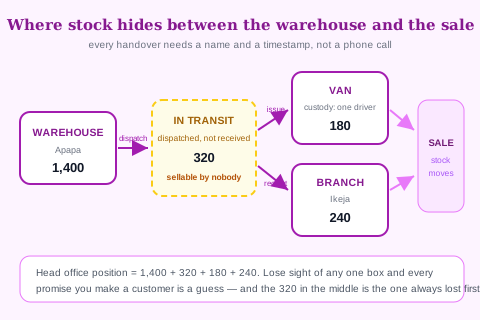
Van sales: the hardest inventory problem in the city
A van leaving your depot loaded with goods is a mobile warehouse with one employee, no supervisor and an unreliable network. Treating it as anything less than a stock location is how distributors lose money they never account for.
Handled properly, van stock is issued to the driver as a custody event — this quantity, this person, this date. Sales are captured on the device as they happen, offline if the network has gone, and syncing when it returns. At the end of the run, the arithmetic is not a negotiation: opening load, minus sales recorded, equals what should return. Anything else is a variance with a name attached. The pattern is the same one we documented for van stock and site custody, and it is the single highest-return control in a Lagos distribution business.
A van is not a delivery vehicle. It is a warehouse that moves, run by one person with no supervision — and it should be governed like one.
The offline requirement is not optional here, and it is not really about Lagos connectivity being poor — it is about it being inconsistent. A driver on Lagos Island at midday and in Ikorodu at four will meet both conditions in one shift. Capture that fails when the signal drops does not just lose data; it teaches the driver to stop bothering, and then you have lost the discipline as well as the record.
The controls worth implementing first, in order
-
Count everything once, properly
A real physical count per location, reconciled and signed off. Every subsequent number is measured from this line, so a shaky baseline undermines everything for a year. Do it before you configure anything clever.
-
Make every sale move stock
No exceptions, no batch updates at close of business. The moment a sale can happen without inventory moving, your position starts drifting and nobody can say when the drift began.
-
Govern transfers with dispatch and receipt
Two events, two people, in-transit stock owned by neither branch. This alone ends most of the arguments between warehouse and branch.
-
Put van stock under custody
Load issued to a named driver, sales captured on the device offline, and end-of-run reconciliation that is arithmetic rather than discussion.
-
Cycle count instead of waiting for stocktake
Count a slice of the warehouse continuously rather than shutting down once a year — cycle counting vs annual stocktake explains why the annual ritual finds problems too late to act on.
-
Then set reorder points that reflect real lead times
Only once your numbers are trustworthy. Reorder point and safety stock is the maths — and in Lagos the lead-time variability matters more than the average.
Do not start with the dashboard
Reporting is downstream of records. Every distributor who has regretted a software purchase bought the reporting layer first and discovered six months later that it was faithfully summarising bad data. Get receipts, transfers and van reconciliation right, and useful reporting becomes almost automatic.
Where the margin actually leaks
Distributors tend to hunt for margin in pricing, which is the hardest place to find it, while ignoring three cheaper sources.
| Leak | What it looks like | The control that closes it |
|---|---|---|
| Cost that was never real | Imported goods priced off an assumed exchange rate with duty and clearing left out | Landed cost recorded per consignment — see landed cost |
| Stock that quietly aged out | Fast-moving lines watched closely while slow lines rot in a corner of the warehouse | ABC discipline and dead-stock review: ABC analysis, dead stock |
| Deliveries nobody checked properly | Goods received against the invoice rather than against the physical count | Three-way matching: order, delivery, invoice — how it works |
| Cash that arrived in three forms | Transfers, POS settlements and cash reconciled monthly instead of daily | A daily close against system sales, per branch, per person |
None of those four is a Lagos-specific problem. What is Lagos-specific is how much larger each one grows when your locations are hours apart and your goods spend half their life in transit.
If you are still choosing a system rather than fixing one, the evaluation rubric and the honest position on FIRS, VAT and the naira are in our Nigeria ERP buyer's guide. If you also run shops rather than only depots, multi-branch retail covers the counter side of the same problem.
Our take
In a Lagos distribution business, buy for control of the middle — in-transit stock, van custody and receiving discipline — and treat everything else as a bonus. A system that can tell you at 11am exactly where your stock is, who is holding it and what it truly cost has already paid for itself. One that only tells you at month-end has simply digitized your uncertainty.
See the middle of your operation
Live stock across every warehouse and branch, governed transfers with in-transit visibility, van stock under named custody, and offline capture that survives a Lagos afternoon.
Explore AWRA for NigeriaFrequently asked questions
Can it show stock that is in transit between two Lagos locations?
Yes, and this is one of the most valuable things it does here. A transfer is two separate events — dispatch by one person, receipt by another — and between them the stock belongs to neither branch's sellable position while remaining fully visible to head office. That means nobody can sell goods still sitting in traffic, and a short delivery becomes a variance raised at the door against a named consignment rather than a mystery discovered weeks later.
How does van sales reconciliation work?
The load is issued to a named driver as a custody event with quantities and a date, sales are captured on the device as they happen, and at the end of the run the system does the arithmetic: opening load minus recorded sales equals expected returns. Any difference is a variance attached to a person and a route. It turns the end-of-day conversation from a negotiation into a reconciliation.
Does it work when the network drops mid-route?
Yes — capture is offline-capable for stock and asset movement on ordinary Android devices and syncs when the connection returns. This matters more than most buyers expect, because the real problem is not poor coverage but inconsistent coverage across a single shift. Capture that fails intermittently does not just lose records, it teaches drivers to stop using the system at all.
We have warehouses in different parts of Lagos plus branches. Is that supported?
Yes. Each warehouse, store, branch and van can be a distinct stock location with its own position, and transfers between any of them are governed by dispatch and receipt. Head office sees the consolidated position and every movement inside it, which is the point — one stock position for the whole business rather than one per location.
Where should a distributor start if we are coming off spreadsheets?
Start with a proper physical count per location to establish a trustworthy baseline, then make every sale move stock, then govern transfers, then bring van stock under custody. Resist starting with reporting or reorder automation — both are only as good as the records beneath them, and configuring clever logic on top of an unreliable baseline is how software projects lose credibility in the first month.
