
Manufacturing & Export Operations in Morocco: Built to Someone Else's Standard
When your customer is in Europe, their audit becomes your operating system. Traceability that survives a client visit, change control nobody skips, and the difference between records that satisfy you and records that satisfy them.
Manufacturers who sell domestically build records for themselves. Manufacturers who supply European customers build records for someone else — and that inversion is the single most important thing to understand about operations software in Casablanca, Tangier or Kenitra.
It changes the standard of proof. Records that satisfy your own management can be partly in a system and partly in the head of the production manager who has been there eleven years. Records that satisfy a customer audit have to be complete, retrievable in front of a visitor, and independent of whoever happens to be in the building that day.
This post is about that standard: what an auditing customer actually tests, how long you have to answer, and where we are useful — plus a clear statement of the certification work we do not do.
What an auditing customer actually tests
A supplier audit is not a tour. It is a small number of specific, adversarial questions, asked in a room, with a clock running. Almost all of them are versions of one question: can you prove what went into this, and where else it went?
Four questions, and what your answer reveals
Show me everything that went into this finished unit.
The comfortable answer
A production file, a batch record, or a folder retrieved from the office.
What they are really testing
Whether backward traceability exists as data or as paperwork. Paperwork passes, slowly, once. Data passes every time and in front of them. Time yourself: under two minutes reads as control, twenty minutes reads as reconstruction.
This input lot was defective. Which of your customers received it?
The comfortable answer
Hesitation, then a promise to come back with a list.
What they are really testing
Forward traceability, which is far rarer than backward and is the one that matters commercially. If you cannot answer it in the room, the customer now knows a recall would be scoped by guesswork rather than by record.
You changed a supplier for this component. Show me the approval.
The comfortable answer
An email, or a name, or an explanation of why the substitution was equivalent.
What they are really testing
Change control. Undocumented substitution is one of the most common findings in supplier audits, and one of the easiest to prevent — it is a procurement discipline before it is a quality one.
What was your yield on this product last quarter?
The comfortable answer
A number, usually from a spreadsheet maintained by one person.
What they are really testing
Whether your process is measured or merely observed. A yield figure produced live from job records says the shop floor is instrumented; a spreadsheet says somebody types it up, which means it is monthly at best and optimistic at worst.
Backward traceability keeps you out of trouble. Forward traceability decides how expensive the trouble is when it arrives.
Both directions, on the clock
Traceability is usually discussed as one capability and is really two, built on the same data but exercised in opposite directions, and most manufacturers are competent at one and helpless at the other.
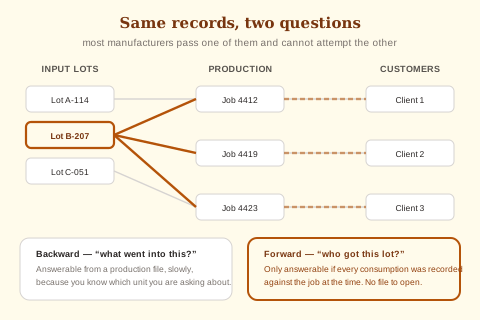
The reason the forward path is rarer is structural. Backward traceability can be assembled after the fact from a production file, because you know which unit you are asking about. Forward traceability cannot — it requires that every consumption of every lot was recorded against the job at the time, because you are searching from the input end and there is no file to open.
-
Receive against a lot, always
Incoming material carries a lot or batch identity from the moment it is received, with the supplier document attached. No lot at receipt means no genealogy downstream, no matter what you do later.
-
Issue to the job, not to the department
Consumption records which lot went into which production order. Issuing to a cost centre or a shift is the single decision that makes forward traceability impossible, and it is usually made for convenience years earlier.
-
Book output as its own lot
Finished goods carry their own batch identity linked to the inputs consumed. This is the join that makes both directions queryable rather than reconstructable.
-
Carry the lot through dispatch
Which batch went to which customer on which delivery. Traceability that stops at the warehouse door answers the audit question but not the recall question.
-
Record scrap and rework against the job too
Material that did not become product is still material that was consumed. Excluding it makes yield wrong and leaves a gap an auditor will find, because the arithmetic will not close.
-
Rehearse it before they do
Pick a lot at random once a quarter and run both traces on the clock, with the person who would actually be asked. The drill costs an hour and is the only honest measure of whether any of the above is working.
The recall drill
Choose an input lot received four months ago. Without phoning anyone, produce: every production order that consumed it, every finished batch that resulted, every customer who received those batches, and the quantity each one got. Write down how long it took. That number is your actual traceability capability — not what is written in your quality manual, and not what you told your customer at the last audit.
Margin in the currency you are paid in
The second thing export manufacturing changes is costing. Your contract is in euros, a large share of your inputs are in euros or dollars, and your conversion cost is in dirhams. A margin computed in dirhams is a translated number that answers a question nobody asked.
One export contract, costed in the contract currency
Illustrative figures indexed to 100. Two things are worth noticing. First, the yield line alone is roughly a third of the remaining margin — which is why BOM accuracy is a commercial issue and not a production one. Second, only a quarter of the cost base is denominated in dirhams, so a business that measures everything in local currency is watching the smallest part of its own exposure. The wider treatment is in the multi-currency post.
The full comparison with Egypt — where the currency problem is the opposite shape — is in multi-currency operations in Egypt and Morocco.
What we are, and firmly are not
What AWRA OpsHub does today
- Lot and batch traceability in both directions — receipt to consumption to output to customer, queryable rather than reconstructable.
- Material issued to a job, with a reason and a person on every issue, so consumption is recorded as it happens and attributable afterwards.
- Scrap and by-products recorded against a reason at the moment they occur, and brought onto stock where they have value.
- Procurement with approvals that refuse, three-way matching, and supplier records with documents and expiry dates — which is where change control actually lives.
- Transactions in their original currency with landed cost on imported inputs at the rate actually applied.
More we can add to your workspace
- A bill of materials: a recipe with a version, an effective date and multi-level explosion, so a finished unit carries a cost assembled from its components.
- A production order. Material issued to a job already sits in a work-in-progress balance and is relieved when output is received against that job; what the order object adds is a unit of work above the job, output valued at what the run consumed rather than at the finished item's standing price, and a home for an issue raised without a job on it.
- A yield and consumption variance. Actual consumption is recorded today; the standard to compare it against comes with the recipe above, and together they make expected-versus-actual a report rather than arithmetic you do outside.
- Customs, clearing or export documentation. We record what a shipment cost, not what it required.
- Moroccan statutory accounting, a DGI filing, Moroccan statutory payroll, and no French or Arabic interface.
Where we point you to a specialist
- We are not a quality management system. No CAPA workflow, no non-conformance process, no inspection plans, no certified document control.
- We do not manage or maintain certifications of any kind, and no auditor will accept a software product in place of a quality system.
- We are not a manufacturing execution system. Machine integration, finite capacity scheduling and shop-floor equipment control are a specialist category with specialist vendors, and we would point you at one.
- We do not certify your compliance to any customer standard — we hold records that make demonstrating it possible.
Two distinctions to hold onto. The first is traceability against quality: a traceability capability is evidence infrastructure, a quality system is a set of processes, responsibilities and reviews that your certification depends on, and neither substitutes for the other. The second is consumption against yield. We record what was issued to a job, accurately and attributably — which is most of what a traceability audit asks for. Comparing it to what should have been issued needs the recipe above. If the yield figure is what you are buying, that is the whole decision, and what production without a recipe actually costs you is the honest version of this conversation.
What we can build for Morocco on top of the standard product
Everything listed above as something we can add describes what ships in the standard product today — it is a starting point for Morocco, not a limit on what AWRA OpsHub can do there. Kenya's eTIMS integration and its maintained payroll engine are in the product because Kenyan clients needed them and commissioned them; neither appeared by itself. The same door is open here. If DGI e-invoicing, a French or Arabic interface, a bank or mobile money feed, a statutory return format, a rule specific to how your operation runs, or a link to a system you already have is what stands between you and a decision, tell us and we will scope it as a build — written spec, timeline and price — before you commit to anything.
DGI declarations and e-invoicing
Declaration output in the format the administration expects and electronic invoicing against any prescribed interface — with retries, a failure queue and a reconciliation report rather than a black box.
French and Arabic interface, banks and payments
Interface language and document templates in French or Arabic with right-to-left layout, plus bank feeds and local payment gateways wired into the Payments Register.
The operational work, which is what most commissions actually are
An extra approval stage in a chain that does not match the standard one, a custom field set on employees or assets that only your sector needs, an expiry that has to block an order rather than send an email, a report your board asks for in a shape nothing produces, or a scanner or weighbridge feeding the goods-in door. These are the commissions we are asked for most often and the smallest ones we quote — and unlike a revenue-authority pipeline, none of them waits on a regulator.
Payroll and statutory returns
IR and CNSS declarations produced in the layout your filing body expects, generated from live payroll records rather than rebuilt in a spreadsheet each month.
Systems you already run
The accounting package, CRM, online store or custom database you intend to keep — connected through our API so a fact is entered once and appears everywhere it is needed.
How it works: you describe the requirement, we return a written scope, timeline and cost, and once agreed it is built into your environment and maintained as part of the product. No roadmap slide, and no pretending in a demo that something exists when it does not.
Tell us what you need integratedPractical notes for exporters
- Instrument the receiving dock first. Everything traceable downstream depends on a lot identity created at the door. It is the cheapest step and the one most often deferred.
- Treat supplier substitution as a procurement control. An approval with a date and a name, before the material is used. Most change-control findings are procurement failures wearing a quality costume.
- Keep the customer's part number as well as your own. Audits and recalls are conducted in their vocabulary, not yours, and translating under pressure is where mistakes get made.
- Record scrap honestly. Understated scrap flatters yield, misstates cost and leaves an arithmetic gap that an auditor closing the material balance will find.
- Store the audit trail with the transaction. Approvals, certificates and delivery documents on the record rather than in a folder that depends on somebody's naming discipline.
- Run the recall drill quarterly and write down the time. A trend in that number tells you more about your operation than any dashboard.
Where to go next
The buying decision, including whether an international platform makes sense for you at all, is in the Morocco buyer's guide. The other manufacturing post in this programme takes up interrupted production and work-in-progress in a different setting — manufacturing in South Africa — and the sector-neutral basics are in three-way matching and what is landed cost.
Our take
Build for the forward trace, because the backward one you probably already pass. Create lot identity at receipt, issue to the job rather than the department, carry the lot through dispatch, and rehearse the recall drill quarterly with a stopwatch. Then cost every contract in the currency it was signed in. Those two disciplines are what an export manufacturer is really buying, and they are worth considerably more than any module named after them.
Run the recall drill on our system
Bring one input lot and one finished product. We will trace both directions in front of you, on the clock, and show what the record produces without anyone phoning the production manager.
Explore AWRA for MoroccoFrequently asked questions
Does AWRA provide lot and batch traceability in both directions?
Yes. Incoming material carries a lot identity from receipt, consumption is recorded against the job rather than against a department, finished output carries its own batch linked to the inputs consumed, and the batch is carried through dispatch to the customer. That structure is what allows both the backward question — what went into this unit — and the forward one — which customers received this input lot — to be answered from records rather than reconstructed from files. One precision, because it is the difference between this and a manufacturing system: the link is an issue charged to a job, not a production order with an expected quantity behind it. For traceability that distinction does not matter. For yield it is the whole story.
Is this a quality management system?
No, and the distinction matters for anyone holding a customer or sector certification. There is no CAPA workflow, no non-conformance process, no inspection planning and no certified document control, and we do not manage or maintain certifications. What we provide is the evidence infrastructure a quality system relies on — traceable material genealogy, approvals with dates and names, documents attached to transactions, and recorded consumption and scrap against the job. Measured yield is not among them — there is no standard to measure against. No auditor accepts software in place of a quality system, and any vendor implying otherwise is setting you up to fail an audit.
Can it show margin on an export contract in euros?
Yes. Transactions are kept in their original currency, so a contract signed in euros, inputs invoiced in euros or dollars, and conversion costs incurred in dirhams can each be held as they were denominated and the margin measured in the contract currency. For a Moroccan exporter this is usually more informative than a dirham view, because the dirham-denominated share of the cost base is often the smallest part of the picture.
How do we handle a supplier substitution properly?
As a procurement control with an approval, a date and a named approver recorded before the material is used, with the supplier record carrying the relevant documents and their expiry dates. Most change-control findings in supplier audits are procurement failures rather than quality failures — the substitution was reasonable, someone senior agreed to it verbally, and nothing was written down at the time. The system's contribution is making the written record the path of least resistance.
Does it produce export documentation or customs paperwork?
No. We are not a customs, clearing or export documentation system. We record what a shipment cost — including duty, freight, insurance and clearing folded into landed cost on the inbound side — but we do not produce the documents a shipment requires. Keep your freight forwarder or a dedicated tool for that layer.
What language is the system in?
English only, with no French or Arabic interface, no right-to-left layout, and documents produced in English. For export manufacturers this is frequently workable because a significant part of the team already operates in English with European customers, but it should be tested with the people on the floor rather than assumed. If your production and warehouse staff work in French, a local vendor is likely to be the better purchase and we will say so.
