
Production Without a Bill of Materials
There is no bill of materials here, no production order, and no yield variance report. This is what a small Kenyan factory can and cannot do on that basis — written plainly, because six of our own manufacturing articles were built on the assumption that a recipe existed.
A miller buys three tonnes of maize, mills it, bags flour, and sells it. Somewhere in that sentence is the entire discipline of manufacturing accounting, and the object most software puts at its centre is the recipe: this much maize makes this much flour, so measure the run against the recipe and the difference is your yield. Every serious manufacturing system is built around that object.
We do not have it. There is no bill of materials, no recipe, no production order, no work order, no assembly and no kit — not partially, not in a limited form. A search of the codebase for any of those returns nothing, which is a more useful answer than a feature list. This article is about what remains, because what remains is more than nothing and is genuinely enough for some manufacturers and genuinely not enough for others.
Why this article exists at all
The manufacturing landing page named recipe-based issuing in its title, its description and two of its feature cards, while its own honesty block correctly listed bills of materials and production orders as unbuilt roadmap. Everything a visitor read first contradicted the one block written to be truthful. That copy has been corrected, and this is the article it should have linked to.
What a bill of materials actually buys you
It is worth being precise about what is missing, because "no BOM" sounds like one absent feature and it is really four.
- An expected quantity. The recipe says a tonne of maize should yield 920 kilos of flour. Without it there is no expectation, and without an expectation there is no variance — the arithmetic simply has nowhere to start.
- A version with an effective date. Recipes change: a supplier substitution, a moisture adjustment, a reformulation. A BOM with versions lets you ask what the recipe was in March, which is the question that arises when March's margin looks wrong.
- A production order to issue against. This is the object that turns material leaving the store into consumption, and that lets a confirmed customer order ring-fence the raw material behind it.
- Yield and consumption variance. The report every processor actually manages on, and the by-product receipt that goes with it.
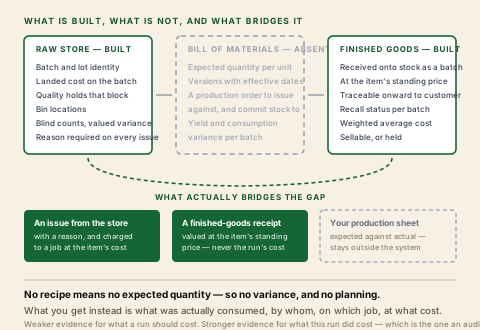
The layers underneath production — landed cost, quality holds, batch traceability — are the harder half to get right, and they are done. The layer on top is the one everybody demonstrates, and it is the one missing.
What you can do instead, precisely
Material leaving the raw store is recorded as a stock issue, and that issue carries more than most people expect. It requires a reason chosen from your own list. It can be charged to a job, at which point the job carries the material at the item's cost. It can come from a specific warehouse and bin, and from held stock where you are working from a reserved allocation. It moves the stock and posts the accounting entry at the moment it is approved, not when it is requested. And above a value you set, it cannot be approved without an elevated permission.
So the record you end up with is not a consumption variance. It is something different and, for a certain kind of manufacturer, better: a dated, reasoned, attributable, approved account of exactly what material left the store, who released it, and which job carried the cost.
What the system holds
Recorded as it happens, by the person doing it.
- Every issue out of the store, with a reason from your own list and an approver.
- The material charged to a job at the item's cost, so the job accumulates what it actually consumed.
- Batch and lot identity on the input, with true landed cost written onto the batch.
- Quality holds that exclude quarantined, expired or damaged stock from being issued at all.
- The finished goods received back onto stock as their own batch, traceable onward to the customer.
- Blind cycle counts with valued variance against the store.
- The recall chain in both directions, from a supplier lot to every customer who received it.
What stays on your production sheet
None of this is computed anywhere.
- The expected quantity. What this run should have consumed, and therefore the variance.
- Getting the run's cost onto the finished good. A receipt is valued at the item's standing buying price, and there is no cost field on the receipt — so the run's actual cost does not reach the output unless you edit the item master first.
- Yield percentage and its trend, by product, by shift, by supplier lot.
- Overhead absorption. Nothing spreads factory overhead across a run.
- Committed stock. A confirmed order does not reserve the raw material behind it.
- By-product valuation. Bran, cake and offcuts can be received onto stock, at a value you decide.
- Rework. It goes back on as an adjustment, not as recorded input against an expectation.
What crosses the seam
- Actual material cost per job, which is the input to your yield sheet rather than a substitute for it.
- The batch identity, which is what lets a yield figure be attributed to a specific supplier lot.
- The landed cost on the batch, which is the only number in this whole picture that is genuinely hard to compute by hand.
The honest summary of the seam: we will tell you accurately what a run cost. We will not tell you what it should have cost. If your margin problem is that you do not know your input costs, that is solved here. If your margin problem is that yields are drifting and nobody can say by how much, it is not.
Which manufacturers this actually fits
This is the section a vendor normally leaves out, and it is the only one that matters if you are evaluating.
Four kinds of factory, honestly assessed
| What your operation needs | Job shop / fabricator | Processor / miller | Food & beverage | Assembly |
|---|---|---|---|---|
| Know the true landed cost of imported inputs | Yes | Yes | Yes | Yes |
| Charge material to a specific job at cost | Yes | Partly — configurable by you | Partly — configurable by you | Partly — configurable by you |
| Batch traceability and a recall chain | Partly — configurable by you | Yes | Yes | Partly — configurable by you |
| Quality holds enforced at the allocation | Yes | Yes | Yes | Yes |
| Measure yield against an expected quantity | No | No | No | No |
| Explode a multi-level product into components | No | No | No | No |
| Reserve raw material behind a confirmed order | No | No | No | No |
Built and maintained Configurable by you, not maintained by us Not built
The pattern in that table is the whole answer. A job shop — a fabricator, a furniture workshop, a metal shop building to order — fits well, because its natural unit of cost is a job and it rarely has a fixed recipe anyway. A processor or miller gets the costing and traceability half and has to run yield on a sheet, which is workable but is the thing they most wanted. An assembler with a multi-level product is the weakest fit for what ships today, and has two honest options rather than one: a dedicated production system alongside this one for the BOM layer, or a bill of materials commissioned here as a scoped build so the recipe, the production order and the yield sit in the same place as the stock they consume. The second is not a hypothetical — module-shaped builds like it are the most common thing clients ask us for. Which is right depends on how many levels deep your product goes and how much of your cost is material.
If your unit of work is a job
This fits, and the job coding is the point
Fabricators, workshops, made-to-order producers. Charge material to the job, add time entries, add purchases, and the job's cost is built from source records rather than estimated. No recipe was ever going to help you.
If your unit of work is a batch with a known recipe
Take the costing half, run yield yourself
Millers, bakers, dairies, feed and oil processors. Landed cost, holds and the recall chain are genuinely strong and are the expensive things to build. Yield goes on a sheet for now, fed by the actual consumption figures. Budget for that discipline being manual.
If yield variance is the reason you are buying
Say so in the first call
We would rather scope the production layer properly as a build, or tell you to buy a manufacturing-specific system, than have you discover the gap in month three. That is not modesty — a factory that bought us for yield reporting is a factory that will leave.
Running yield on a sheet, properly
If you are in the second case, the manual discipline is worth doing well rather than grudgingly. Three rules make the difference between a sheet that catches drift and a sheet that gets abandoned in week five.
-
Make the run the unit, and give it a number
Open a job per production run — not per month, per run — and charge every issue to it. The job number becomes the key that joins your sheet to the system's cost figures, and without a shared key the two records drift apart within a fortnight.
-
Take actual consumption from the system, never from memory
The issues charged to that job are your actual input, already costed and already approved. That is the one column you should never be typing twice. Your sheet supplies the expected figure and the output weight; everything on the input side is a lookup.
-
Record the output as a receipt the same day — and set the price first
Finished goods come back onto stock as their own batch, but the receipt is valued at the item's standing buying price and there is no cost field on it. So compute total job cost divided by good output, put that figure on the item master, and then receive. Skip that order and the output is capitalised at whatever price was last on the item, which for a manufactured good is usually a number nobody has revisited.
One milling run, costed from records and yielded on a sheet
Three tonnes in, 2,760 kilos of flour out. The 92% is arithmetic you did, and the expected 94% you were measuring against lives in your own record. The input side — the landed cost of two separate maize batches, the packaging, the labour — came from the system without anybody retyping it, which is the real value here. The output side does not: that 69.46 has to be written onto the item master by hand before the receipt, because a receipt carries no cost of its own. That manual step is the weakest link in this whole arrangement, and it is the one to put in somebody's job description rather than hope for.
What AWRA OpsHub does today
- Stock issues that require a reason from your own list, and that can be charged to a job at the item's cost.
- Approval before the stock and the ledger move, and an elevated permission required above a value you set.
- True landed cost — freight, duty and clearing allocated across a receipt by value or by quantity, written onto the batch and carried into weighted average cost.
- Quality holds that are enforced by the allocation query itself, so quarantined, inspection-pending, damaged, expired and returned stock cannot be issued or sold.
- Batch and lot identity, with expiry, manufactured and received dates, supplier and source purchase order.
- Traceability in both directions, from a supplier lot forward to every customer and from a finished batch back to its inputs, with a recall status per batch.
- Stock by warehouse and bin, transfers between them with shrinkage recorded, and blind cycle counting with valued variance.
- Custom fields on items, adjustments and transfers, so a grade, a moisture reading or a run number can be captured and required.
More we can add to your workspace
- A bill of materials, recipe, kit, assembly or component model of any kind. Not limited, not partial — the object does not exist.
- A production or work order, turning material leaving the store into consumption measured against an expectation.
- An expected quantity, and therefore no yield or consumption variance report.
- A multi-level explosion. A product made of sub-assemblies cannot be described.
- A committed or reserved stock behind a confirmed order.
- A by-product receipt against a run. By-products go onto stock as an ordinary receipt at a value you decide.
- A rework as recorded input. It re-enters as an adjustment, which is bookkeeping rather than measurement.
- A cost on a finished-goods receipt. A receipt is valued at the item's standing buying price today, so the run's actual cost reaches the output only if somebody edits the item master first; linking the two is the build.
- Standard costing, overhead absorption and a work-in-progress state — the accounting consequence has its own article.
- A weighbridge, moisture or grade capture at receiving, and no supplier payment computed from a verified weight.
Six of our own manufacturing articles were written as though the recipe existed, and that is the more useful confession than any of the bullets above. The failure was not a marketing exaggeration — it was writing about a subject from the outside, using the vocabulary of the field rather than the vocabulary of the code. The check that would have caught it is the one we now run before any capability claim ships: find the class, the column or the migration that implements it, or do not write the sentence.
Anything above that you need, we can build for you
Everything listed above as something we can add describes what ships in the standard product today — it is a starting point, not a limit on what AWRA OpsHub can do for your organisation. Kenya's eTIMS integration and its maintained payroll engine are both in the product because clients needed them and commissioned them; neither appeared by itself, and the same door is open for whatever you just read about. One qualification so this is worth what it claims: a small number of things on this blog we deliberately leave to a specialist rather than build — a statutory ledger we will not sign our name to, a rule that would decide a tax question for you, a clinical or member-funds record that belongs in a regulated system — and where that is true the post says so in those words. Everything else is a scope, a timeline and a price.
The operational work, which is what most commissions actually are
An extra approval stage in a chain that does not match the standard one, a custom field set on employees or assets that only your sector needs, an expiry that has to block an order rather than send an email, a report your board asks for in a shape nothing produces, or a scanner or weighbridge feeding the goods-in door. These are the commissions we are asked for most often and the smallest ones we quote — and unlike a revenue-authority pipeline, none of them waits on a regulator.
The module-shaped additions, which are the ones readers ask for most often
A price list with real discount authority, a customer-facing quotation that expires, a bill of materials or recipe costing, a staff advance that is issued, acquitted and chased, a member or unit ledger, a matching rule that holds a payment. Each of these is a build rather than a setting, and each has been quoted before — a bigger piece of work than a custom field, with a written spec and a date instead of a roadmap slide.
The report, document or pack nothing currently produces
The board pack in the shape your board actually asks for, a donor or funder layout, an invoice or receipt template carrying what your regulator or your customer expects, a dataset the report builder cannot reach yet. Usually the fastest thing on this list to deliver, because the data is already in the system.
Systems, rails and hardware you already run
The accounting package, CRM, online store, core banking or custom database you intend to keep — connected through our API so a fact is entered once and appears everywhere it is needed. Plus the physical edge: a scanner, a scale, a weighbridge or a till peripheral feeding the door it belongs to.
How it works: you describe the requirement, we return a written scope, timeline and cost, and once agreed it is built into your environment and maintained as part of the product. Nothing here waits on a regulator or a published specification, which is why operational builds are the ones we quote fastest. Tell us the requirement that would otherwise rule us out — that is a better first conversation than a demo.
Tell us what your operation needsNone of this is an argument against bills of material — they are the right tool and the discipline behind them is worth running whether or not a system holds them. What one contains, how single-level differs from multi-level, and how to write your first five from a supervised run is the bill of materials explained. Read that for the method; this page is only about what the absence costs.
Our take
If you make things to order, this fits well and the missing recipe was never going to help you. If you run recipes, take the costing and traceability half — which is the expensive half to build and is genuinely done — and accept that yield lives on a sheet fed by real consumption figures. If yield variance is the reason you are shopping, buy a manufacturing system and let us handle the store, the imports and the recall chain underneath it.
Test the two ends, not the middle
Bring one imported receipt with freight and duty, and one supplier lot you would need to recall. Those are the two things that are hard to do by hand and the two things we do properly.
See AWRA for manufacturing